
Recent from talks
Der Rosenkavalier
Knowledge base stats:
Talk channels stats:
Members stats:
Der Rosenkavalier
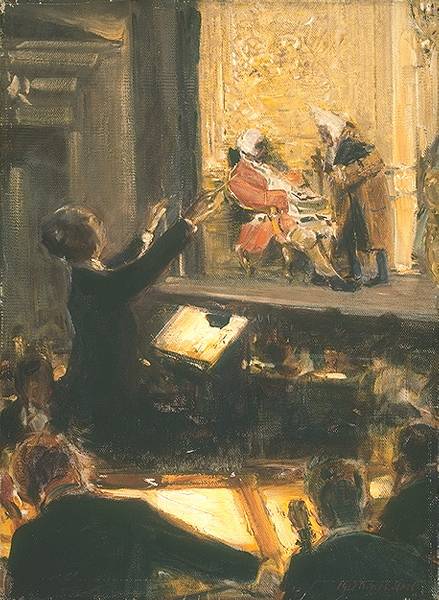
Der Rosenkavalier (The Knight of the Rose or The Rose-Bearer), Op. 59, is a comic opera in three acts by Richard Strauss to an original German libretto by Hugo von Hofmannsthal. It is loosely adapted from Louvet de Couvrai's novel Les amours du chevalier de Faublas and Molière's comedy Monsieur de Pourceaugnac. It was first performed at the Königliches Opernhaus in Dresden on 26 January 1911 under the direction of Max Reinhardt, with Ernst von Schuch conducting. Until the premiere, the working title was Ochs auf Lerchenau. (The choice of the name Ochs is not accidental, as "Ochs" means "ox", which describes the Baron's manner.)
The opera has four main characters: the aristocratic Marschallin; her 17-year-old lover, Count Octavian Rofrano; her brutish cousin Baron Ochs; and Ochs's prospective fiancée, Sophie von Faninal, the daughter of a rich bourgeois. At the Marschallin's suggestion, Octavian acts as Ochs's Rosenkavalier by presenting a ceremonial silver rose to Sophie. But Octavian and Sophie fall in love on the spot, and soon devise a comic intrigue to extricate Sophie from her engagement, with help from the Marschallin, who then yields Octavian to Sophie. Though a comic opera, the work incorporates weighty themes (particularly through the Marschallin's character arc), including infidelity, aging, sexual predation, and selflessness in love.
Der Rosenkavalier is notable for showcasing the female voice, as its protagonists (light lyric soprano Sophie, mezzo-soprano Octavian, and the mature dramatic soprano Marschallin) are written to be portrayed by women, who share several duets as well as a trio at the opera's emotional climax. Some singers have performed two or even all three of these roles over the course of their careers.
There are many recordings of the opera and it is regularly performed.
Richard Strauss first met Hugo von Hofmannsthal in 1899 in Berlin. Strauss was subsequently impressed by Hofmannsthal's play Elektra (1903), and adapted it into an opera that premiered on 25 January 1909. During that process, they agreed to collaborate on a new project that would be more comedic in tone. After Strauss rejected Hofmannsthal's comedy Christinas Heimreise and the plays of Molière yielded little fruit, Hofmannsthal visited Harry Graf Kessler in Weimar. Over the course of a few days in February 1909, Hofmannsthal and Kessler drafted a scenario inspired by a 1907 operetta that Kessler had seen in Paris: L'Ingénu libertin by playwright Louis Artus and composer Claude Terrasse.
Strauss approved the plot outline and work began in earnest. Act I's text was written in February–March 1909, with its music finished in May. Through the summer, Strauss composed Act II, collaborating with Hofmannsthal to add more comedy and plot twists. By spring 1910, the first two acts were printed and Hofmannsthal had finished the libretto. Strauss finished the music of the final act on 26 September 1910.
The first production was slated to be directed by the Dresden Opera's Georg Toller, who had staged the world premiere of Strauss's Elektra, but the creators had subsequently been impressed by the Vienna production of Elektra with sets designed by Alfred Roller (director of the Vienna Kunstgewerbeschule) and lost faith in Toller. Strauss and Hofmannsthal commissioned Roller to design sets and costumes for Der Rosenkavalier and arranged for his designs to be published in an illustrated prompt book that all productions would be obligated to use. They also controversially recruited Max Reinhardt to assist with rehearsals as a "shadow director" or replacement for Toller, although Toller remained the sole credited director.
After the dark and dramatic style of Elektra, Strauss tried to use lighter music with a more lyrical style in this opera. Therefore, the composer mixed Romantic orchestration with elements inspired by classical Viennese musical traditions. This was a distinctive feature of the score, in addition to using frequent Viennese waltz rhythms. This is anachronistic because the story takes place in the 1740s, and the waltz only became famous in Vienna during the early 19th century. Strauss thus intentionally used the waltz to create the nostalgic atmosphere associated with imperial Vienna instead of strict historical realism.
Hub AI
Der Rosenkavalier AI simulator
(@Der Rosenkavalier_simulator)
Der Rosenkavalier
Der Rosenkavalier (The Knight of the Rose or The Rose-Bearer), Op. 59, is a comic opera in three acts by Richard Strauss to an original German libretto by Hugo von Hofmannsthal. It is loosely adapted from Louvet de Couvrai's novel Les amours du chevalier de Faublas and Molière's comedy Monsieur de Pourceaugnac. It was first performed at the Königliches Opernhaus in Dresden on 26 January 1911 under the direction of Max Reinhardt, with Ernst von Schuch conducting. Until the premiere, the working title was Ochs auf Lerchenau. (The choice of the name Ochs is not accidental, as "Ochs" means "ox", which describes the Baron's manner.)
The opera has four main characters: the aristocratic Marschallin; her 17-year-old lover, Count Octavian Rofrano; her brutish cousin Baron Ochs; and Ochs's prospective fiancée, Sophie von Faninal, the daughter of a rich bourgeois. At the Marschallin's suggestion, Octavian acts as Ochs's Rosenkavalier by presenting a ceremonial silver rose to Sophie. But Octavian and Sophie fall in love on the spot, and soon devise a comic intrigue to extricate Sophie from her engagement, with help from the Marschallin, who then yields Octavian to Sophie. Though a comic opera, the work incorporates weighty themes (particularly through the Marschallin's character arc), including infidelity, aging, sexual predation, and selflessness in love.
Der Rosenkavalier is notable for showcasing the female voice, as its protagonists (light lyric soprano Sophie, mezzo-soprano Octavian, and the mature dramatic soprano Marschallin) are written to be portrayed by women, who share several duets as well as a trio at the opera's emotional climax. Some singers have performed two or even all three of these roles over the course of their careers.
There are many recordings of the opera and it is regularly performed.
Richard Strauss first met Hugo von Hofmannsthal in 1899 in Berlin. Strauss was subsequently impressed by Hofmannsthal's play Elektra (1903), and adapted it into an opera that premiered on 25 January 1909. During that process, they agreed to collaborate on a new project that would be more comedic in tone. After Strauss rejected Hofmannsthal's comedy Christinas Heimreise and the plays of Molière yielded little fruit, Hofmannsthal visited Harry Graf Kessler in Weimar. Over the course of a few days in February 1909, Hofmannsthal and Kessler drafted a scenario inspired by a 1907 operetta that Kessler had seen in Paris: L'Ingénu libertin by playwright Louis Artus and composer Claude Terrasse.
Strauss approved the plot outline and work began in earnest. Act I's text was written in February–March 1909, with its music finished in May. Through the summer, Strauss composed Act II, collaborating with Hofmannsthal to add more comedy and plot twists. By spring 1910, the first two acts were printed and Hofmannsthal had finished the libretto. Strauss finished the music of the final act on 26 September 1910.
The first production was slated to be directed by the Dresden Opera's Georg Toller, who had staged the world premiere of Strauss's Elektra, but the creators had subsequently been impressed by the Vienna production of Elektra with sets designed by Alfred Roller (director of the Vienna Kunstgewerbeschule) and lost faith in Toller. Strauss and Hofmannsthal commissioned Roller to design sets and costumes for Der Rosenkavalier and arranged for his designs to be published in an illustrated prompt book that all productions would be obligated to use. They also controversially recruited Max Reinhardt to assist with rehearsals as a "shadow director" or replacement for Toller, although Toller remained the sole credited director.
After the dark and dramatic style of Elektra, Strauss tried to use lighter music with a more lyrical style in this opera. Therefore, the composer mixed Romantic orchestration with elements inspired by classical Viennese musical traditions. This was a distinctive feature of the score, in addition to using frequent Viennese waltz rhythms. This is anachronistic because the story takes place in the 1740s, and the waltz only became famous in Vienna during the early 19th century. Strauss thus intentionally used the waltz to create the nostalgic atmosphere associated with imperial Vienna instead of strict historical realism.
Recent media