



Community hub
Recent from talks
Knowledge base stats:
Talk channels stats:
Members stats:
Detachment fold
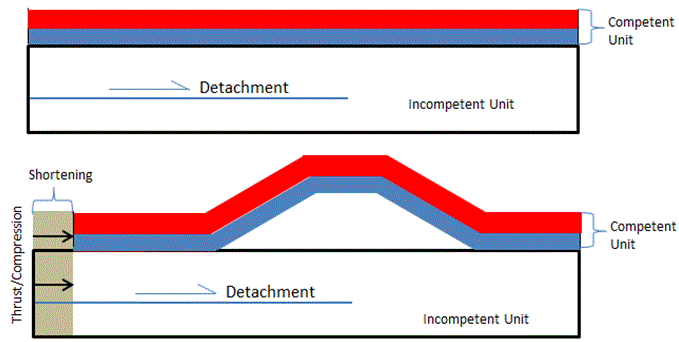
A detachment fold, in geology, occurs as layer parallel thrusting along a decollement (or detachment) develops without upward propagation of a fault; the accommodation of the strain produced by continued displacement along the underlying thrust results in the folding of the overlying rock units. As a visual aid, picture a rug on the floor. By placing your left foot on one end and pushing (with your left foot) towards the other end of the rug, the rug slides across the floor (decollement) and folds upward (detachment fold). Figure 1, is a generalized representation of the geometry assumed by a detachment fault.
Detachment folding occurs as strain imposed on a mechanically weak layer or incompetent unit, such as shale or salt, or at the boundary between an incompetent and more competent unit, induces resistance from the units resulting in folding typically observed in the competent unit. Once the resistance of these units is overcome with strain or the variation in strain between the units becomes great enough, a shearing motion known as a detachment fault may occur. Defined, a detachment fault may be located within an incompetent unit or at the boundary of an incompetent and a competent unit, which accommodates for strain differences between the units and allows displacement to occur in a planar field. Detachment folding occurs in regions of thick-skinned deformation, where the basement is involved in deformation and thin-skinned deformation, where deformation occurs at relatively shallow depth in the crust.
One of the principal ideas that should be recognized in each model is the law of conservation of volume, as conservation is a fundamental law in physics; it should also apply to geology. Two ways to maintain volume conservation are thickening of units and synclinal deflection of incompetent material; it is likely that both may occur.
J. Contreras (2010) developed a model for low amplitude detachments using the conservation of mass equation. The results suggest the occurrence of layer thickening as an initial response to shortening and volume conservation. Hayes and Hanks (2008) confirm layer thickening during the onset of folding, specifically their field data places the thickening at the hinges of folds rather than the limbs. When defining the geometry of detachment folding it may be necessary to define layer thickening as it has been recorded to affect the overall geometry. Though variable limb thickness is assumed; over time, limb rotation and limb length become the dominant mechanisms for deformation, leading to an increase in fold amplitude.
Synclinal deflection, Figure 2, is the result of folding where synclines, adjacent to an anticline in fold geometry, extend into the lower incompetent unit; these typically occur in regions of high wavelength and low amplitude. The occupancy of this area causes displacement above the detachment in the form of material migration to the anticlinal core. Withdrawal from the regional position is dependent on thickness and viscosity differences between the competent and incompetent units as well as the ductile nature of the incompetent unit, like Contreras, recognized a transition from unit deflection and material migration, to limb rotation and limb lengthening.
Though many models have been developed to help explain the kinematic evolution of single layer detachment faulting; many models do not account for multiple layers, complex fold geometries or differential strain through fold geometries or mechanically dissimilar stratigraphic units. These models may not be good indicators of detachment folding on a large scale and are better suited to assist in interpreting fold geometries of detachment folds as their kinematic evolution is generally associated with single fold, single unit deformations. The definition of disharmonic folds (below) however, incorporates many types of symmetric folds over a larger area encompassing many geometries and attributes of the basic models and may be better suited to the application of these models.
By incorporating elementary fold geometries under the term disharmonic fold detachment folds may then be classified into one of two categories; disharmonic folds or lift-off folds. Disharmonic folds, Figure 3, are defined as detachment folds characterized by parallel geometries at the outer limbs and non-parallel interlimb geometries at stratigraphically distinct and lower units; caused by differential strain as a result of strain dissipation or change in mechanical stratigraphy, where the termination of folding typically results in a detachment. Lift-off detachment folds are characterized by isoclinal folding in all units, with a tight isoclinal folded weak unit in the anticline and parallel geometries sometimes existing along the outer units. Present day examples detachment folding can be found in the Jura Mountains of Central Europe. This region complements the idea of detachment fold evolution put forth by Mitra in that it encompasses many of the basic fold geometries and comprises both disharmonic and lift-off geometries.
Disharmonic and lift-off detachment folds are commonly assumed to form by separate modes of deformation; however, Mitra (2003) in a unified kinematic model challenged these ideas by suggesting an evolution of detachment folding wherein progressive deformation yields a fold transition from disharmonic geometry to lift-off detachment folding. While most kinematic models are developed to yield the most simplistic geometries by placing boundary conditions within the model and limiting variables; the unified model incorporates: mechanical stratigraphy parameter limb lengthening, limb rotation, area balancing and anticlinal and synclinal deflection, to develop a system that uniformly demonstrates the evolution of detachment folding.
Hub AI
Detachment fold AI simulator
(@Detachment fold_simulator)
Detachment fold
A detachment fold, in geology, occurs as layer parallel thrusting along a decollement (or detachment) develops without upward propagation of a fault; the accommodation of the strain produced by continued displacement along the underlying thrust results in the folding of the overlying rock units. As a visual aid, picture a rug on the floor. By placing your left foot on one end and pushing (with your left foot) towards the other end of the rug, the rug slides across the floor (decollement) and folds upward (detachment fold). Figure 1, is a generalized representation of the geometry assumed by a detachment fault.
Detachment folding occurs as strain imposed on a mechanically weak layer or incompetent unit, such as shale or salt, or at the boundary between an incompetent and more competent unit, induces resistance from the units resulting in folding typically observed in the competent unit. Once the resistance of these units is overcome with strain or the variation in strain between the units becomes great enough, a shearing motion known as a detachment fault may occur. Defined, a detachment fault may be located within an incompetent unit or at the boundary of an incompetent and a competent unit, which accommodates for strain differences between the units and allows displacement to occur in a planar field. Detachment folding occurs in regions of thick-skinned deformation, where the basement is involved in deformation and thin-skinned deformation, where deformation occurs at relatively shallow depth in the crust.
One of the principal ideas that should be recognized in each model is the law of conservation of volume, as conservation is a fundamental law in physics; it should also apply to geology. Two ways to maintain volume conservation are thickening of units and synclinal deflection of incompetent material; it is likely that both may occur.
J. Contreras (2010) developed a model for low amplitude detachments using the conservation of mass equation. The results suggest the occurrence of layer thickening as an initial response to shortening and volume conservation. Hayes and Hanks (2008) confirm layer thickening during the onset of folding, specifically their field data places the thickening at the hinges of folds rather than the limbs. When defining the geometry of detachment folding it may be necessary to define layer thickening as it has been recorded to affect the overall geometry. Though variable limb thickness is assumed; over time, limb rotation and limb length become the dominant mechanisms for deformation, leading to an increase in fold amplitude.
Synclinal deflection, Figure 2, is the result of folding where synclines, adjacent to an anticline in fold geometry, extend into the lower incompetent unit; these typically occur in regions of high wavelength and low amplitude. The occupancy of this area causes displacement above the detachment in the form of material migration to the anticlinal core. Withdrawal from the regional position is dependent on thickness and viscosity differences between the competent and incompetent units as well as the ductile nature of the incompetent unit, like Contreras, recognized a transition from unit deflection and material migration, to limb rotation and limb lengthening.
Though many models have been developed to help explain the kinematic evolution of single layer detachment faulting; many models do not account for multiple layers, complex fold geometries or differential strain through fold geometries or mechanically dissimilar stratigraphic units. These models may not be good indicators of detachment folding on a large scale and are better suited to assist in interpreting fold geometries of detachment folds as their kinematic evolution is generally associated with single fold, single unit deformations. The definition of disharmonic folds (below) however, incorporates many types of symmetric folds over a larger area encompassing many geometries and attributes of the basic models and may be better suited to the application of these models.
By incorporating elementary fold geometries under the term disharmonic fold detachment folds may then be classified into one of two categories; disharmonic folds or lift-off folds. Disharmonic folds, Figure 3, are defined as detachment folds characterized by parallel geometries at the outer limbs and non-parallel interlimb geometries at stratigraphically distinct and lower units; caused by differential strain as a result of strain dissipation or change in mechanical stratigraphy, where the termination of folding typically results in a detachment. Lift-off detachment folds are characterized by isoclinal folding in all units, with a tight isoclinal folded weak unit in the anticline and parallel geometries sometimes existing along the outer units. Present day examples detachment folding can be found in the Jura Mountains of Central Europe. This region complements the idea of detachment fold evolution put forth by Mitra in that it encompasses many of the basic fold geometries and comprises both disharmonic and lift-off geometries.
Disharmonic and lift-off detachment folds are commonly assumed to form by separate modes of deformation; however, Mitra (2003) in a unified kinematic model challenged these ideas by suggesting an evolution of detachment folding wherein progressive deformation yields a fold transition from disharmonic geometry to lift-off detachment folding. While most kinematic models are developed to yield the most simplistic geometries by placing boundary conditions within the model and limiting variables; the unified model incorporates: mechanical stratigraphy parameter limb lengthening, limb rotation, area balancing and anticlinal and synclinal deflection, to develop a system that uniformly demonstrates the evolution of detachment folding.