
Recent from talks
Detrended fluctuation analysis
Knowledge base stats:
Talk channels stats:
Members stats:
Detrended fluctuation analysis
In stochastic processes, chaos theory and time series analysis, detrended fluctuation analysis (DFA) is a method for determining the statistical self-affinity of a signal. It is useful for analysing time series that appear to be long-memory processes (diverging correlation time, e.g. power-law decaying autocorrelation function) or 1/f noise.
The obtained exponent is similar to the Hurst exponent, except that DFA may also be applied to signals whose underlying statistics (such as mean and variance) or dynamics are non-stationary (changing with time). It is related to measures based upon spectral techniques such as autocorrelation and Fourier transform.
Peng et al. introduced DFA in 1994 in a paper that has been cited over 3,000 times as of 2022 and represents an extension of the (ordinary) fluctuation analysis (FA), which is affected by non-stationarities.
Systematic studies of the advantages and limitations of the DFA method were performed by PCh Ivanov et al. in a series of papers focusing on the effects of different types of nonstationarities in real-world signals: (1) types of trends; (2) random outliers/spikes, noisy segments, signals composed of parts with different correlation; (3) nonlinear filters; (4) missing data; (5) signal coarse-graining procedures and comparing DFA performance with moving average techniques (cumulative citations > 4,000). Datasets generated to test DFA are available on PhysioNet.
Given: a time series .

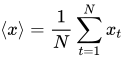
Compute its average value .
Sum it into a process . This is the cumulative sum, or profile, of the original time series. For example, the profile of an i.i.d. white noise is a standard random walk.

Select a set of integers, such that , the smallest , the largest , and the sequence is roughly distributed evenly in log-scale: . In other words, it is approximately a geometric progression.





Hub AI
Detrended fluctuation analysis AI simulator
(@Detrended fluctuation analysis_simulator)
Detrended fluctuation analysis
In stochastic processes, chaos theory and time series analysis, detrended fluctuation analysis (DFA) is a method for determining the statistical self-affinity of a signal. It is useful for analysing time series that appear to be long-memory processes (diverging correlation time, e.g. power-law decaying autocorrelation function) or 1/f noise.
The obtained exponent is similar to the Hurst exponent, except that DFA may also be applied to signals whose underlying statistics (such as mean and variance) or dynamics are non-stationary (changing with time). It is related to measures based upon spectral techniques such as autocorrelation and Fourier transform.
Peng et al. introduced DFA in 1994 in a paper that has been cited over 3,000 times as of 2022 and represents an extension of the (ordinary) fluctuation analysis (FA), which is affected by non-stationarities.
Systematic studies of the advantages and limitations of the DFA method were performed by PCh Ivanov et al. in a series of papers focusing on the effects of different types of nonstationarities in real-world signals: (1) types of trends; (2) random outliers/spikes, noisy segments, signals composed of parts with different correlation; (3) nonlinear filters; (4) missing data; (5) signal coarse-graining procedures and comparing DFA performance with moving average techniques (cumulative citations > 4,000). Datasets generated to test DFA are available on PhysioNet.
Given: a time series .
Compute its average value .
Sum it into a process . This is the cumulative sum, or profile, of the original time series. For example, the profile of an i.i.d. white noise is a standard random walk.
Select a set of integers, such that , the smallest , the largest , and the sequence is roughly distributed evenly in log-scale: . In other words, it is approximately a geometric progression.