Hubbry Logo
Self-similaritySelf-similarityMain
Open search
Self-similarity
Community hub
Self-similarity
logo
8 pages, 0 posts
0 subscribers
Be the first to start a discussion here.
Self-similarity
Self-similarity
from Wikipedia

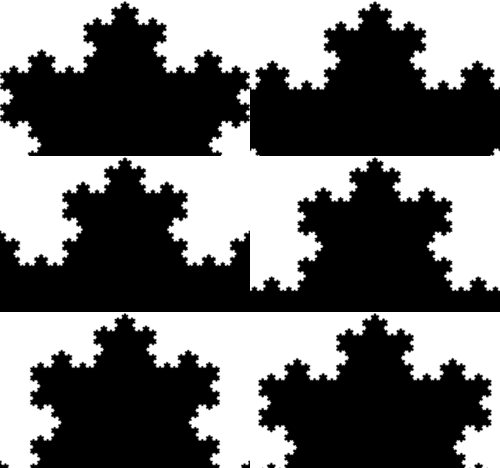
A Koch snowflake has an infinitely repeating self-similarity when it is magnified.
Standard (trivial) self-similarity[1]

In mathematics, a self-similar object is exactly or approximately similar to a part of itself (i.e., the whole has the same shape as one or more of the parts). Many objects in the real world, such as coastlines, are statistically self-similar: parts of them show the same statistical properties at many scales.[2] Self-similarity is a typical property of fractals. Scale invariance is an exact form of self-similarity where at any magnification there is a smaller piece of the object that is similar to the whole. For instance, a side of the Koch snowflake is both symmetrical and scale-invariant; it can be continually magnified 3x without changing shape.

Peitgen et al. explain the concept as such:

If parts of a figure are small replicas of the whole, then the figure is called self-similar....A figure is strictly self-similar if the figure can be decomposed into parts which are exact replicas of the whole. Any arbitrary part contains an exact replica of the whole figure.[3]

Since mathematically, a fractal may show self-similarity under arbitrary magnification, it is impossible to recreate this physically. Peitgen et al. suggest studying self-similarity using approximations:

In order to give an operational meaning to the property of self-similarity, we are necessarily restricted to dealing with finite approximations of the limit figure. This is done using the method which we will call box self-similarity where measurements are made on finite stages of the figure using grids of various sizes.[4]

This vocabulary was introduced by Benoit Mandelbrot in 1964.[5]

Self-affinity

[edit]
A self-affine fractal with Hausdorff dimension = 1.8272

In mathematics, self-affinity is a feature of a fractal whose pieces are scaled by different amounts in the x and y directions. This means that to appreciate the self-similarity of these fractal objects, they have to be rescaled using an anisotropic affine transformation.[citation needed]

Definition

[edit]

A compact topological space X is self-similar if there exists a finite set S indexing a set of non-surjective homeomorphisms for which

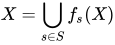
If , we call X self-similar if it is the only non-empty subset of Y such that the equation above holds for . We call


a self-similar structure. The homeomorphisms may be iterated, resulting in an iterated function system. The composition of functions creates the algebraic structure of a monoid. When the set S has only two elements, the monoid is known as the dyadic monoid. The dyadic monoid can be visualized as an infinite binary tree; more generally, if the set S has p elements, then the monoid may be represented as a p-adic tree.

The automorphisms of the dyadic monoid is the modular group; the automorphisms can be pictured as hyperbolic rotations of the binary tree.

A more general notion than self-similarity is self-affinity.

Examples

[edit]
Self-similarity in the Mandelbrot set shown by zooming in on the Feigenbaum point at (−1.401155189..., 0)
An image of the Barnsley fern which exhibits affine self-similarity

The Cantor discontinuum is self-similar since any of its closed subsets is a continuous image of the discontinuum.[6]

The Mandelbrot set is also self-similar around Misiurewicz points.

Self-similarity has important consequences for the design of computer networks, as typical network traffic has self-similar properties. For example, in teletraffic engineering, packet switched data traffic patterns seem to be statistically self-similar.[7] This property means that simple models using a Poisson distribution are inaccurate, and networks designed without taking self-similarity into account are likely to function in unexpected ways.[citation needed]

Similarly, stock market movements are described as displaying self-affinity, i.e. they appear self-similar when transformed via an appropriate affine transformation for the level of detail being shown.[8] Andrew Lo describes stock market log return self-similarity in econometrics.[9]

Finite subdivision rules are a powerful technique for building self-similar sets, including the Cantor set and the Sierpinski triangle.[citation needed]

Some space filling curves, such as the Peano curve and Moore curve, also feature properties of self-similarity.[10]

A triangle subdivided repeatedly using barycentric subdivision. The complement of the large circles becomes a Sierpinski carpet

In cybernetics

[edit]

The viable system model of Stafford Beer is an organizational model with an affine self-similar hierarchy, where a given viable system is one element of the System One of a viable system one recursive level higher up, and for whom the elements of its System One are viable systems one recursive level lower down.[citation needed]

In nature

[edit]
Close-up of a Romanesco broccoli

Self-similarity can be found in nature, as well. Plants, such as Romanesco broccoli, exhibit strong self-similarity.[citation needed]

In music

[edit]

See also

[edit]

References

[edit]
[edit]
Revisions and contributorsEdit on WikipediaRead on Wikipedia
from Grokipedia
Self-similarity is a fundamental property in and where a or remains invariant under changes of scale, meaning that parts of the object resemble the whole when magnified or reduced. This characteristic, often observed in fractals, implies that the object can be divided into smaller copies of itself, either exactly or in a statistical sense, allowing for the description of complex, irregular shapes using simple iterative rules. The concept gained prominence through the work of , who in introduced statistical self-similarity to address the paradoxical variability in measuring natural boundaries like coastlines, where length depends on the measurement scale due to increasingly intricate details. Mandelbrot's analysis revealed that such features exhibit a fractional D=logNlog(1/r)D = \frac{\log N}{\log (1/r)}, where NN is the number of self-similar copies at scale factor rr, enabling quantitative modeling of irregularity beyond traditional . Exact self-similarity, by contrast, occurs in deterministic fractals like the Sierpinski gasket, constructed by recursively removing triangles, resulting in a structure identical to its subsections at every . Beyond geometry, self-similarity manifests in diverse fields, including physics—such as in self-similar spacetimes in , where solutions to Einstein's equations remain unchanged under scaling transformations—and in natural phenomena like branching patterns in trees or , which display hierarchical repetition across scales. In dynamical systems and , it underpins models for and texture analysis, while in algebra and , self-similar structures facilitate the study of iterative processes and branching. These applications highlight self-similarity's role in capturing the complexity of real-world systems, from biological growth to fluctuations, often quantified via dimensions that exceed integer values.

Core Concepts

Definition

Self-similarity is a property observed in certain geometric shapes, processes, or patterns where the structure appears invariant under changes of scale, meaning that zooming in or out reveals similar forms to the original. Intuitively, a self-similar object looks roughly the same at any level, with parts resembling the whole in or statistical properties. This concept manifests in two primary forms: exact self-similarity, where scaled portions are geometrically identical to the entire object, as seen in mathematical constructs like the Koch curve, and statistical self-similarity, where the resemblance is approximate and probabilistic rather than precise, often characterizing irregular natural forms. Formally, in , a compact set SS in a is self-similar if it can be expressed as the union of scaled and translated copies of itself: S=i=1N(riS+ti)S = \bigcup_{i=1}^N (r_i S + t_i), where ri<1r_i < 1 are scaling factors, and tit_i are translation vectors. This definition arises within the framework of iterated function systems (IFS), where the Hutchinson operator WW, defined by W(A)=i=1Nfi(A)W(A) = \bigcup_{i=1}^N f_i(A) for contractive similitudes fi(x)=rix+tif_i(x) = r_i x + t_i, has SS as its unique fixed point when the fif_i satisfy the open set condition. Such self-similar sets exhibit global self-similarity, meaning the entire set satisfies the union equation, in contrast to local self-similarity, where only subsets or magnified portions approximate the whole. The notion of self-similarity gained prominence through Benoit Mandelbrot's work in the 1960s, particularly in his 1967 paper introducing statistical self-similarity to model irregular phenomena like coastlines, building on earlier geometric ideas. Mandelbrot integrated this with fractal geometry, emphasizing how self-similarity leads to non-integer dimensions, extending concepts from Felix Hausdorff's 1918 introduction of the as a measure for set complexity.

Self-affinity

Self-affinity generalizes self-similarity by allowing non-uniform scaling across different dimensions, where a structure remains statistically invariant under affine transformations that scale by different factors in distinct directions, such as horizontal versus vertical. Affine transformations, which preserve collinearity and parallelism but not necessarily distances or angles, enable this directional distortion while maintaining the overall geometric integrity of the pattern. This property is particularly relevant for modeling anisotropic phenomena where scaling behaviors differ along axes. Mathematically, for a function f:RRf: \mathbb{R} \to \mathbb{R}, self-affinity holds if there exist scalars λ>0\lambda > 0 and μ>0\mu > 0 with λμ\lambda \neq \mu such that f(λx)=μf(x)f(\lambda x) = \mu f(x) for all xx, implying that rescaling the input by λ\lambda corresponds to rescaling the output by a different factor μ\mu. A canonical example is the graph of BH(t)B_H(t) with Hurst exponent 0<H<10 < H < 1, where the processes BH(t)B_H(t) and bHBH(bt)b^{-H} B_H(b t) are identically distributed for any b>0b > 0, leading to paths that exhibit self-affine roughness. For standard (H=1/2H = 1/2), this results in local fractal dimensions of 1.5 via box-counting or mass methods, contrasting with a global dimension of 1. In contrast to self-similarity, which requires isotropic scaling by the same factor in all directions and yields a single (e.g., D=logN/log(1/r)D = \log N / \log (1/r) for NN copies scaled by rr), self-affinity introduces that often produces rough surfaces without strict fractality. Self-similarity represents the special isotropic case of self-affinity. For self-affine structures, fractal dimension estimation adapts methods like box-counting by incorporating adjusted metrics to account for directional scaling differences. The concept of self-affinity was coined by in the 1980s, building on his earlier work on self-similarity, to describe scaling in phenomena like turbulent flows where uniform scaling fails. In his 1985 paper, Mandelbrot formalized self-affine fractals to address the distinct local and global scaling behaviors observed in such systems, extending fractal geometry beyond isotropic patterns.

Mathematical Properties

Fractal Dimension

The quantifies the roughness or space-filling capacity of a geometric object, providing a measure of its complexity that often yields non-integer values, in contrast to the topological dimension, which is an integer such as 1 for a line or 2 for a plane. Introduced by in his foundational work on , this dimension captures how the object occupies space at different scales, reflecting its intricate, non-smooth structure. For self-similar sets, the similarity dimension DD is computed using the formula D=logNlog(1/r)D = \frac{\log N}{\log (1/r)}, where NN is the number of self-similar copies and rr is the scaling factor (with 0<r<10 < r < 1) by which each copy is reduced relative to the original. This arises from the scaling relation in self-similar structures: the total measure of the set equals NN times the measure of one scaled copy, leading to NrD=1N \cdot r^D = 1, solved logarithmically as D=limϵ0log(μ(Bϵ))log(ϵ)D = \lim_{\epsilon \to 0} \frac{\log(\mu(B_\epsilon))}{\log(\epsilon)}, where μ(Bϵ)\mu(B_\epsilon) is the measure at scale ϵ\epsilon. Self-similarity enables this exact computation when the set can be precisely decomposed into scaled replicas satisfying the open set condition, ensuring the dimension equals the Hausdorff dimension; however, for sets with overlapping copies or approximate self-similarity, the value may serve only as a lower bound or require adjustment. An alternative measure, the box-counting dimension (also known as the Minkowski-Bouligand dimension), applies more broadly to irregular sets and is defined as D=limϵ0logN(ϵ)logϵD = \lim_{\epsilon \to 0} \frac{\log N(\epsilon)}{-\log \epsilon}, where N(ϵ)N(\epsilon) is the minimum number of boxes of side length ϵ\epsilon needed to cover the set. This dimension estimates scaling behavior by observing how coverage scales with grid size, yielding N(ϵ)ϵDN(\epsilon) \sim \epsilon^{-D} for small ϵ\epsilon, and coincides with the similarity dimension for strictly self-similar fractals but provides an approximation for non-self-similar cases where exact decomposition is impossible. A classic example is the Cantor set, a self-similar fractal formed by iteratively removing middle thirds from [0,1], which decomposes into N=2N=2 copies scaled by r=1/3r=1/3; its similarity dimension is D=log2log30.631D = \frac{\log 2}{\log 3} \approx 0.631, indicating it is dust-like yet more space-filling than a point (dimension 0) but less than a line (dimension 1). Similarly, the Koch curve, another self-similar object with N=4N=4 copies at r=1/3r=1/3, has dimension D=log4log31.262D = \frac{\log 4}{\log 3} \approx 1.262, bridging line-like and plane-like properties.

Scaling and Iteration

Self-similarity in geometric structures often arises through iterative construction processes, where a simple seed shape is repeatedly transformed to generate increasingly intricate details. This method typically involves applying a set of similarity transformations—such as rotations, translations, and scalings—to the initial shape, with each iteration refining the structure toward an infinite resolution. A foundational approach is the , introduced by Michael Barnsley, which defines self-similar sets as the attractors of contractive mappings on a complete metric space. In deterministic IFS, the iteration proceeds by starting with an arbitrary compact set S0S_0 and successively defining Sn+1=i=1Nfi(Sn)S_{n+1} = \bigcup_{i=1}^N f_i(S_n), where each fif_i is a similarity transformation with scaling factor ri<1r_i < 1 to ensure contractivity. This process converges to a unique attractor S=i=1Nfi(S)S = \bigcup_{i=1}^N f_i(S), which is self-similar under the transformations fif_i, meaning the attractor is composed of scaled, rotated, and translated copies of itself. The contractivity condition (maxri<1\max |r_i| < 1) guarantees that the sequence of sets SnS_n contracts toward the attractor in the Hausdorff metric, producing a non-empty compact set with the desired self-similar properties. Scaling laws govern the growth of measures under these iterations, particularly for uniform scaling factors rr applied NN times per step. The measure mnm_n at iteration nn scales as mn=Nnrnm0m_n = N^n r^n m_0, reflecting the multiplicative increase in the number of copies balanced by their reduced size. In the limit, this leads to a fixed-point equation for the dimension dd satisfying 1=Nrd1 = N r^d, which characterizes the scaling behavior without delving into explicit computation. For statistical self-similarity, the process incorporates randomness, where scalings vary multiplicatively across iterations, often modeled as products of independent random variables with E[logr]<0\mathbb{E}[\log r] < 0 to ensure almost sure convergence to a finite attractor. This framework, explored in branching processes and random IFS, allows self-similar sets to exhibit probabilistic scaling, where the average logarithmic scaling rate determines the overall growth or contraction. Such models are crucial for understanding non-deterministic structures while maintaining the core iterative and scaling principles.

Geometric Examples

Koch Curve

The Koch curve is a foundational example of an exact self-similar fractal, constructed through an iterative process that generates a continuous yet highly irregular path. Introduced by Swedish mathematician Helge von Koch in his 1904 paper "Sur une courbe continue sans tangente, obtenue par une construction géométrique élémentaire," the curve was designed to exemplify a continuous function that lacks a tangent at any point, challenging classical notions of smoothness in geometry. This construction marked one of the earliest explicit examples of what would later be termed a fractal curve. The construction begins with an initial straight line segment of length L0L_0. In the first iteration, this segment is divided into three equal parts, and the middle third is removed and replaced by the two equal sides of an equilateral triangle, each of length L0/3L_0 / 3, protruding outward from the line. This process is then applied recursively to every line segment in the resulting figure at each subsequent iteration. After infinitely many iterations, the limiting object is the Koch curve, a connected set that remains bounded within the plane but possesses infinite length. The Koch curve demonstrates exact self-similarity: the entire curve can be decomposed into four non-overlapping copies of itself, each scaled by a linear factor of 1/31/3. This property arises directly from the iterative replacement rule, where each segment generates four smaller segments in the next stage, preserving the structure at reduced scales. Key properties include its perimeter length at the nnth iteration, given by Ln=L0(43)nL_n = L_0 \left( \frac{4}{3} \right)^n, which diverges to infinity as nn \to \infty, despite the curve being confined to a bounded region of the plane. The resulting limit curve is continuous everywhere but nowhere differentiable, meaning no tangent line exists at any point, as originally proven by von Koch. For visualization and computation, the Koch curve can be parametrized in the complex plane using an iterated function system (IFS) consisting of four contractive similarity transformations, each with a scaling factor of 1/31/3, combined with translations and rotations by ±60\pm 60^\circ (or ±π/3\pm \pi/3 radians) to replicate the equilateral bump. Starting from the unit interval [0,1][0, 1] on the real axis, the transformations map the curve onto its four self-similar components: the left third (no rotation), the ascending side of the bump (rotation by 6060^\circ), the descending side (rotation by 60-60^\circ), and the right third (no rotation), with appropriate translations to position them contiguously. The attractor of this IFS is the Koch curve.

Sierpinski Gasket

The Sierpinski gasket, also known as the Sierpinski triangle, is constructed iteratively starting from a solid equilateral triangle. In the first step, connect the midpoints of each side to form four smaller congruent equilateral triangles and remove the interior of the central one, leaving three subtriangles. This process is repeated recursively on each remaining subtriangle, subdividing and excising the middle quarter at every iteration, yielding a limiting set that resembles a dust-like structure composed of uncountably infinite points with zero . This fractal was first described mathematically by the Polish mathematician Wacław Sierpiński in 1915 as an example of a curve where every point is a ramification point. The construction demonstrates exact self-similarity: at each iteration, the gasket comprises three non-overlapping copies of the entire set, each scaled by a linear factor of 12\frac{1}{2}. Key properties include a Hausdorff dimension of log3log21.585\dfrac{\log 3}{\log 2} \approx 1.585, reflecting its intermediate scaling between one and two dimensions, and the fact that it is a compact, connected set embedded in the plane with empty interior. The gasket can also be generated via an iterated function system (IFS) defined by three similarity transformations, each contracting by 12\frac{1}{2} and mapping the original triangle's vertices to the midpoints of its sides: specifically, one fixes a vertex, while the others translate and rotate to the base midpoints.

Natural Phenomena

Coastlines and Landscapes

The coastline paradox arises from the observation that the measured of a coastline increases without bound as the scale of measurement decreases, due to the self-similar indentations and irregularities that repeat across scales. In the 1950s, Lewis Fry Richardson conducted systematic measurements of various coastlines using dividers of progressively smaller , finding that the total length LL scales with the divider δ\delta according to LδkL \propto \delta^{-k}, where k>0k > 0 reflects the ruggedness, leading to longer estimates at finer resolutions. This counterintuitive result, known as the Richardson effect, highlights the absence of a well-defined for highly irregular boundaries exhibiting statistical self-similarity. Benoit Mandelbrot formalized this phenomenon in 1967 by applying fractal geometry to Richardson's data, modeling coastlines as statistically self-similar curves analogous to the Koch curve, where finer details mirror larger structures. For the coast of Britain, Mandelbrot estimated a fractal dimension D1.25D \approx 1.25, indicating a roughness between a smooth line (D=1D = 1) and a space-filling curve (D=2D = 2), with self-similarity holding over scales from kilometers to meters. The dividers method, originally employed by Richardson, remains a standard technique for estimating DD, involving stepping a compass along the coastline at fixed intervals and plotting logL\log L versus logδ\log \delta to yield D=1+kD = 1 + k as the slope. Natural landscapes, including mountains and river networks, display statistical self-similarity across scales, from global contours to local features, often characterized by the HH in self-affine profiles where vertical roughness scales nonlinearly with horizontal extent. In , HH typically ranges from 0.6 to 0.8, indicating persistent roughness that persists over orders of magnitude, as seen in the self-similar branching of river systems and the jagged profiles of mountain ranges. For instance, of river networks reveals dimensions around 1.2, reflecting hierarchical branching invariant under scaling. Empirical studies confirm these properties over vast scale ranges, up to 10610^6 in linear dimensions. The Norwegian coastline, with its intricate fjords, exhibits a fractal dimension of approximately 1.52, capturing self-similar inlets that extend deep inland and multiply the effective length dramatically at finer scales. Similarly, the Australian coastline shows a lower dimension of about 1.13, reflecting smoother contours but still scaling irregularly over resolutions from continental to local bays. These measurements underscore how self-similarity in geographic features challenges traditional Euclidean metrics and informs models of erosion and sediment transport.

Biological Patterns

Self-similarity manifests prominently in biological branching patterns, such as those observed in trees, lungs, and vessels, where structures exhibit repeated bifurcations that optimize and resource distribution. These patterns often follow models like L-systems or (DLA), producing self-similar geometries that minimize energy expenditure while maximizing coverage. In vascular systems, describes the optimal branching where the cube of the parent vessel's radius equals the sum of the cubes of the daughter vessels' radii, ensuring efficient fluid flow and reflecting self-similar scaling across generations of branches. This principle extends to pulmonary arteries and bronchial trees, where deviations from ideal self-similarity can indicate pathological conditions, underscoring the functional role of these fractal-like structures in respiration and circulation. Phyllotaxis, the arrangement of leaves or florets around a stem, frequently approximates self-similarity through sequences and the (approximately 1.618), which govern spiral patterns in sunflowers, pinecones, and shells. These spirals arise from optimal packing to maximize exposure or space efficiency, with divergence angles near 137.5 degrees (the ) promoting non-overlapping growth that scales self-similarly at successive levels. In biological systems, this scaling emerges from dynamical processes in meristems, where follows ratios converging on the , enhancing structural stability and resource access without exact replication but through statistical similarity. Fractal growth models further illustrate self-similarity in biological expansion, particularly in bacterial colonies and crystal-like , where diffusion-limited processes yield statistically self-similar clusters. Bacterial colonies of gram-negative , when grown under nutrient-limited conditions, form DLA-like patterns with fractal dimensions around 1.7 to 1.8, mirroring the irregular, branching morphology of theoretical aggregation models and enabling efficient foraging across scales. Similarly, growth in cellular structures exhibits self-similar tip-splitting, driven by reaction-diffusion dynamics that propagate patterns iteratively. Striking examples of near-exact self-similarity include , where conical florets spiral into smaller replicas of the whole, governed by perturbations in floral that accelerate budding rates and produce logarithmic spirals. leaves, modeled by the (IFS), demonstrate self-similarity through affine transformations that recursively generate subdivisions, closely approximating natural fern morphology and highlighting how probabilistic iterations capture biological variability. From an evolutionary perspective, self-similarity in biological structures promotes efficient packing and transport, as recognized in 1970s studies by Benoît Mandelbrot, who applied fractal geometry to natural forms to explain how irregular, scale-invariant designs optimize space utilization in organisms like and vascular networks. This efficiency likely conferred selective advantages, enabling compact yet expansive growth that balances mechanical support with physiological demands across evolutionary timescales.

Scientific Applications

Chaos Theory and Dynamical Systems

In and dynamical systems, self-similarity is prominently displayed in strange attractors, which are structures in that attract trajectories while exhibiting sensitive dependence on initial conditions. The Lorenz attractor, introduced by Edward Lorenz in 1963 as a model for atmospheric , exemplifies this through its butterfly-shaped formed by the equations x˙=σ(yx)\dot{x} = \sigma(y - x), y˙=x(ρz)y\dot{y} = x(\rho - z) - y, z˙=xyβz\dot{z} = xy - \beta z with parameters σ=10\sigma=10, ρ=28\rho=28, β=8/3\beta=8/3. Trajectories in this reveal self-similar folding and stretching, particularly in the unstable manifolds that branch and scale fractally, contributing to its non-integer dimension of approximately 2.06. Self-similarity also governs the period-doubling cascade leading to chaos in one-dimensional maps, a universality discovered by Mitchell Feigenbaum in the 1970s. Consider the logistic map, given by the recurrence relation xn+1=rxn(1xn),x_{n+1} = r x_n (1 - x_n), where 0xn10 \leq x_n \leq 1 and rr is a control parameter. As rr increases from 3 to approximately 3.57, the fixed point bifurcates into stable periodic orbits of doubling periods (2, 4, 8, ...), culminating in chaos via an infinite sequence of bifurcations. Feigenbaum showed that the ratios of successive bifurcation intervals converge to the universal constant δ4.6692016\delta \approx 4.6692016, producing a self-similar hierarchical structure in the bifurcation diagram; at r=4r=4, the invariant set is a Cantor-like fractal with exact self-similarity under conjugation to the angle-doubling map. The further illustrates infinite self-similarity in the parameter space of complex quadratic maps zn+1=zn2+cz_{n+1} = z_n^2 + c. Defined as the connectedness locus for which the critical of the origin remains bounded, its boundary—discovered and visualized by in 1980—features intricate filigrees and bulbs that replicate the overall cardioid shape at progressively smaller scales. These "mini-Mandelbrots" appear as quasi-self-similar copies, scaled by factors asymptotically approaching 1/3n1/3^n near certain hyperbolic components, reflecting the iterative nature of the dynamics and the of 2 for the boundary. Beyond specific attractors, self-similarity under rescaling is formalized in the approach to , pioneered by Kenneth Wilson in 1971. In systems like the near a , the RG iteratively coarsens the lattice by integrating out short-wavelength fluctuations, revealing fixed points where correlation functions and susceptibilities scale invariantly with length rescalings b>1b > 1. This yields universal , such as ν0.63\nu \approx 0.63 for the 3D , capturing self-similar power-law behaviors in fluctuations and explaining why diverse systems share identical scaling properties at criticality.

Signal Processing and Compression

In , self-similarity plays a crucial role in transforms, which employ self-similar basis functions to enable multi-resolution analysis of non-stationary signals. These transforms decompose signals into components at different scales, capturing scaling behaviors inherent in self-similar structures by using dilations and translations of a mother . The pyramidal developed by Mallat in 1989 provides an efficient computational framework for this decomposition, allowing for fast orthogonal representations that preserve energy across scales. This approach is particularly effective for signals exhibiting fractal-like properties, such as those with long-range correlations, where traditional Fourier methods fail due to poor localization. Fractal compression, pioneered by in the 1980s, leverages systems (IFS) to approximate images as unions of self-similar transformed copies of themselves, encoding the image through a set of contractive affine transformations. The collage theorem underpins this method, stating that an IFS can be constructed such that its closely approximates the original image if the collage of the transformed subsets is sufficiently close to it, with the error bounded by the contractivity factor. Practical implementation often uses partitioned systems (PIFS), which divide the image into non-overlapping range blocks and match them to larger domain blocks via spatial contractions, isometries, and adjustments, enabling block-based self-similarity encoding. Applications of these techniques include high-ratio compression of textured natural images, where fractal methods achieve ratios up to 100:1 while maintaining visual fidelity, outperforming traditional codecs for self-similar content like landscapes. In noise reduction, wavelet transforms exploit the self-similarity of 1/f signals—characterized by power spectra decaying as 1/f—to threshold coefficients across scales, effectively separating signal from additive while preserving fractal structure. Performance is often evaluated using (PSNR) versus storage efficiency; for instance, PIFS-based compression yields PSNR values of 25-35 dB at ratios of 20:1 to 50:1 for images, with hybrid extensions integrating fractal codes into frameworks like JPEG2000 to enhance multi-resolution encoding for scalable bitstreams.

Cultural and Interdisciplinary Uses

Music and Composition

Self-similarity manifests in music through recursive structures, where motifs, rhythms, or melodies repeat at different scales, creating fractal-like patterns. In Johann Sebastian Bach's fugues, such as those in , self-similar inversions and augmentations appear, where themes are transformed and restated in ways that preserve structural similarity across varying temporal scales; this was analyzed as exhibiting geometry in frequency intervals, demonstrating scale-independence akin to 1/f noise. These recursive elements allow for intricate that builds complexity through iteration without redundancy. Spectral analysis of music reveals self-similarity in the distribution of pitches and durations, often following 1/f noise patterns, where power spectra vary inversely with frequency, indicating scale-invariant fluctuations. Pioneering work by Richard F. Voss and John Clarke examined audio signals from diverse musical genres and found that loudness and pitch variations in music exhibit approximate 1/f spectra over several decades, mirroring the self-similar properties observed in natural phenomena like . This 1/f structure contributes to the perceptual naturalness of music, as sequences generated with such spectra sound more musical than white noise or alternatives. In , self-similarity arises from processes that incorporate scaling and probabilistic scaling laws. employed Markov chains in works like Pithoprakta (1956), where stochastic distributions of sound events at multiple scales produce emergent self-similar textures, as seen in the fractal-like cloud formations of glissandi that repeat patterns across octaves and durations. Similarly, composer developed generative methods using algorithmic trajectories and L-systems, creating scales in microtonal music where pitch sequences exhibit self-similarity through recursive substitutions, as in his software-based explorations of harmonic spaces. Representative examples include Maurice Ravel's (1928), where a single motif iterates relentlessly with an escalating crescendo, forming a self-similar structure through rhythmic and timbral repetition at expanding dynamic scales, described by Ravel himself as an "orchestral texture" built on gradual intensification. In contemporary tools, software like Fractal Tune Smithy generates music from self-similar number sequences derived from seeds, such as iterative expansions of 0-1-0 patterns, to produce microtonal melodies that vary intricately across scales. Recent advancements in AI-generated leverage self-similarity for structured compositions; for instance, models using self-similarity matrices as mechanisms produce fractal-like patterns in generated sequences. From a psychoacoustic perspective, self-similar structures in enhance perceived by balancing repetition and variation, fostering engagement without inducing chaos; listeners prefer fractal-like patterns with moderate (around 1.2-1.5) in melodies, as they evoke familiarity while introducing novelty, a linked to the 1/f spectra that mimic natural auditory environments.

Cybernetics and Feedback Systems

In , self-similarity manifests through structures in feedback systems, where control mechanisms at one level mirror those at higher or lower scales to maintain system viability and adaptation. This hierarchical enables systems to handle by propagating similar regulatory patterns across scales, as seen in early foundational works on control and communication. A key example is W. Ross Ashby's law of requisite variety, which posits that a regulator must match the variety of disturbances in its environment to achieve stability, often requiring self-similar hierarchies of and control levels. In such systems, recursive feedback loops allow subunits to observe and adjust at multiple scales, ensuring that higher-level controllers absorb variety from lower ones without central overload. This principle underpins in and , where self-similar regulatory layers prevent under perturbation. Stafford Beer's (VSM) extends this to organizational design, modeling firms as fractal-like structures with recursive levels 1 through 5, where each viable subunit replicates the full model's functions—operational delivery, coordination, oversight, development, and policy—at every scale. handles primary activities autonomously, while higher systems (2-5) provide self-similar meta-controls, fostering adaptability in and AI . This ensures that organizations, like , maintain amid environmental changes. In applications, self-similar encoding enhances robustness in computational models; for instance, scale-invariant architectures in neural networks normalize parameters to prevent gradient explosions, achieving convergence independent of initialization scale and yielding robust comparable to advanced optimizers. Similarly, genetic algorithms exhibit self-similar through recursive selection and , promoting scale-invariant solutions that maintain diversity across generations for optimization tasks. Early cybernetic examples illustrate this in practice: Norbert Wiener's 1948 framework described feedback in as circular processes where systems self-regulate through signaling, akin to self-similar loops in animal physiology and machines. demonstrate emergent self-similarity via stigmergic feedback, where pheromone trails reinforce paths in a way that colony-level patterns replicate individual ant behaviors, solving problems like the traveling salesman through autocatalytic . Modern extensions in AI include architectures, which employ stacked, self-similar layers of multi-head self-attention mechanisms that scale efficiently with sequence length via dot-product scaling (1dk\frac{1}{\sqrt{d_k}}
Add your contribution
Related Hubs
User Avatar
No comments yet.