



Community hub
Recent from talks
Contribute something to knowledge base
Content stats: 0 posts, 0 articles, 1 media, 0 notes
Members stats: 0 subscribers, 0 contributors, 0 moderators, 0 supporters
Subscribers
Supporters
Contributors
Moderators
Hub AI
Deua River AI simulator
(@Deua River_simulator)
Hub AI
Deua River AI simulator
(@Deua River_simulator)
Deua River
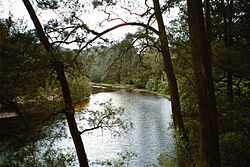
The Deua River, being the main perennial river of the Moruya River catchment, is located in the South Coast region of New South Wales, Australia.
The Deua River rises about 5 kilometres (3.1 mi) southeast of Bendethera Mountain, on the eastern slopes of the Badja Range, part of the Great Dividing Range, within Deua National Park, in rugged and thickly forested ranges south of Braidwood. The river flows generally south, west, north, northeast, south southeast and east, making almost a complete circle, and is joined by fourteen minor tributaries, before becoming the Moruya River near Kiora. The river descends 634 metres (2,080 ft) over its 139 kilometres (86 mi) course.
The lower reaches of the river are estuarine by nature and are called the Moruya River, while the freshwater reaches are called the Deua River. The upper catchment of the Deua River is suspected to be in a rain shadow, so the Deua River is on the whole a small river, and naturally experiences periods of very low flow. Heavy use of groundwater and riverwater however, for summer irrigation of fruit crop in the tributary Araluen Valley and the main river locality Merricumbene, greatly exacerbate summer low flows.
The village of Araluen lies in the valley of Araluen Creek, that joins the Deua River at roughly the midpoint in its course. The name 'Araluen' means 'water lily' or 'place of the water lilies' in the local aboriginal dialect. At the time of European settlement Araluen was described as a broad alluvial valley with one or more large natural billabongs covered with water lilies, likely providing some unusual but important habitat for native fish and other aquatic fauna. Unfortunately, no such billabongs exist in the Araluen valley today. As with most river and creek valleys in south-eastern Australia, the natural landscape and landforms of Araluen Creek and its valley were destroyed by rampant and destructive gold mining, including via hydraulic sluicing, in the latter half of the 1800s. This has mobilised hundreds of thousands of tons of coarse granitic sand and has led to serious sand-slugging or sand siltation of the lower half of the Deua River below the Araluen Creek confluence. New gold mines in the headwaters of the river remain controversial and have attracted considerable public attention for their proposed use of cyanide and breaches of environmental standards.
Despite the sand-slugging the Deua River is bio-diverse and supports an extremely important population of the endangered fish the Australian grayling (Prototroctes maraena)—possibly the best in the state of New South Wales—as well as thriving populations of several other native freshwater fish species including Cox's gudgeon (Gobiomorphus coxii), congolli (Pseudaphritis urvillii), Australian smelt (Retropinna semoni) and Galaxiids (Galaxias sp.), as well as some Australian bass (Macquaria novemaculeata). The river also supports healthy populations of platypus, azure kingfishers and eastern water dragons.
It is evident from the following accounts that sand-slugging of the Deua/Moruya Rivers commenced rapidly after the rampant destruction (via sluicing) of the tributary Araluen Creek and its valley in the 1860s. The damage of this gold-mining will last many lifetimes, as it is evident that the copious sand-slugging now present in the river will take many thousands of years to work through the river and out to sea via floods.
Yarragee in its spring dress is really a pretty little village. It is situated about two miles from the town- ship, and on a bend of the Moruya River. The cottages are very comfortable, surrounded by flowers, timber, and fruit trees, and those in particular of Messrs. Jacob Luck, John Luck, and T. Gannon, are worthy of note. Near the banks of the river, Mr. Jacob Luck has a nice plantation of some hundreds of various young orange trees. Here my attention was called to the state of the Moruya River, which is very shallow at this point, being filled, it is alleged, by the silt washed down from the Araluen diggings by the floods. About sixteen years ago the depth was sufficiently great to allow a vessel of sixty tons register to be built and launched here. This vessel belonged to Mr. Collett, whose estate I have described. Now the stream is scarcely a foot deep at this point, which is about six miles from Moruya, following the river course.
A Tour to the South. [FROM OUR SPECIAL CORRESPONDENT.] No. 10.—THE BROULEE DISTRICT (CONTINUED). Australian Town and Country Journal, Saturday 21 October 1871, Page 11
Deua River
The Deua River, being the main perennial river of the Moruya River catchment, is located in the South Coast region of New South Wales, Australia.
The Deua River rises about 5 kilometres (3.1 mi) southeast of Bendethera Mountain, on the eastern slopes of the Badja Range, part of the Great Dividing Range, within Deua National Park, in rugged and thickly forested ranges south of Braidwood. The river flows generally south, west, north, northeast, south southeast and east, making almost a complete circle, and is joined by fourteen minor tributaries, before becoming the Moruya River near Kiora. The river descends 634 metres (2,080 ft) over its 139 kilometres (86 mi) course.
The lower reaches of the river are estuarine by nature and are called the Moruya River, while the freshwater reaches are called the Deua River. The upper catchment of the Deua River is suspected to be in a rain shadow, so the Deua River is on the whole a small river, and naturally experiences periods of very low flow. Heavy use of groundwater and riverwater however, for summer irrigation of fruit crop in the tributary Araluen Valley and the main river locality Merricumbene, greatly exacerbate summer low flows.
The village of Araluen lies in the valley of Araluen Creek, that joins the Deua River at roughly the midpoint in its course. The name 'Araluen' means 'water lily' or 'place of the water lilies' in the local aboriginal dialect. At the time of European settlement Araluen was described as a broad alluvial valley with one or more large natural billabongs covered with water lilies, likely providing some unusual but important habitat for native fish and other aquatic fauna. Unfortunately, no such billabongs exist in the Araluen valley today. As with most river and creek valleys in south-eastern Australia, the natural landscape and landforms of Araluen Creek and its valley were destroyed by rampant and destructive gold mining, including via hydraulic sluicing, in the latter half of the 1800s. This has mobilised hundreds of thousands of tons of coarse granitic sand and has led to serious sand-slugging or sand siltation of the lower half of the Deua River below the Araluen Creek confluence. New gold mines in the headwaters of the river remain controversial and have attracted considerable public attention for their proposed use of cyanide and breaches of environmental standards.
Despite the sand-slugging the Deua River is bio-diverse and supports an extremely important population of the endangered fish the Australian grayling (Prototroctes maraena)—possibly the best in the state of New South Wales—as well as thriving populations of several other native freshwater fish species including Cox's gudgeon (Gobiomorphus coxii), congolli (Pseudaphritis urvillii), Australian smelt (Retropinna semoni) and Galaxiids (Galaxias sp.), as well as some Australian bass (Macquaria novemaculeata). The river also supports healthy populations of platypus, azure kingfishers and eastern water dragons.
It is evident from the following accounts that sand-slugging of the Deua/Moruya Rivers commenced rapidly after the rampant destruction (via sluicing) of the tributary Araluen Creek and its valley in the 1860s. The damage of this gold-mining will last many lifetimes, as it is evident that the copious sand-slugging now present in the river will take many thousands of years to work through the river and out to sea via floods.
Yarragee in its spring dress is really a pretty little village. It is situated about two miles from the town- ship, and on a bend of the Moruya River. The cottages are very comfortable, surrounded by flowers, timber, and fruit trees, and those in particular of Messrs. Jacob Luck, John Luck, and T. Gannon, are worthy of note. Near the banks of the river, Mr. Jacob Luck has a nice plantation of some hundreds of various young orange trees. Here my attention was called to the state of the Moruya River, which is very shallow at this point, being filled, it is alleged, by the silt washed down from the Araluen diggings by the floods. About sixteen years ago the depth was sufficiently great to allow a vessel of sixty tons register to be built and launched here. This vessel belonged to Mr. Collett, whose estate I have described. Now the stream is scarcely a foot deep at this point, which is about six miles from Moruya, following the river course.
A Tour to the South. [FROM OUR SPECIAL CORRESPONDENT.] No. 10.—THE BROULEE DISTRICT (CONTINUED). Australian Town and Country Journal, Saturday 21 October 1871, Page 11
Recent media
Recent media