



Community hub
Recent from talks
Knowledge base stats:
Talk channels stats:
Members stats:
Devil facial tumour disease
Devil facial tumour disease (DFTD) is an aggressive non-viral clonally transmissible cancer which affects Tasmanian devils, a marsupial native to the Australian island of Tasmania. The cancer manifests itself as lumps of soft and ulcerating tissue around the mouth, which may invade surrounding organs and metastasise to other parts of the body. Severe genetic abnormalities exist in cancer cells—for example, DFT2 cells are tetraploid, containing twice as much genetic material as normal cells. DFTD is most often spread by bites, when teeth come into contact with cancer cells; less important pathways of transmission are ingesting of infected carcasses and sharing of food. Adult Tasmanian devils who are otherwise the fittest are most susceptible to the disease.
DFTD is estimated to have first developed in 1986. There are two currently existing strains, both appearing to be derived from Schwann cells. DFT1 is the main and older strain that infects most of the devil population. It was first described in 1996 in an animal from Mount William National Park in northeastern Tasmania. DFT2 appeared around 2011 and was first detected in 2014; all cases are limited to the area of southern Tasmania near the D'Entrecasteaux Channel. There still remain disease-free pockets in the relatively isolated south-west of the island.
The disease poses a direct threat to the survival of Tasmanian devils as a species as the disease is almost universally fatal. In the two decades since the disease was first spotted, population of Devils (Sarcophilus harrisii) declined by 80% (locally exceeding 90%), as the condition spread through virtually all of Tasmania. The Tasmanian Government, Australian universities and zoos are engaged in efforts to curb the disease. Culling infected individuals, the policy used by state officials until 2010, brought little success. Thus the main prevention method became taking hundreds of devils into captivity and then releasing some of them into the wild. There is no cure for the cancer so far. Vaccination offers some promise in the fight against the pathogen, but researchers have not found a suitable candidate yet. A 2017 vaccine trial found that only 1 in 5 devils could resist DFTD; a DFT1 oral vaccine candidate is being tested in the captive devil population.
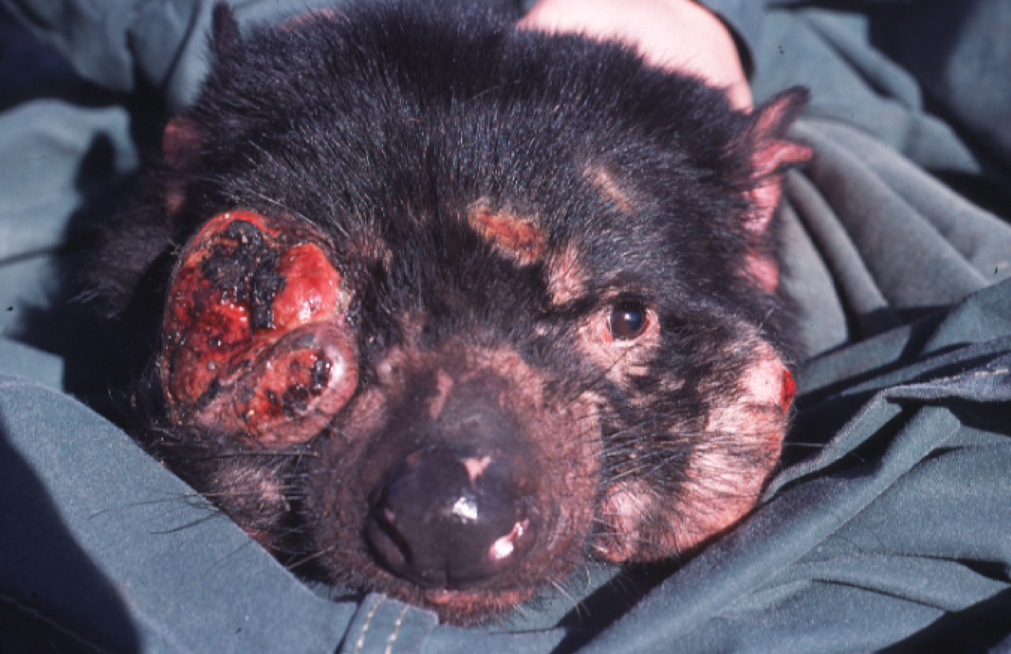
There is often more than one primary tumour. Visible signs of DFTD begin with lumps of soft tissue around the mouth, which ulcerate. Tumours are locally aggressive, destroying the underlying bone of the jaw which interferes with feeding. Tumours may also cover the eyes. Devils usually die within six months from organ failure, secondary infection, or metabolic starvation.
DFTD is rare in juveniles. It affects males and females equally.
The most plausible route of transmission is through biting, particularly when canine teeth come into direct contact with the diseased cells. Other modes of transmission may include the ingestion of infected carcasses and the sharing of food, both of which involve an allogeneic transfer of cells between unrelated individuals. The animals most likely to become infected are the fittest devil individuals.
DFTD tumours are large soft tissue masses which become centrally ulcerated. The tumours are composed of lobules of nodules of round to spindle-shaped cells, often within a pseudocapsule. Tumours metastasise to regional lymph nodes involvement and systemically to the lungs, spleen and heart.
Tasmanian devil cells have 14 chromosomes; the oldest-known strain of the tumour cells have thirteen chromosomes, nine of which are recognisable and four of which are mutated "marker" chromosomes. More recently evolved strains have an additional mutant marker chromosome, for a total of fourteen chromosomes. Researchers identified the cancer as a neuroendocrine tumour, and found identical chromosomal rearrangements in all the cancer cells. The karyotype anomalies of DFTD cells are similar to those of cancer cells from canine transmissible venereal tumour (CTVT), a cancer of dogs that is transmitted by physical contact. Among the mutations present in the tumour genome are trisomy in chromosome 5p, as well as several single base mutations, and short insertions and deletions, e.g., deletions in the chromosomes 1, 2 and 3. Some of the mutated or deleted genes in DFTD are RET, FANCD2, MAST3 and BTNL9-like gene.
Hub AI
Devil facial tumour disease AI simulator
(@Devil facial tumour disease_simulator)
Devil facial tumour disease
Devil facial tumour disease (DFTD) is an aggressive non-viral clonally transmissible cancer which affects Tasmanian devils, a marsupial native to the Australian island of Tasmania. The cancer manifests itself as lumps of soft and ulcerating tissue around the mouth, which may invade surrounding organs and metastasise to other parts of the body. Severe genetic abnormalities exist in cancer cells—for example, DFT2 cells are tetraploid, containing twice as much genetic material as normal cells. DFTD is most often spread by bites, when teeth come into contact with cancer cells; less important pathways of transmission are ingesting of infected carcasses and sharing of food. Adult Tasmanian devils who are otherwise the fittest are most susceptible to the disease.
DFTD is estimated to have first developed in 1986. There are two currently existing strains, both appearing to be derived from Schwann cells. DFT1 is the main and older strain that infects most of the devil population. It was first described in 1996 in an animal from Mount William National Park in northeastern Tasmania. DFT2 appeared around 2011 and was first detected in 2014; all cases are limited to the area of southern Tasmania near the D'Entrecasteaux Channel. There still remain disease-free pockets in the relatively isolated south-west of the island.
The disease poses a direct threat to the survival of Tasmanian devils as a species as the disease is almost universally fatal. In the two decades since the disease was first spotted, population of Devils (Sarcophilus harrisii) declined by 80% (locally exceeding 90%), as the condition spread through virtually all of Tasmania. The Tasmanian Government, Australian universities and zoos are engaged in efforts to curb the disease. Culling infected individuals, the policy used by state officials until 2010, brought little success. Thus the main prevention method became taking hundreds of devils into captivity and then releasing some of them into the wild. There is no cure for the cancer so far. Vaccination offers some promise in the fight against the pathogen, but researchers have not found a suitable candidate yet. A 2017 vaccine trial found that only 1 in 5 devils could resist DFTD; a DFT1 oral vaccine candidate is being tested in the captive devil population.
There is often more than one primary tumour. Visible signs of DFTD begin with lumps of soft tissue around the mouth, which ulcerate. Tumours are locally aggressive, destroying the underlying bone of the jaw which interferes with feeding. Tumours may also cover the eyes. Devils usually die within six months from organ failure, secondary infection, or metabolic starvation.
DFTD is rare in juveniles. It affects males and females equally.
The most plausible route of transmission is through biting, particularly when canine teeth come into direct contact with the diseased cells. Other modes of transmission may include the ingestion of infected carcasses and the sharing of food, both of which involve an allogeneic transfer of cells between unrelated individuals. The animals most likely to become infected are the fittest devil individuals.
DFTD tumours are large soft tissue masses which become centrally ulcerated. The tumours are composed of lobules of nodules of round to spindle-shaped cells, often within a pseudocapsule. Tumours metastasise to regional lymph nodes involvement and systemically to the lungs, spleen and heart.
Tasmanian devil cells have 14 chromosomes; the oldest-known strain of the tumour cells have thirteen chromosomes, nine of which are recognisable and four of which are mutated "marker" chromosomes. More recently evolved strains have an additional mutant marker chromosome, for a total of fourteen chromosomes. Researchers identified the cancer as a neuroendocrine tumour, and found identical chromosomal rearrangements in all the cancer cells. The karyotype anomalies of DFTD cells are similar to those of cancer cells from canine transmissible venereal tumour (CTVT), a cancer of dogs that is transmitted by physical contact. Among the mutations present in the tumour genome are trisomy in chromosome 5p, as well as several single base mutations, and short insertions and deletions, e.g., deletions in the chromosomes 1, 2 and 3. Some of the mutated or deleted genes in DFTD are RET, FANCD2, MAST3 and BTNL9-like gene.