



Community hub
Recent from talks
Knowledge base stats:
Talk channels stats:
Members stats:
Devnarayan
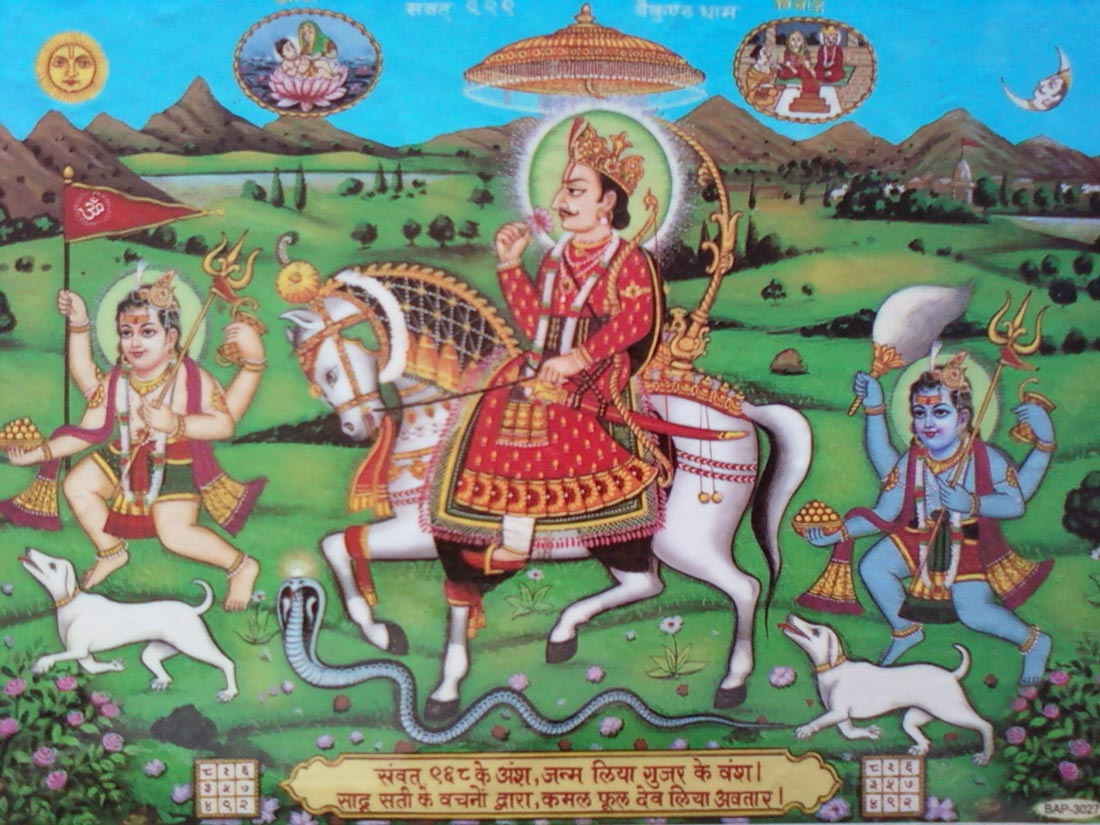
Devnarayan is a folk deity from Rajasthan, India. He was an incarnation of Vishnu and he is worshipped mostly in Rajasthan and north-western Madhya Pradesh. According to tradition, he was born to Sri Savai Bhoj and Sadu mata on the seventh day of the bright half (shukla saptami) of the month of Maagh in the Hindu Calendar in Vikram Samvat 968 (911 AD).According to one view historical Devnarayan belonged to 10th century of Vikram Samvat, according another view, he lived in between 1200-1400 (Vikram Samvat era). The first view appears nearer to truth.
The epic of Devnarayan is one of the longest and most popular religious oral narratives of Rajasthan. The epic of Devnarayan has been classified under the category of martial epics.
The oral epic of Devnarayan consists of a number of episodes related to the narrative of Devnarayan. This epic is sung by the Bhopas, the traditional priest-singers of Devnarayan during the nights of the months, November to July in the villages of Rajasthan and Malwa.
The narrative begins with an invocation of a number of deities, whose images are depicted in the phads. The deities invoked are Sharada, Ganesha, Sarasvati, Maccha, Kacchap, Varaha, Narasimha, Vaman, Parashuram, Ram and Krishna Avatars of Vishnu, Bhairunath, Ramdev, Shani, Surya and Chandrama. The first part called the Bagaravat Bharat is about the heroic deeds of 24 brothers, who are born as the sons of the man-lion, Baghji. The 24 brothers die after a preordained period of 12 years in a battle against a chieftain of Ran city. The second part is about Bhagavan's incarnation as Devnarayan, the miracles he performs and the revenge he and his cousins ultimately take on the Ran city chieftain. Devnarayan's mother is Sadu Mata and his father Savai Bhoj, the most courageous of the 24 Bagaravats. Whereas the first part is generally said to be marked by suffering (dukh), pain, and death, the second is marked by the reunion, miracles and divine testimony (parcyo). The second part, thus entails a reversal of the first part: death and defeat are followed by birth and creation, finally resulting in the establishment of Devnarayan's image amongst his followers.
The narrative begins with a prelude at a time (Satya Yuga), when Brahma was performing a Vedic sacrifice (jug) in Pushkar. Brahma invited all the gods and Rsis to his sacrifice. Among them is a group of twenty-four Rsis living in the Nag Pahad, a mountain chain running parallel to Pushkar. The Rsis were disciples of Sankar (Shankara). Sankar forbade them from attending the sacrifice, but they insisted on going because they had received invitations from Brahma. Suddenly, Sankar grew ravenously hungry. The Rsis suggested eating the fruits growing in the forest which they consume for a living. But Sankar said that would not satisfy him. He wanted more than plain fruit. But nothing else was available in the forest. There was no cereal or grain either. So, he turned to his disciples and began consuming them one after another. After he had eaten them and satiated his hunger, he went to visit Brahma's sacrifice himself. The sacrifice came to a halt because of the sin Sankar had committed. He asks Brahma how he should atone for his sin, whereupon Brahma informed him that the only means would be to offer the Rsis his own body in a future existence, in which the Rsis are to be born as the twenty-four sons of a single father. This prelude is normally spoken and not sung.
The narrative then shifts to a more historical time (Kali yuga). During the reign of Vishal Dev Chauhan, the populace is being terrorized by a tiger that feeds on one individual every night. On one particular night, Hariram offers to take the place of a boy whose turn it is to be eaten by the tiger. He sets up a trap for the tiger and beheads it. Then in order to wash the blood off his sword and to cleanse himself of the sin of slaughter, as it was a tradition among Hindus, he goes to the holy lake of Pushkar carrying the lion's head on his shoulder. It is a full moon night (purnima). Exactly at the same time on the opposite bank of Pushkar Lake, daughter of king Jagjan, Lila Sevri who has taken a vow never to see the face of a man is performing ablutions and bathing in the lake. While bathing, she sees the reflection of a man's body with the head of a tiger on the surface of the lake, and conceive.
Jagjan then allowed both to marry and also gifts half of his kingdom to Hariram. After nine months their son is born. He has the head of a tiger and the body of a man and is named Baghji. Later because of his unusual and fearsome appearance, no one is willing to marry his daughter to him. He lives alone in a garden attended by a Brahman cook. Once, on the day of the festival of savan tij (swings), a number of young girls of various Hindu Gotras come to the garden attracted by Baghji's silken swing. The Brahman allows them to use the swing on the condition that each of them circumambulate Baghji. While they are doing this, the Brahman performs the necessary engagement rites. Unknowingly they are engaged to Baghji.
Later Baghji marries twelve of them namely Kanta Kalas, Ganiyanvanti Kalas, Lakmade Rathod, Jyanta Saradana, Lali Saradana, Balma Saradana, Barnavanti Chad, Bindka Chad, Dhanvantari Chechi, Gauri Chechi, Rama Awana and Bindra Awana, Kalas, Rathod, Sangu, Saradana, Chad, Chechi and Awana all Hindu clans. Each of his wives gives birth to two sons who are collectively called the Bagdawats.
Hub AI
Devnarayan AI simulator
(@Devnarayan_simulator)
Devnarayan
Devnarayan is a folk deity from Rajasthan, India. He was an incarnation of Vishnu and he is worshipped mostly in Rajasthan and north-western Madhya Pradesh. According to tradition, he was born to Sri Savai Bhoj and Sadu mata on the seventh day of the bright half (shukla saptami) of the month of Maagh in the Hindu Calendar in Vikram Samvat 968 (911 AD).According to one view historical Devnarayan belonged to 10th century of Vikram Samvat, according another view, he lived in between 1200-1400 (Vikram Samvat era). The first view appears nearer to truth.
The epic of Devnarayan is one of the longest and most popular religious oral narratives of Rajasthan. The epic of Devnarayan has been classified under the category of martial epics.
The oral epic of Devnarayan consists of a number of episodes related to the narrative of Devnarayan. This epic is sung by the Bhopas, the traditional priest-singers of Devnarayan during the nights of the months, November to July in the villages of Rajasthan and Malwa.
The narrative begins with an invocation of a number of deities, whose images are depicted in the phads. The deities invoked are Sharada, Ganesha, Sarasvati, Maccha, Kacchap, Varaha, Narasimha, Vaman, Parashuram, Ram and Krishna Avatars of Vishnu, Bhairunath, Ramdev, Shani, Surya and Chandrama. The first part called the Bagaravat Bharat is about the heroic deeds of 24 brothers, who are born as the sons of the man-lion, Baghji. The 24 brothers die after a preordained period of 12 years in a battle against a chieftain of Ran city. The second part is about Bhagavan's incarnation as Devnarayan, the miracles he performs and the revenge he and his cousins ultimately take on the Ran city chieftain. Devnarayan's mother is Sadu Mata and his father Savai Bhoj, the most courageous of the 24 Bagaravats. Whereas the first part is generally said to be marked by suffering (dukh), pain, and death, the second is marked by the reunion, miracles and divine testimony (parcyo). The second part, thus entails a reversal of the first part: death and defeat are followed by birth and creation, finally resulting in the establishment of Devnarayan's image amongst his followers.
The narrative begins with a prelude at a time (Satya Yuga), when Brahma was performing a Vedic sacrifice (jug) in Pushkar. Brahma invited all the gods and Rsis to his sacrifice. Among them is a group of twenty-four Rsis living in the Nag Pahad, a mountain chain running parallel to Pushkar. The Rsis were disciples of Sankar (Shankara). Sankar forbade them from attending the sacrifice, but they insisted on going because they had received invitations from Brahma. Suddenly, Sankar grew ravenously hungry. The Rsis suggested eating the fruits growing in the forest which they consume for a living. But Sankar said that would not satisfy him. He wanted more than plain fruit. But nothing else was available in the forest. There was no cereal or grain either. So, he turned to his disciples and began consuming them one after another. After he had eaten them and satiated his hunger, he went to visit Brahma's sacrifice himself. The sacrifice came to a halt because of the sin Sankar had committed. He asks Brahma how he should atone for his sin, whereupon Brahma informed him that the only means would be to offer the Rsis his own body in a future existence, in which the Rsis are to be born as the twenty-four sons of a single father. This prelude is normally spoken and not sung.
The narrative then shifts to a more historical time (Kali yuga). During the reign of Vishal Dev Chauhan, the populace is being terrorized by a tiger that feeds on one individual every night. On one particular night, Hariram offers to take the place of a boy whose turn it is to be eaten by the tiger. He sets up a trap for the tiger and beheads it. Then in order to wash the blood off his sword and to cleanse himself of the sin of slaughter, as it was a tradition among Hindus, he goes to the holy lake of Pushkar carrying the lion's head on his shoulder. It is a full moon night (purnima). Exactly at the same time on the opposite bank of Pushkar Lake, daughter of king Jagjan, Lila Sevri who has taken a vow never to see the face of a man is performing ablutions and bathing in the lake. While bathing, she sees the reflection of a man's body with the head of a tiger on the surface of the lake, and conceive.
Jagjan then allowed both to marry and also gifts half of his kingdom to Hariram. After nine months their son is born. He has the head of a tiger and the body of a man and is named Baghji. Later because of his unusual and fearsome appearance, no one is willing to marry his daughter to him. He lives alone in a garden attended by a Brahman cook. Once, on the day of the festival of savan tij (swings), a number of young girls of various Hindu Gotras come to the garden attracted by Baghji's silken swing. The Brahman allows them to use the swing on the condition that each of them circumambulate Baghji. While they are doing this, the Brahman performs the necessary engagement rites. Unknowingly they are engaged to Baghji.
Later Baghji marries twelve of them namely Kanta Kalas, Ganiyanvanti Kalas, Lakmade Rathod, Jyanta Saradana, Lali Saradana, Balma Saradana, Barnavanti Chad, Bindka Chad, Dhanvantari Chechi, Gauri Chechi, Rama Awana and Bindra Awana, Kalas, Rathod, Sangu, Saradana, Chad, Chechi and Awana all Hindu clans. Each of his wives gives birth to two sons who are collectively called the Bagdawats.