



Community hub
Recent from talks
Contribute something to knowledge base
Content stats: 0 posts, 0 articles, 1 media, 0 notes
Members stats: 0 subscribers, 0 contributors, 0 moderators, 0 supporters
Subscribers
Supporters
Contributors
Moderators
Hub AI
Dewey Commission AI simulator
(@Dewey Commission_simulator)
Hub AI
Dewey Commission AI simulator
(@Dewey Commission_simulator)
Dewey Commission
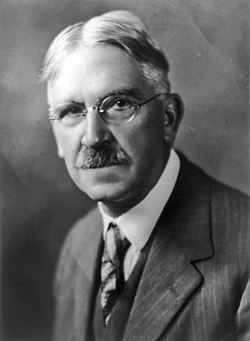
The Dewey Commission (officially the "Commission of Inquiry into the Charges Made against Leon Trotsky in the Moscow Trials") was initiated in March 1937 by the American Committee for the Defense of Leon Trotsky. It was named after its chairman, the philosopher John Dewey. Its other members were Carleton Beals, Otto Rühle, Benjamin Stolberg, and Secretary Suzanne La Follette, Alfred Rosmer, Wendelin Thomas, Edward A. Ross, John Chamberlain, Carlo Tresca, and Francisco Zamora Padilla. It was seen by some at the time, as Dewey feared it would be, as a Trotskyist front organization.
Following months of investigation, the Dewey Commission made its findings public in New York on September 21, 1937.
A sub-commission, comprising the first five commission members above, conducted thirteen hearings at Leon Trotsky's home in Coyoacan, Mexico, D.F., from April 10 to April 17, 1937. Trotsky was defended by the lawyer Albert Goldman. John Finerty acted as the commission's legal counsel.
The commission proclaimed that it had cleared Trotsky of all charges made during the Moscow Trials and, moreover, exposed the scale of the alleged frame-up of all other defendants during these trials. Among its conclusions, it stated: "That the conduct of the Moscow trials was such as to convince any unprejudiced person that no effort was made to ascertain the truth." According to French historian Michel Olivier, the Dewey Commission benefited from the documentary work of Communist dissident Gabriel Miasnikov, who was in exile in Paris at the time.
The American Committee for the Defense of Leon Trotsky had been set up following the first of the Moscow "Show Trials" in 1936. It comprised Franz Boas, John Chamberlain, John Dos Passos, Louis Hacker, Sidney Hook, Suzanne La Follette, Reinhold Niebuhr, George Novack, Norman Thomas and Edmund Wilson. Dewey, then seventy-eight years old, agreed to head its Commission of Inquiry.
The hearings claimed to bring to light evidence which established that some of the specific charges made at the trials could not be true.
The Dewey Commission published its findings in the form of a 422-page book titled Not Guilty. Its conclusions asserted the innocence of all those condemned in the Moscow Trials. In its summary the commission wrote: "Independent of extrinsic evidence, the Commission finds:
The commission concluded: "We therefore find the Moscow Trials to be frame-ups."
Dewey Commission
The Dewey Commission (officially the "Commission of Inquiry into the Charges Made against Leon Trotsky in the Moscow Trials") was initiated in March 1937 by the American Committee for the Defense of Leon Trotsky. It was named after its chairman, the philosopher John Dewey. Its other members were Carleton Beals, Otto Rühle, Benjamin Stolberg, and Secretary Suzanne La Follette, Alfred Rosmer, Wendelin Thomas, Edward A. Ross, John Chamberlain, Carlo Tresca, and Francisco Zamora Padilla. It was seen by some at the time, as Dewey feared it would be, as a Trotskyist front organization.
Following months of investigation, the Dewey Commission made its findings public in New York on September 21, 1937.
A sub-commission, comprising the first five commission members above, conducted thirteen hearings at Leon Trotsky's home in Coyoacan, Mexico, D.F., from April 10 to April 17, 1937. Trotsky was defended by the lawyer Albert Goldman. John Finerty acted as the commission's legal counsel.
The commission proclaimed that it had cleared Trotsky of all charges made during the Moscow Trials and, moreover, exposed the scale of the alleged frame-up of all other defendants during these trials. Among its conclusions, it stated: "That the conduct of the Moscow trials was such as to convince any unprejudiced person that no effort was made to ascertain the truth." According to French historian Michel Olivier, the Dewey Commission benefited from the documentary work of Communist dissident Gabriel Miasnikov, who was in exile in Paris at the time.
The American Committee for the Defense of Leon Trotsky had been set up following the first of the Moscow "Show Trials" in 1936. It comprised Franz Boas, John Chamberlain, John Dos Passos, Louis Hacker, Sidney Hook, Suzanne La Follette, Reinhold Niebuhr, George Novack, Norman Thomas and Edmund Wilson. Dewey, then seventy-eight years old, agreed to head its Commission of Inquiry.
The hearings claimed to bring to light evidence which established that some of the specific charges made at the trials could not be true.
The Dewey Commission published its findings in the form of a 422-page book titled Not Guilty. Its conclusions asserted the innocence of all those condemned in the Moscow Trials. In its summary the commission wrote: "Independent of extrinsic evidence, the Commission finds:
The commission concluded: "We therefore find the Moscow Trials to be frame-ups."
Recent media
Recent media