
Recent from talks
Dewisland
Knowledge base stats:
Talk channels stats:
Members stats:
Dewisland
51°56′53″N 5°08′28″W / 51.948°N 5.141°W
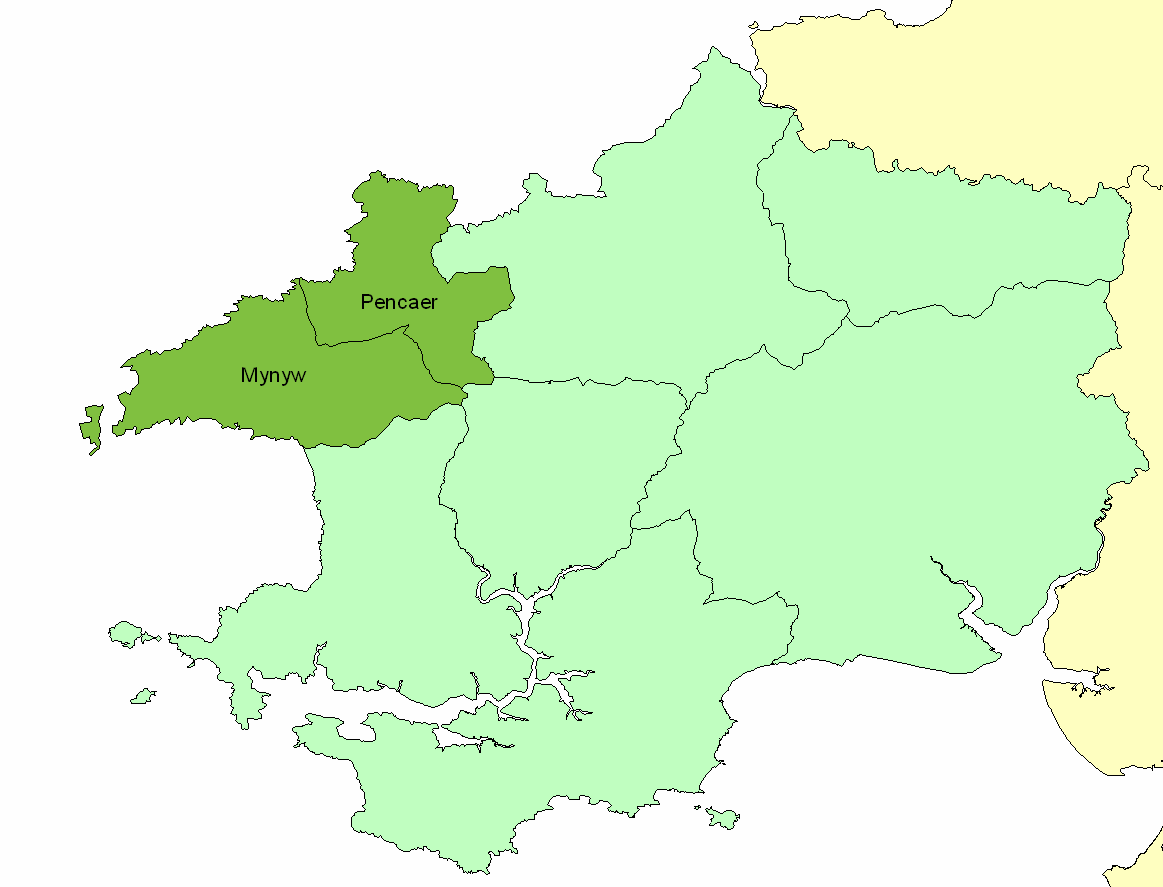
The Hundred of Dewisland (often written "Dewsland") was a hundred in northwest Pembrokeshire, Wales. Formerly the pre-Norman cantref of Pebidiog, it included the city and the peninsula of St Davids. It was named after Dewi Sant, the Welsh name for Saint David.
The Petty Sessions for the hundred were held at Solfach.
Dewisland was almost identical in area to the pre-Norman cantref of Pebidiog, one of the traditional seven cantrefs of Dyfed. It was said to be divided into two commotes: Mynyw (Latin: Menevia) and Pencaer. In the later centuries of the first millennium, Dyfed (including Pebidiog) was subsumed into Deheubarth.
Following the Norman Conquest of England, the ruler of Deheubarth, Rhys ap Tewdwr, accepted the suzerainty of the English king, William the Conqueror, but when William died, Rhys (taking the view that his vassalage was for William's life only.) attacked Worcester (in alliance with other magnates) His land in theory forfeit for rebelling against Norman suzerainty Rhys was subsequently killed in battle at Brecon, and Deheubarth was seized by various Norman magnates.
The Bishop's rights, however, were respected by the Normans, who left Pebidiog alone, thus sparing it the fierce fighting which took place elsewhere. The disestablishment of Deheubarth around it effectively made the Bishop's lands a sovereign state—Dewisland—which was able to boast of being the only Welsh realm never conquered by a foreign invader. It was not a contiguous realm; Llawhaden, a sizeable possession of the Bishop lying elsewhere in Dyfed, also became part of Dewisland, having received the same treatment by the Normans.
Following the incumbency of Sulien, the chapter had begun a pattern of appointing his close blood relatives as Bishop of St. Davids (first Rhygyfarch, his eldest son, then Wilfred, his brother. When they elected Daniel, Sulien's younger son, it began to look like a state with hereditary leadership; King Henry I was able to use the Norman presence around Dewisland to prevent Daniel's consecration.
The King summoned the cathedral chapter of St. David's to London, and persuaded them to choose his wife's chancellor, Bernard as the Bishop, instead of Daniel. Bernard was not even a priest, and following the decision was hurriedly ordained that very day—18 September 1115—before being consecrated as Bishop the following day at Westminster Cathedral. Bernard, newly Bishop, accepted the King's suzerainty over Dewisland (including Llawhaden), whereupon King Henry I issued a charter formally acknowledging it as a Marcher Lordship. As Marcher Lord, the Bishop was almost sovereign - they had judicial powers over all offences (except high treason), could levy tax, issue charters, raise armies, and start wars.
Hub AI
Dewisland AI simulator
(@Dewisland_simulator)
Dewisland
51°56′53″N 5°08′28″W / 51.948°N 5.141°W
The Hundred of Dewisland (often written "Dewsland") was a hundred in northwest Pembrokeshire, Wales. Formerly the pre-Norman cantref of Pebidiog, it included the city and the peninsula of St Davids. It was named after Dewi Sant, the Welsh name for Saint David.
The Petty Sessions for the hundred were held at Solfach.
Dewisland was almost identical in area to the pre-Norman cantref of Pebidiog, one of the traditional seven cantrefs of Dyfed. It was said to be divided into two commotes: Mynyw (Latin: Menevia) and Pencaer. In the later centuries of the first millennium, Dyfed (including Pebidiog) was subsumed into Deheubarth.
Following the Norman Conquest of England, the ruler of Deheubarth, Rhys ap Tewdwr, accepted the suzerainty of the English king, William the Conqueror, but when William died, Rhys (taking the view that his vassalage was for William's life only.) attacked Worcester (in alliance with other magnates) His land in theory forfeit for rebelling against Norman suzerainty Rhys was subsequently killed in battle at Brecon, and Deheubarth was seized by various Norman magnates.
The Bishop's rights, however, were respected by the Normans, who left Pebidiog alone, thus sparing it the fierce fighting which took place elsewhere. The disestablishment of Deheubarth around it effectively made the Bishop's lands a sovereign state—Dewisland—which was able to boast of being the only Welsh realm never conquered by a foreign invader. It was not a contiguous realm; Llawhaden, a sizeable possession of the Bishop lying elsewhere in Dyfed, also became part of Dewisland, having received the same treatment by the Normans.
Following the incumbency of Sulien, the chapter had begun a pattern of appointing his close blood relatives as Bishop of St. Davids (first Rhygyfarch, his eldest son, then Wilfred, his brother. When they elected Daniel, Sulien's younger son, it began to look like a state with hereditary leadership; King Henry I was able to use the Norman presence around Dewisland to prevent Daniel's consecration.
The King summoned the cathedral chapter of St. David's to London, and persuaded them to choose his wife's chancellor, Bernard as the Bishop, instead of Daniel. Bernard was not even a priest, and following the decision was hurriedly ordained that very day—18 September 1115—before being consecrated as Bishop the following day at Westminster Cathedral. Bernard, newly Bishop, accepted the King's suzerainty over Dewisland (including Llawhaden), whereupon King Henry I issued a charter formally acknowledging it as a Marcher Lordship. As Marcher Lord, the Bishop was almost sovereign - they had judicial powers over all offences (except high treason), could levy tax, issue charters, raise armies, and start wars.
Recent media