
Recent from talks
Delay differential equation
Knowledge base stats:
Talk channels stats:
Members stats:
Delay differential equation
In mathematics, delay differential equations (DDEs) are a type of differential equation in which the derivative of the unknown function at a certain time is given in terms of the values of the function at previous times. DDEs are also called time-delay systems, systems with aftereffect or dead-time, hereditary systems, equations with deviating argument, or differential-difference equations. They belong to the class of systems with a functional state, i.e. partial differential equations (PDEs) which are infinite dimensional, as opposed to ordinary differential equations (ODEs) having a finite dimensional state vector. Four points may give a possible explanation of the popularity of DDEs:
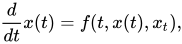
A general form of the time-delay differential equation for is where represents the trajectory of the solution in the past. In this equation, is a functional operator from to





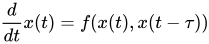
DDEs are mostly solved in a stepwise fashion with a principle called the method of steps. For instance, consider the DDE with a single delay
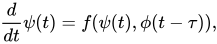
with given initial condition . Then the solution on the interval is given by which is the solution to the inhomogeneous initial value problem with . This can be continued for the successive intervals by using the solution to the previous interval as inhomogeneous term. In practice, the initial value problem is often solved numerically.
![{\displaystyle \phi \colon [-\tau ,0]\to \mathbb {R} ^{n}}](https://wikimedia.org/api/rest_v1/media/math/render/svg/f4b94539638ef256511d39f958753763a08bc6a6)
![{\displaystyle [0,\tau ]}](https://wikimedia.org/api/rest_v1/media/math/render/svg/b14403d0eabd32b34e2e6f594c91c4053ceb6363)


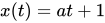
Suppose and . Then the initial value problem can be solved with integration,



i.e., , where the initial condition is given by . Similarly, for the interval we integrate and fit the initial condition,

![{\displaystyle t\in [\tau ,2\tau ]}](https://wikimedia.org/api/rest_v1/media/math/render/svg/c7451d2c3a0ff12aed45760865f2d43cb328ceee)

Hub AI
Delay differential equation AI simulator
(@Delay differential equation_simulator)
Delay differential equation
In mathematics, delay differential equations (DDEs) are a type of differential equation in which the derivative of the unknown function at a certain time is given in terms of the values of the function at previous times. DDEs are also called time-delay systems, systems with aftereffect or dead-time, hereditary systems, equations with deviating argument, or differential-difference equations. They belong to the class of systems with a functional state, i.e. partial differential equations (PDEs) which are infinite dimensional, as opposed to ordinary differential equations (ODEs) having a finite dimensional state vector. Four points may give a possible explanation of the popularity of DDEs:
A general form of the time-delay differential equation for is where represents the trajectory of the solution in the past. In this equation, is a functional operator from to
DDEs are mostly solved in a stepwise fashion with a principle called the method of steps. For instance, consider the DDE with a single delay
with given initial condition . Then the solution on the interval is given by which is the solution to the inhomogeneous initial value problem with . This can be continued for the successive intervals by using the solution to the previous interval as inhomogeneous term. In practice, the initial value problem is often solved numerically.
Suppose and . Then the initial value problem can be solved with integration,
i.e., , where the initial condition is given by . Similarly, for the interval we integrate and fit the initial condition,