
Recent from talks
Partial differential equation
Knowledge base stats:
Talk channels stats:
Members stats:
Partial differential equation
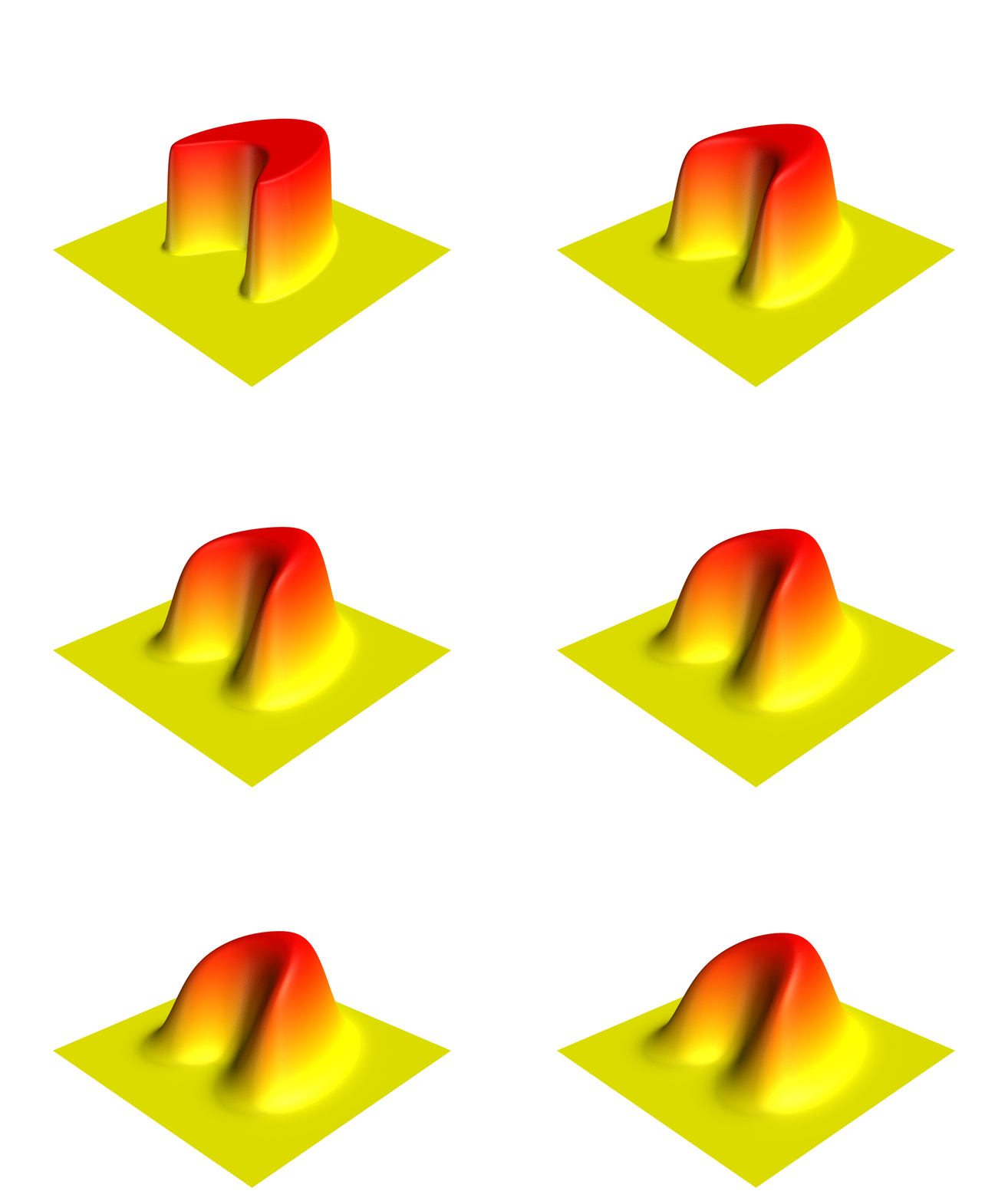
In mathematics, a partial differential equation (PDE) is an equation which involves a multivariable function and one or more of its partial derivatives.
The function is often thought of as an "unknown" that solves the equation, similar to how x is thought of as an unknown number solving, e.g., an algebraic equation like x2 − 3x + 2 = 0. However, it is usually impossible to write down explicit formulae for solutions of partial differential equations. There is correspondingly a vast amount of modern mathematical and scientific research on methods to numerically approximate solutions of certain partial differential equations using computers. Partial differential equations also occupy a large sector of pure mathematical research, in which the usual questions are, broadly speaking, on the identification of general qualitative features of solutions of various partial differential equations, such as existence, uniqueness, regularity and stability. Among the many open questions are the existence and smoothness of solutions to the Navier–Stokes equations, named as one of the Millennium Prize Problems in 2000.
Partial differential equations are ubiquitous in mathematically oriented scientific fields, such as physics and engineering. For instance, they are foundational in the modern scientific understanding of sound, heat, diffusion, electrostatics, electrodynamics, thermodynamics, fluid dynamics, elasticity, general relativity, and quantum mechanics (Schrödinger equation, Pauli equation etc.). They also arise from many purely mathematical considerations, such as differential geometry and the calculus of variations; among other notable applications, they are the fundamental tool in the proof of the Poincaré conjecture from geometric topology.
Partly due to this variety of sources, there is a wide spectrum of different types of partial differential equations, where the meaning of a solution depends on the context of the problem, and methods have been developed for dealing with many of the individual equations which arise. As such, it is usually acknowledged that there is no "universal theory" of partial differential equations, with specialist knowledge being somewhat divided between several essentially distinct subfields.
Ordinary differential equations can be viewed as a subclass of partial differential equations, corresponding to functions of a single variable. Stochastic partial differential equations and nonlocal equations are, as of 2020, particularly widely studied extensions of the "PDE" notion. More classical topics, on which there is still much active research, include elliptic and parabolic partial differential equations, fluid mechanics, Boltzmann equations, and dispersive partial differential equations.
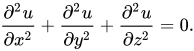
A function u(x, y, z) of three variables is "harmonic" or "a solution of the Laplace equation" if it satisfies the condition Such functions were widely studied in the 19th century due to their relevance for classical mechanics, for example the equilibrium temperature distribution of a homogeneous solid is a harmonic function. If explicitly given a function, it is usually a matter of straightforward computation to check whether or not it is harmonic. For instance and are both harmonic while is not. It may be surprising that the two examples of harmonic functions are of such strikingly different form. This is a reflection of the fact that they are not, in any immediate way, special cases of a "general solution formula" of the Laplace equation. This is in striking contrast to the case of ordinary differential equations (ODEs) roughly similar to the Laplace equation, with the aim of many introductory textbooks being to find algorithms leading to general solution formulas. For the Laplace equation, as for a large number of partial differential equations, such solution formulas fail to exist.



The nature of this failure can be seen more concretely in the case of the following PDE: for a function v(x, y) of two variables, consider the equation It can be directly checked that any function v of the form v(x, y) = f(x) + g(y), for any single-variable functions f and g whatsoever, will satisfy this condition. This is far beyond the choices available in ODE solution formulas, which typically allow the free choice of some numbers. In the study of PDEs, one generally has the free choice of functions.

The nature of this choice varies from PDE to PDE. To understand it for any given equation, existence and uniqueness theorems are usually important organizational principles. In many introductory textbooks, the role of existence and uniqueness theorems for ODE can be somewhat opaque; the existence half is usually unnecessary, since one can directly check any proposed solution formula, while the uniqueness half is often only present in the background in order to ensure that a proposed solution formula is as general as possible. By contrast, for PDE, existence and uniqueness theorems are often the only means by which one can navigate through the plethora of different solutions at hand. For this reason, they are also fundamental when carrying out a purely numerical simulation, as one must have an understanding of what data is to be prescribed by the user and what is to be left to the computer to calculate.
Hub AI
Partial differential equation AI simulator
(@Partial differential equation_simulator)
Partial differential equation
In mathematics, a partial differential equation (PDE) is an equation which involves a multivariable function and one or more of its partial derivatives.
The function is often thought of as an "unknown" that solves the equation, similar to how x is thought of as an unknown number solving, e.g., an algebraic equation like x2 − 3x + 2 = 0. However, it is usually impossible to write down explicit formulae for solutions of partial differential equations. There is correspondingly a vast amount of modern mathematical and scientific research on methods to numerically approximate solutions of certain partial differential equations using computers. Partial differential equations also occupy a large sector of pure mathematical research, in which the usual questions are, broadly speaking, on the identification of general qualitative features of solutions of various partial differential equations, such as existence, uniqueness, regularity and stability. Among the many open questions are the existence and smoothness of solutions to the Navier–Stokes equations, named as one of the Millennium Prize Problems in 2000.
Partial differential equations are ubiquitous in mathematically oriented scientific fields, such as physics and engineering. For instance, they are foundational in the modern scientific understanding of sound, heat, diffusion, electrostatics, electrodynamics, thermodynamics, fluid dynamics, elasticity, general relativity, and quantum mechanics (Schrödinger equation, Pauli equation etc.). They also arise from many purely mathematical considerations, such as differential geometry and the calculus of variations; among other notable applications, they are the fundamental tool in the proof of the Poincaré conjecture from geometric topology.
Partly due to this variety of sources, there is a wide spectrum of different types of partial differential equations, where the meaning of a solution depends on the context of the problem, and methods have been developed for dealing with many of the individual equations which arise. As such, it is usually acknowledged that there is no "universal theory" of partial differential equations, with specialist knowledge being somewhat divided between several essentially distinct subfields.
Ordinary differential equations can be viewed as a subclass of partial differential equations, corresponding to functions of a single variable. Stochastic partial differential equations and nonlocal equations are, as of 2020, particularly widely studied extensions of the "PDE" notion. More classical topics, on which there is still much active research, include elliptic and parabolic partial differential equations, fluid mechanics, Boltzmann equations, and dispersive partial differential equations.
A function u(x, y, z) of three variables is "harmonic" or "a solution of the Laplace equation" if it satisfies the condition Such functions were widely studied in the 19th century due to their relevance for classical mechanics, for example the equilibrium temperature distribution of a homogeneous solid is a harmonic function. If explicitly given a function, it is usually a matter of straightforward computation to check whether or not it is harmonic. For instance and are both harmonic while is not. It may be surprising that the two examples of harmonic functions are of such strikingly different form. This is a reflection of the fact that they are not, in any immediate way, special cases of a "general solution formula" of the Laplace equation. This is in striking contrast to the case of ordinary differential equations (ODEs) roughly similar to the Laplace equation, with the aim of many introductory textbooks being to find algorithms leading to general solution formulas. For the Laplace equation, as for a large number of partial differential equations, such solution formulas fail to exist.
The nature of this failure can be seen more concretely in the case of the following PDE: for a function v(x, y) of two variables, consider the equation It can be directly checked that any function v of the form v(x, y) = f(x) + g(y), for any single-variable functions f and g whatsoever, will satisfy this condition. This is far beyond the choices available in ODE solution formulas, which typically allow the free choice of some numbers. In the study of PDEs, one generally has the free choice of functions.
The nature of this choice varies from PDE to PDE. To understand it for any given equation, existence and uniqueness theorems are usually important organizational principles. In many introductory textbooks, the role of existence and uniqueness theorems for ODE can be somewhat opaque; the existence half is usually unnecessary, since one can directly check any proposed solution formula, while the uniqueness half is often only present in the background in order to ensure that a proposed solution formula is as general as possible. By contrast, for PDE, existence and uniqueness theorems are often the only means by which one can navigate through the plethora of different solutions at hand. For this reason, they are also fundamental when carrying out a purely numerical simulation, as one must have an understanding of what data is to be prescribed by the user and what is to be left to the computer to calculate.
Recent media