
Recent from talks
Dilwara Temples
Knowledge base stats:
Talk channels stats:
Members stats:
Dilwara Temples
The Delwada Temples or Delvada Temples are a group of Śvētāmbara Jain temples located about 2+1⁄2 kilometres from the Mount Abu settlement in Sirohi District, Rajasthan's only hill station. The earliest were built by Vimal Shah , a Jain minister of Solanki king of Gurjaratra , Bhima I and additions to the temples were made by Vastupala, Jain minister of Vaghelas of Gurjaratra. They date between the 11th and 16th centuries, forming some of the most famous monuments in the style of Solanki architecture, famous for their use of a very pure white marble and intricate marble carvings. They are managed by Seth Shri Kalyanji Anandji Pedhi, Sirohi and are a pilgrimage place for Jains, and a significant general tourist attraction. The Dilwara temples are regarded as the most impressive among Jain temples in Rajasthan.
The five Dilwara temples are among the most famous Jain temples. The Vimal Vasahi is much the earliest, constructed by 1031, with the Luna Vasahi by 1230, and the others at intervals between 1459 and 1582. All are in white marble which adds greatly to their effect and remains in use. The oldest and largest two have large amounts of intricate carving even by the standards of the style, reaching a peak in the Luna Vasahi temple. The main buildings of the first three named are surrounded by "cloister" screens of devakulikā shrines, and are fairly plain on the outer walls of these; in the case of the Vimal Vasahi this screen was a later addition, around the time of the second temple. These three have an axis from the sanctuary through a closed, then an open mandapa to an open rangamandapa, or larger hall for dance or drama. Surrounding the main temple with a curtain of shrines was to become a distinctive feature of the Jain temples of West India, still employed in some modern temples.
In later temples in the Māru-Gurjara style, a very pure white marble like that at Dilwara came to be regarded as highly desirable, even essential. In modern times, when the style has become popular in other regions of India, and with Hindu and Jain communities in other countries, local Rajastani marble is often carved and transported to the new building.
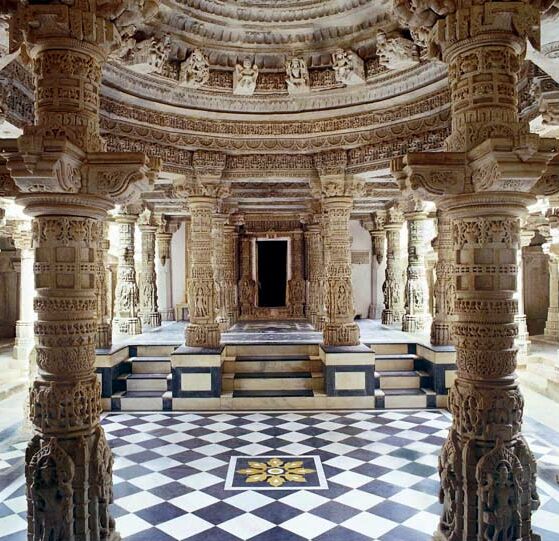
The temples have an opulent entranceway, the simplicity in architecture reflecting Jain values like honesty and frugality. The ornamental detail spreading over the minutely carved ceilings, doorways, pillars, and panels is considered to be remarkable. It is said that workmen were paid in gold according to the weight of marble powder scraped off.
The temple complex is in the midst of a range of forested hills. There are five temples in all, each with its own unique identity. All the five temples are enclosed within a single high walled compound. The group is named after the small village of Dilwara or Delvara in which they are located. The five temples are:
Among the five marble temples of Dilwara, the most famous are the Vimal Vasahi and the Luna Vasahi temples. Dilwara Temples along with Ashtapad, Girnar, Shatrunjaya and Shikharji are known as Śvētāmbara Pancha Tirth (five principal pilgrimage shrine).
The Adinatha or Vimala Vasahi Temple is carved entirely out of white marble and was mostly built in 1026 by Vimal Shah, a minister of Bhima I, the Chaulukya king of Gujarat. The outer mandapa is an addition of the next century. The temple is dedicated to Rishabhanatha. The temple stands in an open courtyard surrounded by a corridor, which has numerous cells containing smaller idols of the tirthankaras. The richly carved corridors, pillars, arches, and 'mandaps' or porticoes of the temple are simply amazing.
The ceilings feature engraved designs of lotus-buds, petals, flowers and scenes from Jain mythology. The figures of animal life, life journey from dream to incarnation of tirthankars are carved. There are 59 devakulikas (small shrine) facing the main image of Rishabhanatha. There are 7 additional cells are found, 1 cell houses image of Ambika and 2 cells of Munisuvrata. The mulnayak idol of Rishabhanatha is carved with attendant deities and images of 4 tirthankaras, giving the idol name Saparikar Panchtirthi. The principal shrine was originally surrounded by 24 sub-shrines but later 74 shub-shrines were added in the 12th century.
Hub AI
Dilwara Temples AI simulator
(@Dilwara Temples_simulator)
Dilwara Temples
The Delwada Temples or Delvada Temples are a group of Śvētāmbara Jain temples located about 2+1⁄2 kilometres from the Mount Abu settlement in Sirohi District, Rajasthan's only hill station. The earliest were built by Vimal Shah , a Jain minister of Solanki king of Gurjaratra , Bhima I and additions to the temples were made by Vastupala, Jain minister of Vaghelas of Gurjaratra. They date between the 11th and 16th centuries, forming some of the most famous monuments in the style of Solanki architecture, famous for their use of a very pure white marble and intricate marble carvings. They are managed by Seth Shri Kalyanji Anandji Pedhi, Sirohi and are a pilgrimage place for Jains, and a significant general tourist attraction. The Dilwara temples are regarded as the most impressive among Jain temples in Rajasthan.
The five Dilwara temples are among the most famous Jain temples. The Vimal Vasahi is much the earliest, constructed by 1031, with the Luna Vasahi by 1230, and the others at intervals between 1459 and 1582. All are in white marble which adds greatly to their effect and remains in use. The oldest and largest two have large amounts of intricate carving even by the standards of the style, reaching a peak in the Luna Vasahi temple. The main buildings of the first three named are surrounded by "cloister" screens of devakulikā shrines, and are fairly plain on the outer walls of these; in the case of the Vimal Vasahi this screen was a later addition, around the time of the second temple. These three have an axis from the sanctuary through a closed, then an open mandapa to an open rangamandapa, or larger hall for dance or drama. Surrounding the main temple with a curtain of shrines was to become a distinctive feature of the Jain temples of West India, still employed in some modern temples.
In later temples in the Māru-Gurjara style, a very pure white marble like that at Dilwara came to be regarded as highly desirable, even essential. In modern times, when the style has become popular in other regions of India, and with Hindu and Jain communities in other countries, local Rajastani marble is often carved and transported to the new building.
The temples have an opulent entranceway, the simplicity in architecture reflecting Jain values like honesty and frugality. The ornamental detail spreading over the minutely carved ceilings, doorways, pillars, and panels is considered to be remarkable. It is said that workmen were paid in gold according to the weight of marble powder scraped off.
The temple complex is in the midst of a range of forested hills. There are five temples in all, each with its own unique identity. All the five temples are enclosed within a single high walled compound. The group is named after the small village of Dilwara or Delvara in which they are located. The five temples are:
Among the five marble temples of Dilwara, the most famous are the Vimal Vasahi and the Luna Vasahi temples. Dilwara Temples along with Ashtapad, Girnar, Shatrunjaya and Shikharji are known as Śvētāmbara Pancha Tirth (five principal pilgrimage shrine).
The Adinatha or Vimala Vasahi Temple is carved entirely out of white marble and was mostly built in 1026 by Vimal Shah, a minister of Bhima I, the Chaulukya king of Gujarat. The outer mandapa is an addition of the next century. The temple is dedicated to Rishabhanatha. The temple stands in an open courtyard surrounded by a corridor, which has numerous cells containing smaller idols of the tirthankaras. The richly carved corridors, pillars, arches, and 'mandaps' or porticoes of the temple are simply amazing.
The ceilings feature engraved designs of lotus-buds, petals, flowers and scenes from Jain mythology. The figures of animal life, life journey from dream to incarnation of tirthankars are carved. There are 59 devakulikas (small shrine) facing the main image of Rishabhanatha. There are 7 additional cells are found, 1 cell houses image of Ambika and 2 cells of Munisuvrata. The mulnayak idol of Rishabhanatha is carved with attendant deities and images of 4 tirthankaras, giving the idol name Saparikar Panchtirthi. The principal shrine was originally surrounded by 24 sub-shrines but later 74 shub-shrines were added in the 12th century.
Recent media