
Recent from talks
Ding (vessel)
Knowledge base stats:
Talk channels stats:
Members stats:
Ding (vessel)
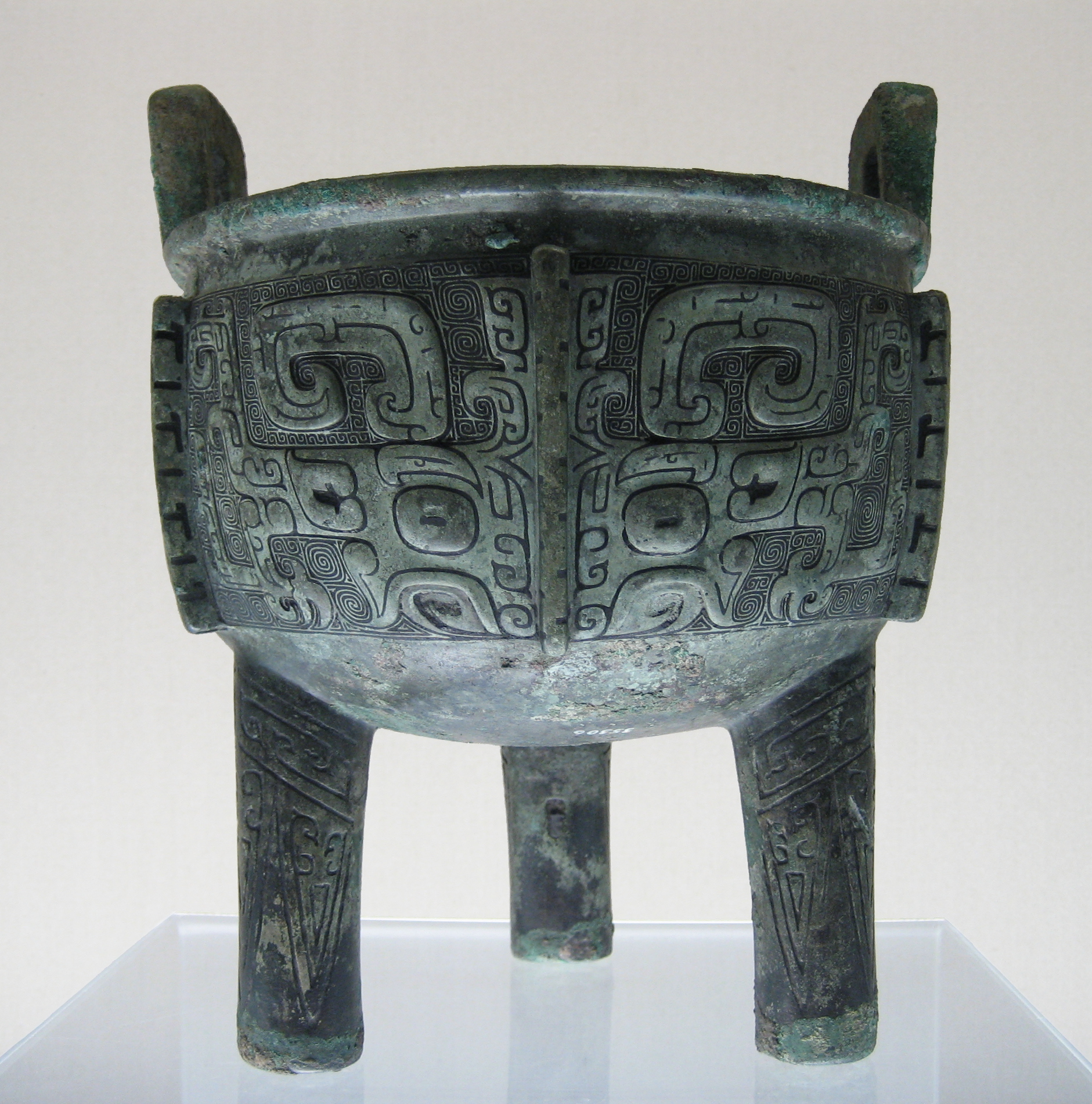
Ding (Chinese: 鼎; pinyin: dǐng) are prehistoric and ancient Chinese cauldrons standing upon legs with a lid and two facing handles. They are one of the most important shapes used in Chinese ritual bronzes. They were made in two shapes: round vessels with three legs and rectangular ones with four, the latter often called fāng dǐng (方鼎; 'square ding'). They were used for cooking, storage, and ritual offerings to the gods or to ancestors.
The earliest recovered examples are ceramic tripods from the Neolithic Peiligang culture, but they are better known from the Chinese Bronze Age, particularly after the Zhou deemphasized the ritual use of huangjiu alcohol practiced by the Shang kings. Under the Zhou, the ding and the privilege to perform the associated rituals became symbols of authority. The number of permitted ding varied according to one's rank in the Chinese nobility: the Nine Ding of the Zhou kings were a symbol of their rule over all China but were lost by the first emperor, Shi Huangdi in the late 3rd century BCE. Subsequently, imperial authority was represented by the Heirloom Seal of the Realm, carved out of the sacred Heshibi; it was lost at some point during the Five Dynasties after the collapse of the Tang.
In Chinese history and culture, possession of one or more ancient ding is often associated with power and dominion over the land. Therefore, the ding is often used as an implicit symbolism for power. The term "inquiring of the ding" (問鼎; wèn dǐng) is often used interchangeably with the quest for power.
In the early Bronze Age of China, the use of wine and food vessels served a religious purpose. While ding were the most important food vessels, wine vessels were the more prominent ritual bronzes of this time, likely due to the belief in Shamanism and spirit worship. Ding were used to make ritual sacrifices, both human and animal, to ancestors. They varied in size, but were generally quite large, indicating that whole animals were likely sacrificed. The sacrifices were meant to appease ancestors due to the Shang belief that spirits had the capability to affect the world of the living. If the ancestors were happy, the living would be blessed with good fortune.
During the early Western Zhou dynasty, the people underwent a political and cultural change. King Wu of Zhou believed that the Shang people were drunkards. He believed that their over-consumption of wine led their king to lose the Mandate of Heaven, thus leading to the downfall of the Shang dynasty. Because of this belief, food vessels (and ding in particular) replaced wine vessels in importance. Bronze vessels underwent what has been called the "Ritual Revolution". This theory suggests that because there was a change in decor as well as the types and variations of vessels found in tombs, their function shifted from solely religious to a more secular one. Instead of sacrificing food to appease ancestors, the Zhou used ding to show off the status of the deceased to both the living and spirits. Ding symbolized status. For example, emperors were buried with nine ding, feudal lords with seven, ministers with five, and scholar-bureaucrats with three or one. The vessels served as symbols of authority for the elite far into the Warring States period.
Like other ritual bronze shapes, the ding was originally an ordinary ceramic cooking, serving and storage vessel, dating back to the Chinese Neolithic, and ceramic dings continued to be used during and after the period when ceremonial bronze versions were made. From the time of the Shang dynasty in the 2nd millennium BCE, dings were also cast in bronze as high-status "ritual bronzes", which were often buried in the tomb of their owners for use in the afterlife. This is the period to which the oldest examples of bronze dings date. Inscriptions found on dings and zhongs are used to study bronzeware script.
The most commonly believed bronze vessel casting process of ancient Chinese vessels is the piece mold process. In this process, a model of the finished vessel, complete with décor, is made of clay and left to harden. Next, a negative of this is made by adding a layer of wet clay to the completed model and allowed to harden to the point where it can still be cut away from it. The model would then be shaved down to form the core, which would eventually become the empty interior of the completed vessel. In the final step, the negative layer was replaced around the core; these were held apart by small bronze and copper pieces called chaplets until the molten bronze could be poured into the opening and fill the empty space between the two layers. When the bronze had cooled, the clay would be broken away from the vessel and the process was complete.
A newer variation on the piece mold process was put forth as a way to explain asymmetrical faces on vessels which, as a rule, should be symmetrical. It was proposed that décor was not made on a model and then transferred to the outer mold layer, but that the décor was carved into and built up on the outer, shell layer as the first step. Décor was added in a variety of ways. The first was by simply carving and incising lines into the clay mold layer. The second was to stamp or press an image, inscription, or design into the wet clay. The third was a technique called tube lining. In this technique, soft, liquid clay would be put into a leather bag and piped onto a surface through some kind of very fine tube made of metal or bone. This technique would have been quite intensive, as it was difficult to maintain constant pressure on the bag, which was needed to create even lines; however, because of certain types of décor, such as thunder or quill patterns, this would have been the most likely technique used to create low relief design in this process.
Hub AI
Ding (vessel) AI simulator
(@Ding (vessel)_simulator)
Ding (vessel)
Ding (Chinese: 鼎; pinyin: dǐng) are prehistoric and ancient Chinese cauldrons standing upon legs with a lid and two facing handles. They are one of the most important shapes used in Chinese ritual bronzes. They were made in two shapes: round vessels with three legs and rectangular ones with four, the latter often called fāng dǐng (方鼎; 'square ding'). They were used for cooking, storage, and ritual offerings to the gods or to ancestors.
The earliest recovered examples are ceramic tripods from the Neolithic Peiligang culture, but they are better known from the Chinese Bronze Age, particularly after the Zhou deemphasized the ritual use of huangjiu alcohol practiced by the Shang kings. Under the Zhou, the ding and the privilege to perform the associated rituals became symbols of authority. The number of permitted ding varied according to one's rank in the Chinese nobility: the Nine Ding of the Zhou kings were a symbol of their rule over all China but were lost by the first emperor, Shi Huangdi in the late 3rd century BCE. Subsequently, imperial authority was represented by the Heirloom Seal of the Realm, carved out of the sacred Heshibi; it was lost at some point during the Five Dynasties after the collapse of the Tang.
In Chinese history and culture, possession of one or more ancient ding is often associated with power and dominion over the land. Therefore, the ding is often used as an implicit symbolism for power. The term "inquiring of the ding" (問鼎; wèn dǐng) is often used interchangeably with the quest for power.
In the early Bronze Age of China, the use of wine and food vessels served a religious purpose. While ding were the most important food vessels, wine vessels were the more prominent ritual bronzes of this time, likely due to the belief in Shamanism and spirit worship. Ding were used to make ritual sacrifices, both human and animal, to ancestors. They varied in size, but were generally quite large, indicating that whole animals were likely sacrificed. The sacrifices were meant to appease ancestors due to the Shang belief that spirits had the capability to affect the world of the living. If the ancestors were happy, the living would be blessed with good fortune.
During the early Western Zhou dynasty, the people underwent a political and cultural change. King Wu of Zhou believed that the Shang people were drunkards. He believed that their over-consumption of wine led their king to lose the Mandate of Heaven, thus leading to the downfall of the Shang dynasty. Because of this belief, food vessels (and ding in particular) replaced wine vessels in importance. Bronze vessels underwent what has been called the "Ritual Revolution". This theory suggests that because there was a change in decor as well as the types and variations of vessels found in tombs, their function shifted from solely religious to a more secular one. Instead of sacrificing food to appease ancestors, the Zhou used ding to show off the status of the deceased to both the living and spirits. Ding symbolized status. For example, emperors were buried with nine ding, feudal lords with seven, ministers with five, and scholar-bureaucrats with three or one. The vessels served as symbols of authority for the elite far into the Warring States period.
Like other ritual bronze shapes, the ding was originally an ordinary ceramic cooking, serving and storage vessel, dating back to the Chinese Neolithic, and ceramic dings continued to be used during and after the period when ceremonial bronze versions were made. From the time of the Shang dynasty in the 2nd millennium BCE, dings were also cast in bronze as high-status "ritual bronzes", which were often buried in the tomb of their owners for use in the afterlife. This is the period to which the oldest examples of bronze dings date. Inscriptions found on dings and zhongs are used to study bronzeware script.
The most commonly believed bronze vessel casting process of ancient Chinese vessels is the piece mold process. In this process, a model of the finished vessel, complete with décor, is made of clay and left to harden. Next, a negative of this is made by adding a layer of wet clay to the completed model and allowed to harden to the point where it can still be cut away from it. The model would then be shaved down to form the core, which would eventually become the empty interior of the completed vessel. In the final step, the negative layer was replaced around the core; these were held apart by small bronze and copper pieces called chaplets until the molten bronze could be poured into the opening and fill the empty space between the two layers. When the bronze had cooled, the clay would be broken away from the vessel and the process was complete.
A newer variation on the piece mold process was put forth as a way to explain asymmetrical faces on vessels which, as a rule, should be symmetrical. It was proposed that décor was not made on a model and then transferred to the outer mold layer, but that the décor was carved into and built up on the outer, shell layer as the first step. Décor was added in a variety of ways. The first was by simply carving and incising lines into the clay mold layer. The second was to stamp or press an image, inscription, or design into the wet clay. The third was a technique called tube lining. In this technique, soft, liquid clay would be put into a leather bag and piped onto a surface through some kind of very fine tube made of metal or bone. This technique would have been quite intensive, as it was difficult to maintain constant pressure on the bag, which was needed to create even lines; however, because of certain types of décor, such as thunder or quill patterns, this would have been the most likely technique used to create low relief design in this process.
Recent media