
Recent from talks
Dinghy racing
Knowledge base stats:
Talk channels stats:
Members stats:
Dinghy racing
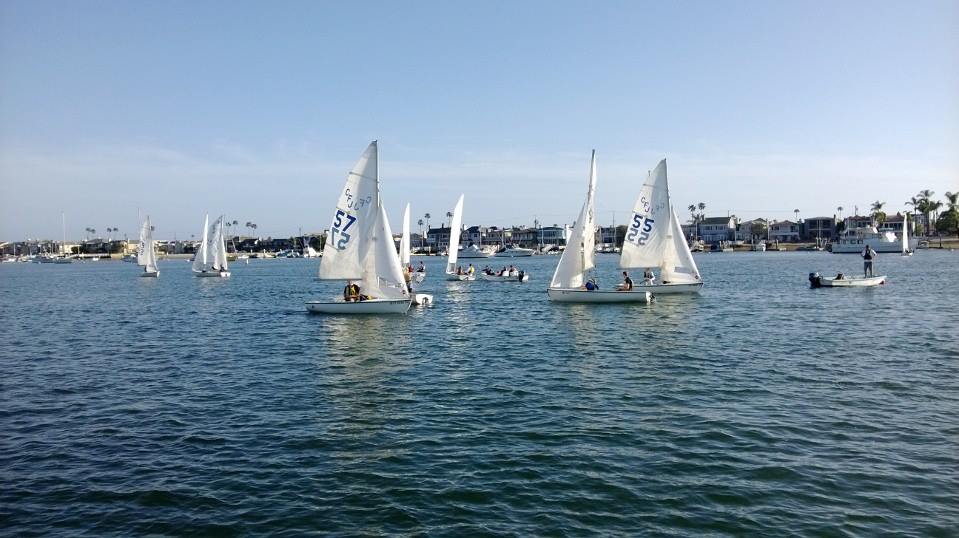
Dinghy racing is a competitive sport using dinghies, which are small boats which may be rowboats, have an outboard motor, or be sailing dinghies. Dinghy racing has affected aspects of the modern sailing dinghy, including hull design, sail materials and sailplan, and techniques such as planing and trapezing.
Dinghy racing comes under the auspices of World Sailing. Organisations such as the Royal Yachting Association, National School Sailing Association (UK) and Canadian Yachting Association (Canada) organise and regulate the sport at a national level. Sailing dinghies compete on an international, national, state, association, club and class basis, using the ISAF International Racing Rules of Sailing, which are revised every four years. There are several courses used, such as the Olympic triangle.
The International Association for Disabled Sailing (IFDS) is the body authorized by ISAF to be responsible for disabled sailing worldwide. IFDS works with yachting associations worldwide to run regional events all the way to the Paralympic Games, as well as adapt ISAF Racing Rules of Sailing to meet disability requirements. Many standard boats are suitable for people with disabilities which can be made more accessible by adaptations. More boats are being designed with disabled people in mind and used regularly around the world by people with disabilities.
Dinghies often race around a windward-leeward racecourse. There is a start/finish "line", set up perpendicular to the wind, marked by a committee boat at one end, and a buoy on the other. After the starting signal, competitors are allowed to cross the line and begin to race to the next mark. The next mark is called the windward mark. The windward mark is placed directly upwind from the start/finish line. Competitors must round the mark going counterclockwise, leaving the mark on the port side of the boat. After rounding the windward mark, the fleet now heads towards the leeward mark. The leeward mark is positioned directly downwind from the windward mark, below the start/finish line. Sailors also round this mark counterclockwise. After rounding, competitors head upwind to cross the finish line. The course may require more than one lap around the marks.
Not all courses are windward-leeward. Variations include triangles, offset marks, gates, and rectangles. Sometimes the finish is to leeward instead of to windward.
In Bermuda, the Bermuda rig, now almost universal on small sailing vessels, can still be seen in its purest form in the Bermuda Fitted Dinghy, used for a series of races contested each year by the colony's yacht clubs. The first race of this type was held in 1880, as a way of reducing the costs then experienced racing larger Bermudian sloops, with their similarly larger professional crews. BFD racing was restricted to amateurs, although each dinghy carries a crew of six.
Most racing dinghies can be classified as being either single-handed (one person only) such as the Laser, RS Vareo or double-handed, such as the 470, 505, Heron, Tasar, Flying Junior, International Fireball or the International Fourteen. A few classes of dinghy carry more than two crew whilst racing, typically heavier dayboat types, but also a couple of high-performance, Australian-origin skiff-type dinghies. Some classes allow children to sail double handed until a particular age and then require them to compete single-handed. Some double-handed boats are ideal for an adult and child like the Heron, while some such as the Tasar have weight restrictions which ensure they are sailed competitively by two adults or near-adults. Weight equalisation is also used on certain high-performance classes to ensure that comparative levels of performance are attained.
Sailing dinghies can be strict one-design, with virtually no difference between boats and strict rules controlling construction. This allows the competition to be more about sailing ability than about who can afford the newest innovation, although the weight of the boat and sail age and quality may be differentiating factors even in strict one-design classes.
Hub AI
Dinghy racing AI simulator
(@Dinghy racing_simulator)
Dinghy racing
Dinghy racing is a competitive sport using dinghies, which are small boats which may be rowboats, have an outboard motor, or be sailing dinghies. Dinghy racing has affected aspects of the modern sailing dinghy, including hull design, sail materials and sailplan, and techniques such as planing and trapezing.
Dinghy racing comes under the auspices of World Sailing. Organisations such as the Royal Yachting Association, National School Sailing Association (UK) and Canadian Yachting Association (Canada) organise and regulate the sport at a national level. Sailing dinghies compete on an international, national, state, association, club and class basis, using the ISAF International Racing Rules of Sailing, which are revised every four years. There are several courses used, such as the Olympic triangle.
The International Association for Disabled Sailing (IFDS) is the body authorized by ISAF to be responsible for disabled sailing worldwide. IFDS works with yachting associations worldwide to run regional events all the way to the Paralympic Games, as well as adapt ISAF Racing Rules of Sailing to meet disability requirements. Many standard boats are suitable for people with disabilities which can be made more accessible by adaptations. More boats are being designed with disabled people in mind and used regularly around the world by people with disabilities.
Dinghies often race around a windward-leeward racecourse. There is a start/finish "line", set up perpendicular to the wind, marked by a committee boat at one end, and a buoy on the other. After the starting signal, competitors are allowed to cross the line and begin to race to the next mark. The next mark is called the windward mark. The windward mark is placed directly upwind from the start/finish line. Competitors must round the mark going counterclockwise, leaving the mark on the port side of the boat. After rounding the windward mark, the fleet now heads towards the leeward mark. The leeward mark is positioned directly downwind from the windward mark, below the start/finish line. Sailors also round this mark counterclockwise. After rounding, competitors head upwind to cross the finish line. The course may require more than one lap around the marks.
Not all courses are windward-leeward. Variations include triangles, offset marks, gates, and rectangles. Sometimes the finish is to leeward instead of to windward.
In Bermuda, the Bermuda rig, now almost universal on small sailing vessels, can still be seen in its purest form in the Bermuda Fitted Dinghy, used for a series of races contested each year by the colony's yacht clubs. The first race of this type was held in 1880, as a way of reducing the costs then experienced racing larger Bermudian sloops, with their similarly larger professional crews. BFD racing was restricted to amateurs, although each dinghy carries a crew of six.
Most racing dinghies can be classified as being either single-handed (one person only) such as the Laser, RS Vareo or double-handed, such as the 470, 505, Heron, Tasar, Flying Junior, International Fireball or the International Fourteen. A few classes of dinghy carry more than two crew whilst racing, typically heavier dayboat types, but also a couple of high-performance, Australian-origin skiff-type dinghies. Some classes allow children to sail double handed until a particular age and then require them to compete single-handed. Some double-handed boats are ideal for an adult and child like the Heron, while some such as the Tasar have weight restrictions which ensure they are sailed competitively by two adults or near-adults. Weight equalisation is also used on certain high-performance classes to ensure that comparative levels of performance are attained.
Sailing dinghies can be strict one-design, with virtually no difference between boats and strict rules controlling construction. This allows the competition to be more about sailing ability than about who can afford the newest innovation, although the weight of the boat and sail age and quality may be differentiating factors even in strict one-design classes.
Recent media