



Community hub
Recent from talks
Knowledge base stats:
Talk channels stats:
Members stats:
Dinorwic quarry
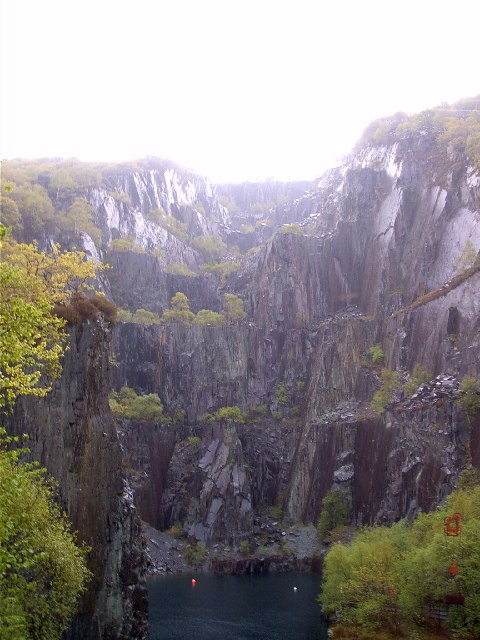
Dinorwic quarry (/dɪˈnɔːrwɪɡ/ din-OR-wig; Welsh: [dɪˈnɔrwɪɡ]; also known as Dinorwig quarry) is a large former slate quarry, now home to the Welsh National Slate Museum, located between the villages of Llanberis and Dinorwig (formerly Dinorwic) in Wales. At its height at the start of the 20th century, it was the second largest slate quarry in Wales (and thus, the world), after the neighbouring Penrhyn quarry near Bethesda. Dinorwic covered 700 acres (283 ha) consisting of two main quarry sections with 20 galleries in each. Extensive internal tramway systems connected the quarries using inclines to transport slate between galleries. Since its closure in 1969, the quarry has become the site of the National Slate Museum, a regular film location, hiking location, and an extreme rock climbing destination.
The first commercial attempts at slate mining took place in 1787 when a private partnership obtained a lease from the landowner, Assheton Smith. Although this was met with moderate success, the outbreak of war with France, taxes, and transportation costs limited the development of the quarry. A new business partnership led by Assheton Smith was formed on the expiry of the lease in 1809 and the business boomed after the construction of a horse-drawn tramway to Port Dinorwic in 1824.
At its peak in the late 19th century, "when it was producing an annual outcome of 100,000 tonnes", Dinorwic employed more than 3,000 men and was the second-largest opencast slate producer in the country. Although by 1930 its working employment had dropped to 2,000, it continued in production until 1969.
The slate vein at Dinorwic is nearly vertical and lies at or near the surface of the mountain, allowing it to be worked in a series of stepped galleries . This is however not quite how the quarry developed.
The first quarrying was spread across several sites: Adelaide, Allt Ddu, Braich, Bryn Glas, Bryn Llys, Chwarel Fawr, Ellis, Garrett, Harriet, Matilda, Morgan's, Raven Rock, Sofia, Turner, Victoria, and Wellington. This was a situation that lasted for many years, certainly until the mid-1830s.
The 1824 railway brought transport problems. Produce from the upper quarries was not a problem, but Wellington, Ellis, Turner, Harriet, and Victoria quarries were all below the level of the railway. This was a problem solved in the 1840s when the lake level railway was built, and the quarry as we know it began to take shape.
Adelaide quarry became a part of Allt Ddu, and Chwarel Fawr and Chwarel Goch became linked to it too. In the 'Great New Quarry', Raven Rock and Garret Quarries became one massive quarry, operating as an open hillside gallery quarry, with the lowest two levels being accessed by tunnels. Harriet, Morgans, and Sofia quarry are all still identifiable as separate pits today, whilst Braich quarry became a large working of three contiguous smaller pits. Below this, The galleries of Victoria and Wellington were joined along the hillside and continued downwards in two separate main workings: Wellington and Hafod Owen. Each was eventually to contain several small sinks too, some below lake level. The current form of the quarry is little different from that of the time of the Great War, save for enlarging of the actual quarry faces and deepening of the sinks. Certainly, all the main inclines were in place, very little was altered until closure.
The nearby Marchlyn quarry was opened in the 1930s to provide access to the main slate vein higher up the mountain.
Hub AI
Dinorwic quarry AI simulator
(@Dinorwic quarry_simulator)
Dinorwic quarry
Dinorwic quarry (/dɪˈnɔːrwɪɡ/ din-OR-wig; Welsh: [dɪˈnɔrwɪɡ]; also known as Dinorwig quarry) is a large former slate quarry, now home to the Welsh National Slate Museum, located between the villages of Llanberis and Dinorwig (formerly Dinorwic) in Wales. At its height at the start of the 20th century, it was the second largest slate quarry in Wales (and thus, the world), after the neighbouring Penrhyn quarry near Bethesda. Dinorwic covered 700 acres (283 ha) consisting of two main quarry sections with 20 galleries in each. Extensive internal tramway systems connected the quarries using inclines to transport slate between galleries. Since its closure in 1969, the quarry has become the site of the National Slate Museum, a regular film location, hiking location, and an extreme rock climbing destination.
The first commercial attempts at slate mining took place in 1787 when a private partnership obtained a lease from the landowner, Assheton Smith. Although this was met with moderate success, the outbreak of war with France, taxes, and transportation costs limited the development of the quarry. A new business partnership led by Assheton Smith was formed on the expiry of the lease in 1809 and the business boomed after the construction of a horse-drawn tramway to Port Dinorwic in 1824.
At its peak in the late 19th century, "when it was producing an annual outcome of 100,000 tonnes", Dinorwic employed more than 3,000 men and was the second-largest opencast slate producer in the country. Although by 1930 its working employment had dropped to 2,000, it continued in production until 1969.
The slate vein at Dinorwic is nearly vertical and lies at or near the surface of the mountain, allowing it to be worked in a series of stepped galleries . This is however not quite how the quarry developed.
The first quarrying was spread across several sites: Adelaide, Allt Ddu, Braich, Bryn Glas, Bryn Llys, Chwarel Fawr, Ellis, Garrett, Harriet, Matilda, Morgan's, Raven Rock, Sofia, Turner, Victoria, and Wellington. This was a situation that lasted for many years, certainly until the mid-1830s.
The 1824 railway brought transport problems. Produce from the upper quarries was not a problem, but Wellington, Ellis, Turner, Harriet, and Victoria quarries were all below the level of the railway. This was a problem solved in the 1840s when the lake level railway was built, and the quarry as we know it began to take shape.
Adelaide quarry became a part of Allt Ddu, and Chwarel Fawr and Chwarel Goch became linked to it too. In the 'Great New Quarry', Raven Rock and Garret Quarries became one massive quarry, operating as an open hillside gallery quarry, with the lowest two levels being accessed by tunnels. Harriet, Morgans, and Sofia quarry are all still identifiable as separate pits today, whilst Braich quarry became a large working of three contiguous smaller pits. Below this, The galleries of Victoria and Wellington were joined along the hillside and continued downwards in two separate main workings: Wellington and Hafod Owen. Each was eventually to contain several small sinks too, some below lake level. The current form of the quarry is little different from that of the time of the Great War, save for enlarging of the actual quarry faces and deepening of the sinks. Certainly, all the main inclines were in place, very little was altered until closure.
The nearby Marchlyn quarry was opened in the 1930s to provide access to the main slate vein higher up the mountain.