Hubbry Logo
Diomira JacobiniDiomira JacobiniMain
Open search
Diomira Jacobini
Community hub
Diomira Jacobini
logo
8 pages, 0 posts
0 subscribers
Be the first to start a discussion here.
Diomira Jacobini
Diomira Jacobini
from Wikipedia

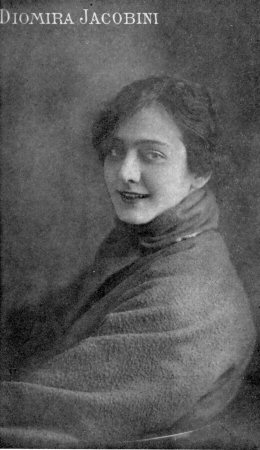
Diomira Jacobini (25 May 1899 – 13 September 1959) was an Italian film actress of the silent era.[1] She was the younger sister of actress Maria Jacobini.

Key Information

Selected filmography

[edit]

References

[edit]

Bibliography

[edit]
[edit]
Revisions and contributorsEdit on WikipediaRead on Wikipedia
from Grokipedia
Diomira Jacobini (25 May 1899 – 13 September 1959) was an Italian film actress known for her work in the silent era of Italian cinema. As the younger sister of actress Maria Jacobini, she emerged as a notable performer in her own right, appearing in numerous films between 1913 and 1933. Born in Rome, Jacobini began her screen career in the early days of Italian silent film and built a reputation through roles in dramatic, adventure, and period productions, sometimes stepping out from the shadow of her more celebrated sibling. Her work included appearances in popular series and standalone features, contributing to the vibrant landscape of Italy's pre-sound cinema before transitioning to a few early talkies. She remained active until the early 1930s, leaving a legacy tied to the golden age of Italian silent films.

Early life

Birth and family

Diomira Jacobini was born on 25 May 1899 in Rome, Lazio, Italy. She was the younger sister of Maria Jacobini, a well-known Italian actress of the silent film era who was born in Rome in February 1892. The Jacobini family had deep Roman origins and ecclesiastical connections, with the sisters being nieces of Cardinal Jacobini, a high-ranking Vatican official who served as minister of state to Pope Leo XIII. This family background placed them within Rome's cultural and institutional circles, though little is documented about Diomira's specific early experiences or influences prior to her entry into film.

Film career

Early silent roles (1913–1919)

Diomira Jacobini had early film appearances in short films by 1913, including The Miser's Millions and Le birichinate di Kri Kri e Diomira (also known as Bloomer and Diomira at Play). She entered more prominent work in 1915 at the prestigious Cines studio in Rome, appearing as an extra in La marcia nuziale, directed by Carmine Gallone. That same year, she secured her first leading role in Il piccolo mozzo, also directed by Gallone, marking her transition to more significant positions in Italian silent cinema. Following her sister's established career, Jacobini moved to Celio Film and appeared alongside Maria Jacobini and Leda Gys in Ananka, directed by Nino Oxilia in 1915. She then joined Tiber Film, where she collaborated frequently with director Emilio Ghione on several productions, including La rosa di Granata (1916), Tormento gentile (1916), and Il figlio dell'amore (1916). Her career gained momentum in 1917 with the success of Demonietto, directed by Gennaro Righelli and co-starring Alberto Collo, who became a recurring collaborator. Jacobini worked repeatedly with directors Gennaro Righelli, Baldassarre Negroni, and Emilio Ghione during this period, appearing in films such as L'ombra che passa (1917, Righelli), L'aigrette (1917, Negroni), and La via della luce (1917, Negroni). The late 1910s reflected the high productivity typical of Italian silent film during its boom, with Jacobini featuring in additional titles like Quando tramonta il sole (1918, Righelli) and others under Righelli's direction.

Mid-career silent films (1920–1925)

In the early 1920s, Diomira Jacobini continued her work in Italian silent cinema amid a sharp decline in her output compared to the prolific 1910s. The Italian film industry faced a deep crisis during this period, producing far fewer films and prompting many leading actors and directors to seek opportunities abroad. Despite these challenges, Jacobini appeared in several notable productions, successfully showcasing her talents in key roles. She collaborated with director Luciano Doria on La rosa di Fortunio (1922), where she played Mirella di San Florio. Jacobini also worked with Mario Camerini on Jolly, clown da circo (1923) and La casa dei pulcini (1924), the latter featuring her as an institutrice alongside Amleto Novelli. In 1924, she starred opposite the popular strongman Bartolomeo Pagano in the action film Maciste e il nipote d'America, directed by Eleuterio Rodolfi. She additionally collaborated with Amleto Palermi on titles such as My Little Dog (1923) and International gran prix (1924). This mid-career phase reflected a shift toward fewer but still significant contributions to Italian silent film.

International work and later silent roles (1925–1929)

In the late silent era, Diomira Jacobini expanded her career beyond Italy through international work, primarily in German productions from 1925 to 1929. These appearances reflected the collaborative nature of European cinema during the final years of silent film, as German studios attracted talent from across the continent. Following her domestic successes like Maciste e il nipote d'America (1924), she starred in the German silent film Der Trödler von Amsterdam (also known as Il rigattiere di Amsterdam) in 1925, directed by Victor Janson and co-starring Werner Krauss. She played the role of Annette Bergh in this production. That same year, she appeared in another German silent film, Die vertauschte Braut, in the role of Lilian. In 1928, Jacobini took a leading role in Revolutionshochzeit (also known as Revolutionsbryllup in Danish and The Last Night in English), directed by A. W. Sandberg and produced by Terra Film in Berlin. She portrayed Alaine, appearing alongside Gösta Ekman and Karina Bell. Her later silent work included the German production Don Manuel, der Bandit in 1929, marking one of her final appearances before the widespread transition to sound films. These roles extended her silent career through cross-border opportunities in the declining years of the format.

Sound era appearances and retirement (1930–1933)

Diomira Jacobini's involvement in the sound era was brief and limited compared to her extensive silent film career. She appeared in only two Italian sound films between 1930 and 1933 before retiring from acting. In 1932, she starred in the comedy L'ultima avventura, directed by Mario Camerini and produced by Cines-Pittaluga. She played opposite Armando Falconi in this early Italian sound production, reuniting with Camerini after several silent collaborations. The following year, she appeared in Cento di questi giorni (1933), co-directed by Mario Camerini and his brother Augusto Camerini. Jacobini portrayed the character Marina in this film, which marked her final screen appearance. After completing Cento di questi giorni, Jacobini retired from the film industry in 1933, concluding her acting career with a notably sparse output in the sound period.

Personal life

Marriage and private years

Diomira Jacobini was married to Luciano Ghezzi. After retiring from acting following her final film appearance in 1933, she led a private life in Rome, Italy, until her death there on 13 September 1959. Publicly available information about her marriage, family life including any children, or other activities during these years remains limited, with few documented details beyond her residence in Rome.

Death

Final years and burial

In her later years, Diomira Jacobini lived a private life in Rome following her retirement from acting in 1933. She died in Rome on 13 September 1959 at the age of 60. Jacobini was buried in the Cimitero Comunale Monumentale Campo Verano (Verano Cemetery) in Rome, in Area XVIII (Altopiano vecchio reparto), Arciconfr. del Preziosissimo sangue di Gesù, column 35, row 10. Her sister Maria Jacobini is interred in the same section at column 35, row 6.
Add your contribution
Related Hubs
User Avatar
No comments yet.