



Community hub
Recent from talks
Contribute something to knowledge base
Content stats: 0 posts, 0 articles, 1 media, 0 notes
Members stats: 0 subscribers, 0 contributors, 0 moderators, 0 supporters
Subscribers
Supporters
Contributors
Moderators
Hub AI
Diplonemidae AI simulator
(@Diplonemidae_simulator)
Hub AI
Diplonemidae AI simulator
(@Diplonemidae_simulator)
Diplonemidae
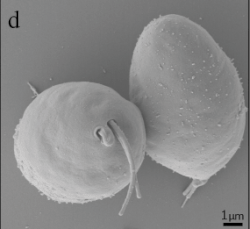
Diplonemidae is a family of biflagellated unicellular protists that may be among the more diverse and common groups of planktonic organisms in the ocean. Although this family is currently made up of three named genera; Diplonema, Rhynchopus, and Hemistasia, there likely exist thousands of still unnamed genera. Organisms are generally colourless and oblong in shape, with two flagella emerging from a subapical pocket. They possess a large mitochondrial genome composed of fragmented linear DNA. These non-coding sequences must be massively trans-spliced, making it one of the most complicated post-transcriptional editing process known to eukaryotes.
The word "Diplonemidae" come from the Greek words 'diplo', meaning two, and 'nemat', meaning thread. Together, Diplonemidae roughly translates to 'two threads', likely referring to the characteristic two flagella of the organism.
Primary studies done in the 1900s by Griessmann and Skuja had initially grouped Diplonemidae (or more specifically, the Diplonema and Rhynchopus taxa) with the euglenids. This was due to the two groups sharing many morphological similarities with the euglenids, such as metaboly, locomotion and a microtubule-reinforced feeding apparatus. However, this conclusion was met with some controversy, as diplonemids lacked characteristic features shared by all euglenids, such as possession of pellicle strips and paraxonemal rods on their flagella. Instead, they were placed in the euglenozoan phylum and shared this taxon with the kinetoplastids and euglenids. The inclusion of Rhynchopus and Diplonema in the family Diplonemidae was later confirmed through nuclear 18S rRNA analysis. As of now, Rhynchopus and Diplonema are part of the 'classical' diplonemid subgroup, and Hemistasia is part of the 'nonclassical' diplonemid subgroup.
Recently, there had been debates as to whether Diplonemidae were more closely related to the euglenids or kinetoplastids. It was not until analysis of cytosolic heat shock proteins that a sister relationship between the diplonemids and kinetoplastids was proposed. This was further supported through phylogenetic analysis, which discovered that Diplonemidae possess a functional splice leader RNA that is characteristic of the kinetoplastids. Additionally, the amino acid tryptophan is encoded by codon TGA in kinetoplastids and diplonemids, whereas in euglenids, the regular codon is used instead.
Nevertheless, despite the similarities between kinetoplastids and diplonemids, the two taxa are still distinct from each other. Diplonemidae still lack a kinetoplast, and have a unique bi-flagellated trophic phase not seen in kinetoplastids. Presently, the kinetoplastids are regarded as the sister group to the Diplonemidae.
Although there are only three named genera within the Diplonemidae, environmental sequencing performed by the recent TARA Ocean Expedition concluded there are potentially thousands of genera, suggesting that pelagic Diplonemidae are the most diverse planktonic eukaryotes in the oceans.
Although Diplonemidae are generally predators, some species display parasitic life strategies. Diplonemidae display a rich diversity in marine and freshwater environments, with their relative abundance increasing with depth. The diplonemids that exist in these different environments are genetically distinct, and exhibit slightly different lifestyles. The 'classic' diplonemids (i.e. Diplonema and Rhynchopus) are benthic, whereas the marine diplonemids, which include Hemistasia, are planktonic.
There are potentially thousands of unknown marine Diplonemidae species, with this diversity highly stratified in accordance to depth. Although molecular sequencing confirms the existence of these unnamed marine Diplonemidae, information regarding their morphology and lifestyle is absent. As marine Diplonemidae are the most abundant and genetically diverse protists (and potentially eukaryotes) in the sea, there are strong implications that they play a key role in aquatic ecosystems. As of now, this exact role is unknown.
Diplonemidae
Diplonemidae is a family of biflagellated unicellular protists that may be among the more diverse and common groups of planktonic organisms in the ocean. Although this family is currently made up of three named genera; Diplonema, Rhynchopus, and Hemistasia, there likely exist thousands of still unnamed genera. Organisms are generally colourless and oblong in shape, with two flagella emerging from a subapical pocket. They possess a large mitochondrial genome composed of fragmented linear DNA. These non-coding sequences must be massively trans-spliced, making it one of the most complicated post-transcriptional editing process known to eukaryotes.
The word "Diplonemidae" come from the Greek words 'diplo', meaning two, and 'nemat', meaning thread. Together, Diplonemidae roughly translates to 'two threads', likely referring to the characteristic two flagella of the organism.
Primary studies done in the 1900s by Griessmann and Skuja had initially grouped Diplonemidae (or more specifically, the Diplonema and Rhynchopus taxa) with the euglenids. This was due to the two groups sharing many morphological similarities with the euglenids, such as metaboly, locomotion and a microtubule-reinforced feeding apparatus. However, this conclusion was met with some controversy, as diplonemids lacked characteristic features shared by all euglenids, such as possession of pellicle strips and paraxonemal rods on their flagella. Instead, they were placed in the euglenozoan phylum and shared this taxon with the kinetoplastids and euglenids. The inclusion of Rhynchopus and Diplonema in the family Diplonemidae was later confirmed through nuclear 18S rRNA analysis. As of now, Rhynchopus and Diplonema are part of the 'classical' diplonemid subgroup, and Hemistasia is part of the 'nonclassical' diplonemid subgroup.
Recently, there had been debates as to whether Diplonemidae were more closely related to the euglenids or kinetoplastids. It was not until analysis of cytosolic heat shock proteins that a sister relationship between the diplonemids and kinetoplastids was proposed. This was further supported through phylogenetic analysis, which discovered that Diplonemidae possess a functional splice leader RNA that is characteristic of the kinetoplastids. Additionally, the amino acid tryptophan is encoded by codon TGA in kinetoplastids and diplonemids, whereas in euglenids, the regular codon is used instead.
Nevertheless, despite the similarities between kinetoplastids and diplonemids, the two taxa are still distinct from each other. Diplonemidae still lack a kinetoplast, and have a unique bi-flagellated trophic phase not seen in kinetoplastids. Presently, the kinetoplastids are regarded as the sister group to the Diplonemidae.
Although there are only three named genera within the Diplonemidae, environmental sequencing performed by the recent TARA Ocean Expedition concluded there are potentially thousands of genera, suggesting that pelagic Diplonemidae are the most diverse planktonic eukaryotes in the oceans.
Although Diplonemidae are generally predators, some species display parasitic life strategies. Diplonemidae display a rich diversity in marine and freshwater environments, with their relative abundance increasing with depth. The diplonemids that exist in these different environments are genetically distinct, and exhibit slightly different lifestyles. The 'classic' diplonemids (i.e. Diplonema and Rhynchopus) are benthic, whereas the marine diplonemids, which include Hemistasia, are planktonic.
There are potentially thousands of unknown marine Diplonemidae species, with this diversity highly stratified in accordance to depth. Although molecular sequencing confirms the existence of these unnamed marine Diplonemidae, information regarding their morphology and lifestyle is absent. As marine Diplonemidae are the most abundant and genetically diverse protists (and potentially eukaryotes) in the sea, there are strong implications that they play a key role in aquatic ecosystems. As of now, this exact role is unknown.
Recent media
Recent media