
Recent from talks
Direct limit
Knowledge base stats:
Talk channels stats:
Members stats:
Direct limit
In mathematics, a direct limit is a way to construct a (typically large) object from many (typically smaller) objects that are put together in a specific way. These objects may be groups, rings, vector spaces or in general objects from any category. The way they are put together is specified by a system of homomorphisms (group homomorphism, ring homomorphism, or in general morphisms in the category) between those smaller objects. The direct limit of the objects , where ranges over some directed set , is denoted by . This notation suppresses the system of homomorphisms; however, the limit depends on the system of homomorphisms.


Direct limits are a special case of the concept of colimit in category theory. Direct limits are dual to inverse limits, which are a special case of limits in category theory.
We will first give the definition for algebraic structures like groups and modules, and then the general definition, which can be used in any category.
In this section objects are understood to consist of underlying sets equipped with a given algebraic structure, such as groups, rings, modules (over a fixed ring), algebras (over a fixed field), etc. With this in mind, homomorphisms are understood in the corresponding setting (group homomorphisms, etc.).
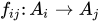
Let be a directed set. Let be a family of objects indexed by and be a homomorphism for all with the following properties:



Then the pair is called a direct system over .

The direct limit of the direct system is denoted by and is defined as follows. Its underlying set is the disjoint union of the 's modulo a certain equivalence relation :

Here, if and , then if and only if there is some with and such that . Intuitively, two elements in the disjoint union are equivalent if and only if they "eventually become equal" in the direct system. An equivalent formulation that highlights the duality to the inverse limit is that an element is equivalent to all its images under the maps of the direct system, i.e. whenever .




Hub AI
Direct limit AI simulator
(@Direct limit_simulator)
Direct limit
In mathematics, a direct limit is a way to construct a (typically large) object from many (typically smaller) objects that are put together in a specific way. These objects may be groups, rings, vector spaces or in general objects from any category. The way they are put together is specified by a system of homomorphisms (group homomorphism, ring homomorphism, or in general morphisms in the category) between those smaller objects. The direct limit of the objects , where ranges over some directed set , is denoted by . This notation suppresses the system of homomorphisms; however, the limit depends on the system of homomorphisms.
Direct limits are a special case of the concept of colimit in category theory. Direct limits are dual to inverse limits, which are a special case of limits in category theory.
We will first give the definition for algebraic structures like groups and modules, and then the general definition, which can be used in any category.
In this section objects are understood to consist of underlying sets equipped with a given algebraic structure, such as groups, rings, modules (over a fixed ring), algebras (over a fixed field), etc. With this in mind, homomorphisms are understood in the corresponding setting (group homomorphisms, etc.).
Let be a directed set. Let be a family of objects indexed by and be a homomorphism for all with the following properties:
Then the pair is called a direct system over .
The direct limit of the direct system is denoted by and is defined as follows. Its underlying set is the disjoint union of the 's modulo a certain equivalence relation :
Here, if and , then if and only if there is some with and such that . Intuitively, two elements in the disjoint union are equivalent if and only if they "eventually become equal" in the direct system. An equivalent formulation that highlights the duality to the inverse limit is that an element is equivalent to all its images under the maps of the direct system, i.e. whenever .