


Community hub
Recent from talks
Contribute something to knowledge base
Content stats: 0 posts, 0 articles, 1 media, 0 notes
Members stats: 0 subscribers, 0 contributors, 0 moderators, 0 supporters
Subscribers
Supporters
Contributors
Moderators
Hub AI
Disc film AI simulator
(@Disc film_simulator)
Hub AI
Disc film AI simulator
(@Disc film_simulator)
Disc film
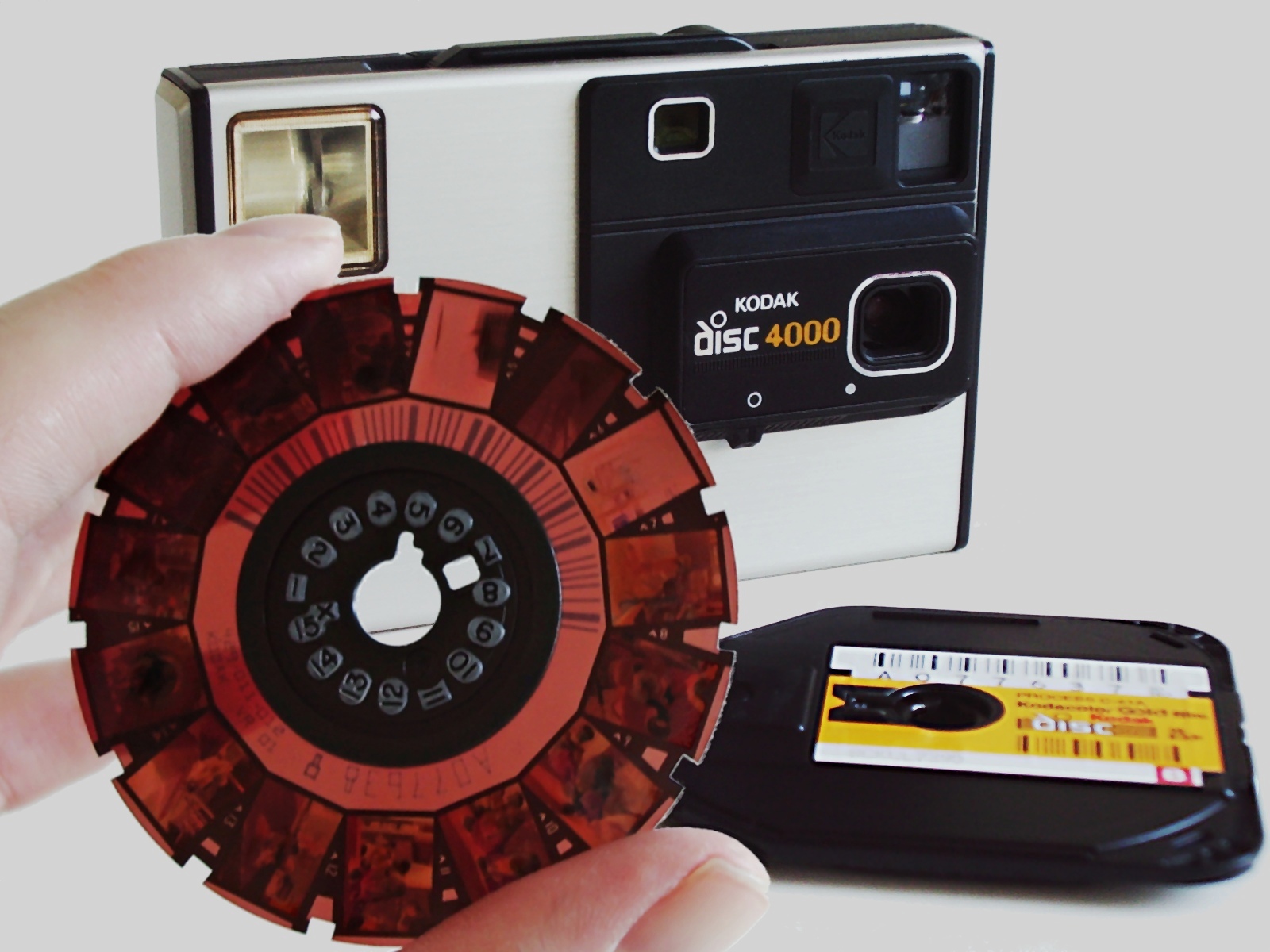
Disc film is a discontinued still-photography film format that was aimed at the consumer market. It was introduced by Kodak in 1982.
The film is in the form of a flat disc, and is fully housed within a plastic cartridge. Each disc holds fifteen 10 × 8 mm exposures, arranged around the outside of the disc, with the disc being rotated 24° between successive images.
The system was a consumer-oriented product, and most cameras are self-contained units with no expansion capability. The disc film allows them to be compact and considerably thinner than other cameras of the time. The cameras are very simple to load and unload, and are generally completely automated. The cassette has a built-in dark slide to prevent stray light reaching the film when the disc is removed.
As the film is rotated on a disc instead of over a spool, the cassette is very thin. The flat nature of the format also led to the potential advantage of greater sharpness over curved spool-based cassette formats (such as Minox film, 110 and 126 film). Disc film has a very thick acetate base, comparable thickness with 4×5" sheet film, which holds the film much flatter than the other formats of the time.
A special '23' demonstration disc was made by Kodak so that dealers could show the camera's features without wasting an actual film.
Disc film did not prove successful, mainly because the image on the negative is 10 mm by 8 mm, leading to generally unacceptable grain and poor definition in the final prints from the analog imaging equipment used at the time. The film was intended to be printed with special six-element lenses from Kodak, but many labs simply printed discs with standard three-element lenses used for larger negative formats.
Kodak also produced a device that could be screwed into a standard enlarger lens mount which contained a negative carrier and a special disc enlarging lens. This is still used by photo finishers in the US.
The resulting prints often disappointed the consumer. Few labs made the investment required to get the best out of the small negative size.
Disc film
Disc film is a discontinued still-photography film format that was aimed at the consumer market. It was introduced by Kodak in 1982.
The film is in the form of a flat disc, and is fully housed within a plastic cartridge. Each disc holds fifteen 10 × 8 mm exposures, arranged around the outside of the disc, with the disc being rotated 24° between successive images.
The system was a consumer-oriented product, and most cameras are self-contained units with no expansion capability. The disc film allows them to be compact and considerably thinner than other cameras of the time. The cameras are very simple to load and unload, and are generally completely automated. The cassette has a built-in dark slide to prevent stray light reaching the film when the disc is removed.
As the film is rotated on a disc instead of over a spool, the cassette is very thin. The flat nature of the format also led to the potential advantage of greater sharpness over curved spool-based cassette formats (such as Minox film, 110 and 126 film). Disc film has a very thick acetate base, comparable thickness with 4×5" sheet film, which holds the film much flatter than the other formats of the time.
A special '23' demonstration disc was made by Kodak so that dealers could show the camera's features without wasting an actual film.
Disc film did not prove successful, mainly because the image on the negative is 10 mm by 8 mm, leading to generally unacceptable grain and poor definition in the final prints from the analog imaging equipment used at the time. The film was intended to be printed with special six-element lenses from Kodak, but many labs simply printed discs with standard three-element lenses used for larger negative formats.
Kodak also produced a device that could be screwed into a standard enlarger lens mount which contained a negative carrier and a special disc enlarging lens. This is still used by photo finishers in the US.
The resulting prints often disappointed the consumer. Few labs made the investment required to get the best out of the small negative size.
Recent media
Recent media