
Recent from talks
Dissolution of Austria-Hungary
Knowledge base stats:
Talk channels stats:
Members stats:
Dissolution of Austria-Hungary
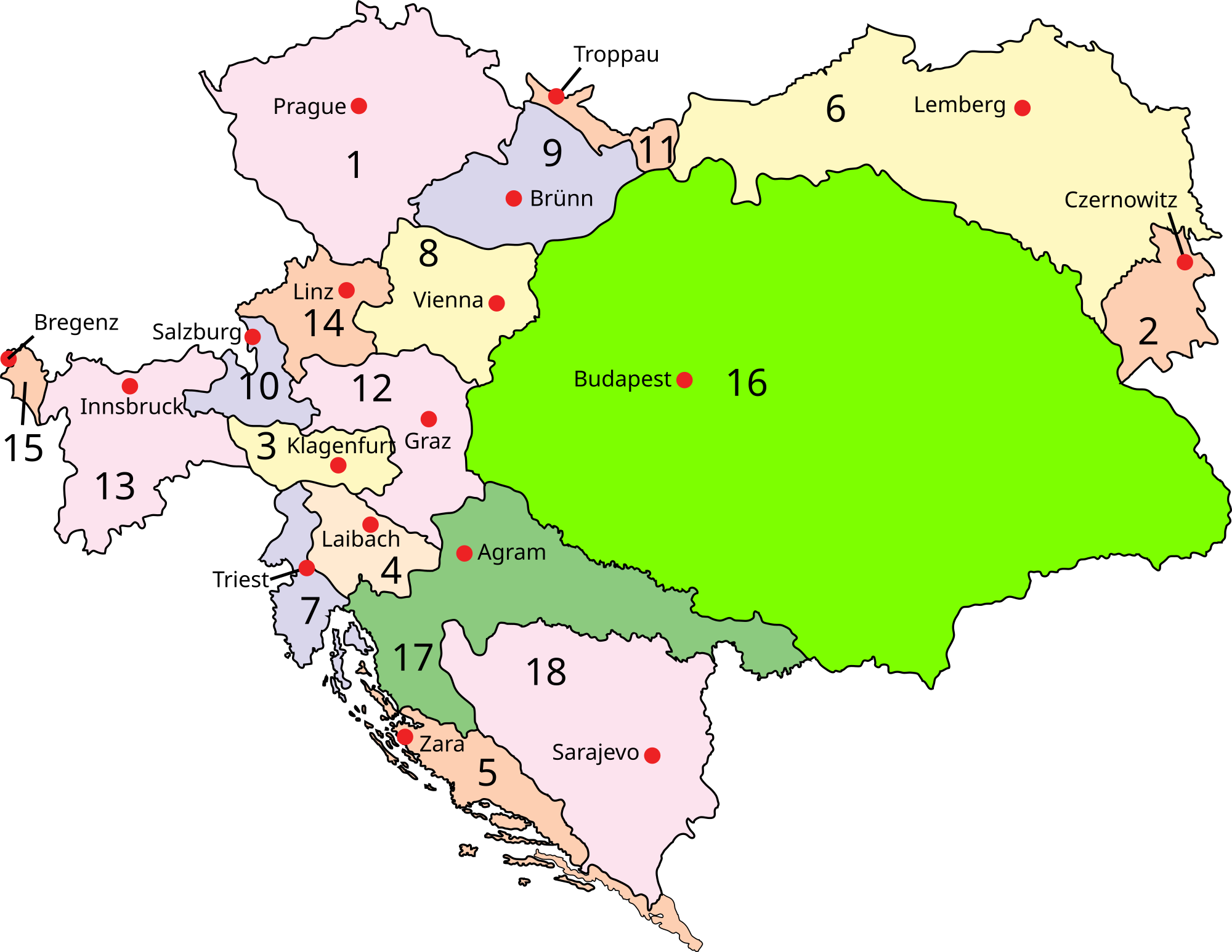
The dissolution of Austria-Hungary was a major political event that occurred as a result of the growth of internal social contradictions and the separation of different parts of Austria-Hungary. The more immediate reasons for the collapse of the state were World War I, the worsening food crisis since late 1917, general starvation in Cisleithania during the winter of 1917–1918, the demands of Austria-Hungary's military alliance with the German Empire and its de facto subservience to the German High Command, and its conclusion of the Bread Peace of 9 February 1918 with Ukraine, resulting in uncontrollable civil unrest and nationalist secessionism. The Austro-Hungarian Empire had additionally been weakened over time by a widening gap between Hungarian and Austrian interests. Furthermore, a history of chronic overcommitment rooted in the 1815 Congress of Vienna in which Metternich pledged Austria to fulfill a role that necessitated unwavering Austrian strength and resulted in overextension. Upon this weakened foundation, additional stressors during World War I catalyzed the collapse of the empire. The 1917 October Revolution and the Wilsonian peace pronouncements from January 1918 onward encouraged socialism on the one hand, and nationalism on the other, or alternatively a combination of both tendencies, among all peoples of the Habsburg monarchy.
The remaining territories inhabited by divided peoples fell into the composition of existing or newly formed states. Legally, the collapse of the empire was formalized in the September 1919 Treaty of Saint-Germain-en-Laye with Austria, which also acted as a peace treaty after the First World War, and in the June 1920 Treaty of Trianon with Hungary. Later, additional territories were ceded to other countries.
By 1918, the economic situation had deteriorated. The government had failed badly on the homefront. Historian Alexander Watson reports:
across central Europe ... The majority lived in a state of advanced misery by the spring of 1918, and conditions later worsened, for the summer of 1918 saw both the drop in food supplied to the levels of the 'turnip winter', and the onset of the 1918 flu pandemic that killed at least 20 million worldwide. Society was relieved, exhausted and yearned for peace.
As the Imperial economy collapsed into severe hardship and even starvation, its multi-ethnic army lost its morale and was increasingly hard-pressed to hold its line. Furthermore, nationalists within the empire were becoming increasingly embittered as, under expanded wartime powers, the military routinely suspended civil rights and treated different national groups with varying degrees of contempt throughout the Austrian half of the Dual Monarchy. At the last Italian offensive, the Austro-Hungarian Army took to the field without any food and munition supply and fought without any political supports for a de facto non-existent empire.
The Austro-Hungarian monarchy collapsed with dramatic speed in the autumn of 1918. Leftist and pacifist political movements organized strikes in factories, and uprisings in the army had become commonplace. These leftist or left-liberal pro-Entente maverick parties opposed the monarchy as a form of government and considered themselves internationalist rather than patriotic. Eventually, the German defeat and the minor revolutions in Vienna and Budapest gave political power to the left/liberal political parties.
As the war went on the ethnic unity declined; the Allies encouraged breakaway demands from minorities and the Empire faced disintegration. As it became apparent that the Allied powers would win World War I, nationalist movements, which had previously been calling for a greater degree of autonomy for various areas, started pressing for full independence. In the capital cities of Vienna and Budapest, the leftist and liberal movements and opposition parties strengthened and supported the separatism of ethnic minorities. The multiethnic Austro-Hungarian Empire started to disintegrate, leaving its army alone on the battlefields. The military breakdown of the Italian front marked the start of the rebellion for the numerous ethnicities who made up the multiethnic Empire, as they refused to keep on fighting for a cause that now appeared senseless. The Emperor had lost much of his power to rule, as his realm disintegrated.
As one of his Fourteen Points, President Woodrow Wilson demanded that the nationalities of Austria–Hungary have the "freest opportunity to autonomous development". In response, Emperor Karl I agreed to reconvene the Imperial Parliament in 1917[dubious – discuss] and allow the creation of a confederation with each national group exercising self-governance. However, the leaders of these national groups rejected the idea; they deeply distrusted Vienna and were now determined to get independence.
Hub AI
Dissolution of Austria-Hungary AI simulator
(@Dissolution of Austria-Hungary_simulator)
Dissolution of Austria-Hungary
The dissolution of Austria-Hungary was a major political event that occurred as a result of the growth of internal social contradictions and the separation of different parts of Austria-Hungary. The more immediate reasons for the collapse of the state were World War I, the worsening food crisis since late 1917, general starvation in Cisleithania during the winter of 1917–1918, the demands of Austria-Hungary's military alliance with the German Empire and its de facto subservience to the German High Command, and its conclusion of the Bread Peace of 9 February 1918 with Ukraine, resulting in uncontrollable civil unrest and nationalist secessionism. The Austro-Hungarian Empire had additionally been weakened over time by a widening gap between Hungarian and Austrian interests. Furthermore, a history of chronic overcommitment rooted in the 1815 Congress of Vienna in which Metternich pledged Austria to fulfill a role that necessitated unwavering Austrian strength and resulted in overextension. Upon this weakened foundation, additional stressors during World War I catalyzed the collapse of the empire. The 1917 October Revolution and the Wilsonian peace pronouncements from January 1918 onward encouraged socialism on the one hand, and nationalism on the other, or alternatively a combination of both tendencies, among all peoples of the Habsburg monarchy.
The remaining territories inhabited by divided peoples fell into the composition of existing or newly formed states. Legally, the collapse of the empire was formalized in the September 1919 Treaty of Saint-Germain-en-Laye with Austria, which also acted as a peace treaty after the First World War, and in the June 1920 Treaty of Trianon with Hungary. Later, additional territories were ceded to other countries.
By 1918, the economic situation had deteriorated. The government had failed badly on the homefront. Historian Alexander Watson reports:
across central Europe ... The majority lived in a state of advanced misery by the spring of 1918, and conditions later worsened, for the summer of 1918 saw both the drop in food supplied to the levels of the 'turnip winter', and the onset of the 1918 flu pandemic that killed at least 20 million worldwide. Society was relieved, exhausted and yearned for peace.
As the Imperial economy collapsed into severe hardship and even starvation, its multi-ethnic army lost its morale and was increasingly hard-pressed to hold its line. Furthermore, nationalists within the empire were becoming increasingly embittered as, under expanded wartime powers, the military routinely suspended civil rights and treated different national groups with varying degrees of contempt throughout the Austrian half of the Dual Monarchy. At the last Italian offensive, the Austro-Hungarian Army took to the field without any food and munition supply and fought without any political supports for a de facto non-existent empire.
The Austro-Hungarian monarchy collapsed with dramatic speed in the autumn of 1918. Leftist and pacifist political movements organized strikes in factories, and uprisings in the army had become commonplace. These leftist or left-liberal pro-Entente maverick parties opposed the monarchy as a form of government and considered themselves internationalist rather than patriotic. Eventually, the German defeat and the minor revolutions in Vienna and Budapest gave political power to the left/liberal political parties.
As the war went on the ethnic unity declined; the Allies encouraged breakaway demands from minorities and the Empire faced disintegration. As it became apparent that the Allied powers would win World War I, nationalist movements, which had previously been calling for a greater degree of autonomy for various areas, started pressing for full independence. In the capital cities of Vienna and Budapest, the leftist and liberal movements and opposition parties strengthened and supported the separatism of ethnic minorities. The multiethnic Austro-Hungarian Empire started to disintegrate, leaving its army alone on the battlefields. The military breakdown of the Italian front marked the start of the rebellion for the numerous ethnicities who made up the multiethnic Empire, as they refused to keep on fighting for a cause that now appeared senseless. The Emperor had lost much of his power to rule, as his realm disintegrated.
As one of his Fourteen Points, President Woodrow Wilson demanded that the nationalities of Austria–Hungary have the "freest opportunity to autonomous development". In response, Emperor Karl I agreed to reconvene the Imperial Parliament in 1917[dubious – discuss] and allow the creation of a confederation with each national group exercising self-governance. However, the leaders of these national groups rejected the idea; they deeply distrusted Vienna and were now determined to get independence.
Recent media