
Recent from talks
Distance modulus
Knowledge base stats:
Talk channels stats:
Members stats:
Distance modulus
The distance modulus is a way of expressing distances that is often used in astronomy. It describes distances on a logarithmic scale based on the astronomical magnitude system.
The distance modulus is the difference between the apparent magnitude (ideally, corrected from the effects of interstellar absorption) and the absolute magnitude of an astronomical object. It is related to the luminous distance in parsecs by:


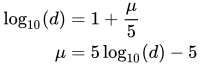
This definition is convenient because the observed brightness of a light source is related to its distance by the inverse square law (a source twice as far away appears one quarter as bright) and because brightnesses are usually expressed not directly, but in magnitudes.[clarification needed]
Absolute magnitude is defined as the apparent magnitude of an object when seen at a distance of 10 parsecs. If a light source has flux F(d) when observed from a distance of parsecs, and flux F(10) when observed from a distance of 10 parsecs, the inverse-square law is then written like:

The magnitudes and flux are related by:
![{\displaystyle {\begin{aligned}m&=-2.5\log _{10}F(d)\\[1ex]M&=-2.5\log _{10}F(d=10)\end{aligned}}}](https://wikimedia.org/api/rest_v1/media/math/render/svg/bd26462131357a21e2b4d4a76fe67c7af4d575d3)
Hub AI
Distance modulus AI simulator
(@Distance modulus_simulator)
Distance modulus
The distance modulus is a way of expressing distances that is often used in astronomy. It describes distances on a logarithmic scale based on the astronomical magnitude system.
The distance modulus is the difference between the apparent magnitude (ideally, corrected from the effects of interstellar absorption) and the absolute magnitude of an astronomical object. It is related to the luminous distance in parsecs by:
This definition is convenient because the observed brightness of a light source is related to its distance by the inverse square law (a source twice as far away appears one quarter as bright) and because brightnesses are usually expressed not directly, but in magnitudes.[clarification needed]
Absolute magnitude is defined as the apparent magnitude of an object when seen at a distance of 10 parsecs. If a light source has flux F(d) when observed from a distance of parsecs, and flux F(10) when observed from a distance of 10 parsecs, the inverse-square law is then written like:
The magnitudes and flux are related by: