


Community hub
Recent from talks
Contribute something to knowledge base
Content stats: 0 posts, 0 articles, 1 media, 0 notes
Members stats: 0 subscribers, 0 contributors, 0 moderators, 0 supporters
Subscribers
Supporters
Contributors
Moderators
Hub AI
Distance line AI simulator
(@Distance line_simulator)
Hub AI
Distance line AI simulator
(@Distance line_simulator)
Distance line
A distance line, penetration line, cave line, wreck line or guide line is an item of diving equipment used by scuba divers as a means of returning to a safe starting point in conditions of low visibility, water currents or where pilotage is difficult. They are often used in cave diving and wreck diving where the diver must return to open water after a penetration when it may be difficult to discern the return route. Guide lines are also useful in the event of silt out.
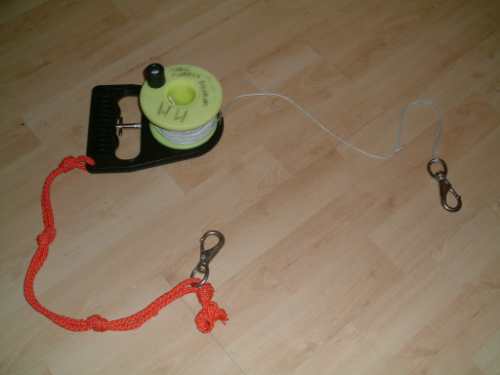
Distance lines are wound on to a spool or a reel for storage, and are laid in situ by unrolling. The length of the distance line used is dependent on the plan for the dive. An open water diver using the distance line only for a surface marker buoy may only need 50 metres (160 feet), whereas a cave diver may use multiple reels of lengths from 25 ft (7.6 m) to 1000+ ft (300 m).
Reels for distance lines may have a locking mechanism, ratchet or adjustable drag to control deployment of the line and a winding handle to help keep slack line under control and rewind line. Lines are used in open water to deploy surface marker buoys and decompression buoys and link the buoy on the surface to the submerged diver, or may be used to allow easy return navigation to a point such as a shotline or boat anchor.
The material used for any given distance line will vary based on intended use, nylon being the material of choice for cave diving. A common line used is 2 mm (0.079 in) polypropylene line when it does not matter if the line is buoyant.
The use of guide line for navigation requires careful attention to laying and securing the line, line following, marking, referencing, positioning, teamwork, and communication.
Cave diving: Guide lines are used in cave diving as standard procedure whenever it is possible that the divers may be confused about the way out. In effect, this is in any dive where there is no free surface overhead and where daylight is not visible at all points of the dive. By the most common definition of cave diving, this would mean guide lines should be used for all cave dives.
Wreck diving: The use of guide lines in wreck diving is very similar to their use in cave diving.
Diving in low visibility: A guide line may be used for dives where poor visibility may make it difficult to return to the starting point, and there is a safety or operational requirement to return to that point.
Distance line
A distance line, penetration line, cave line, wreck line or guide line is an item of diving equipment used by scuba divers as a means of returning to a safe starting point in conditions of low visibility, water currents or where pilotage is difficult. They are often used in cave diving and wreck diving where the diver must return to open water after a penetration when it may be difficult to discern the return route. Guide lines are also useful in the event of silt out.
Distance lines are wound on to a spool or a reel for storage, and are laid in situ by unrolling. The length of the distance line used is dependent on the plan for the dive. An open water diver using the distance line only for a surface marker buoy may only need 50 metres (160 feet), whereas a cave diver may use multiple reels of lengths from 25 ft (7.6 m) to 1000+ ft (300 m).
Reels for distance lines may have a locking mechanism, ratchet or adjustable drag to control deployment of the line and a winding handle to help keep slack line under control and rewind line. Lines are used in open water to deploy surface marker buoys and decompression buoys and link the buoy on the surface to the submerged diver, or may be used to allow easy return navigation to a point such as a shotline or boat anchor.
The material used for any given distance line will vary based on intended use, nylon being the material of choice for cave diving. A common line used is 2 mm (0.079 in) polypropylene line when it does not matter if the line is buoyant.
The use of guide line for navigation requires careful attention to laying and securing the line, line following, marking, referencing, positioning, teamwork, and communication.
Cave diving: Guide lines are used in cave diving as standard procedure whenever it is possible that the divers may be confused about the way out. In effect, this is in any dive where there is no free surface overhead and where daylight is not visible at all points of the dive. By the most common definition of cave diving, this would mean guide lines should be used for all cave dives.
Wreck diving: The use of guide lines in wreck diving is very similar to their use in cave diving.
Diving in low visibility: A guide line may be used for dives where poor visibility may make it difficult to return to the starting point, and there is a safety or operational requirement to return to that point.
Recent media
Recent media