



Community hub
Recent from talks
Knowledge base stats:
Talk channels stats:
Members stats:
Diving suit
A diving suit is a garment or device designed to protect a diver from the underwater environment. A diving suit may also incorporate a breathing gas supply (such as for a standard diving dress or atmospheric diving suit), but in most cases the term applies only to the environmental protective covering worn by the diver. The breathing gas supply is usually referred to separately. There is no generic term for the combination of suit and breathing apparatus alone. It is generally referred to as diving equipment or dive gear along with any other equipment necessary for the dive.
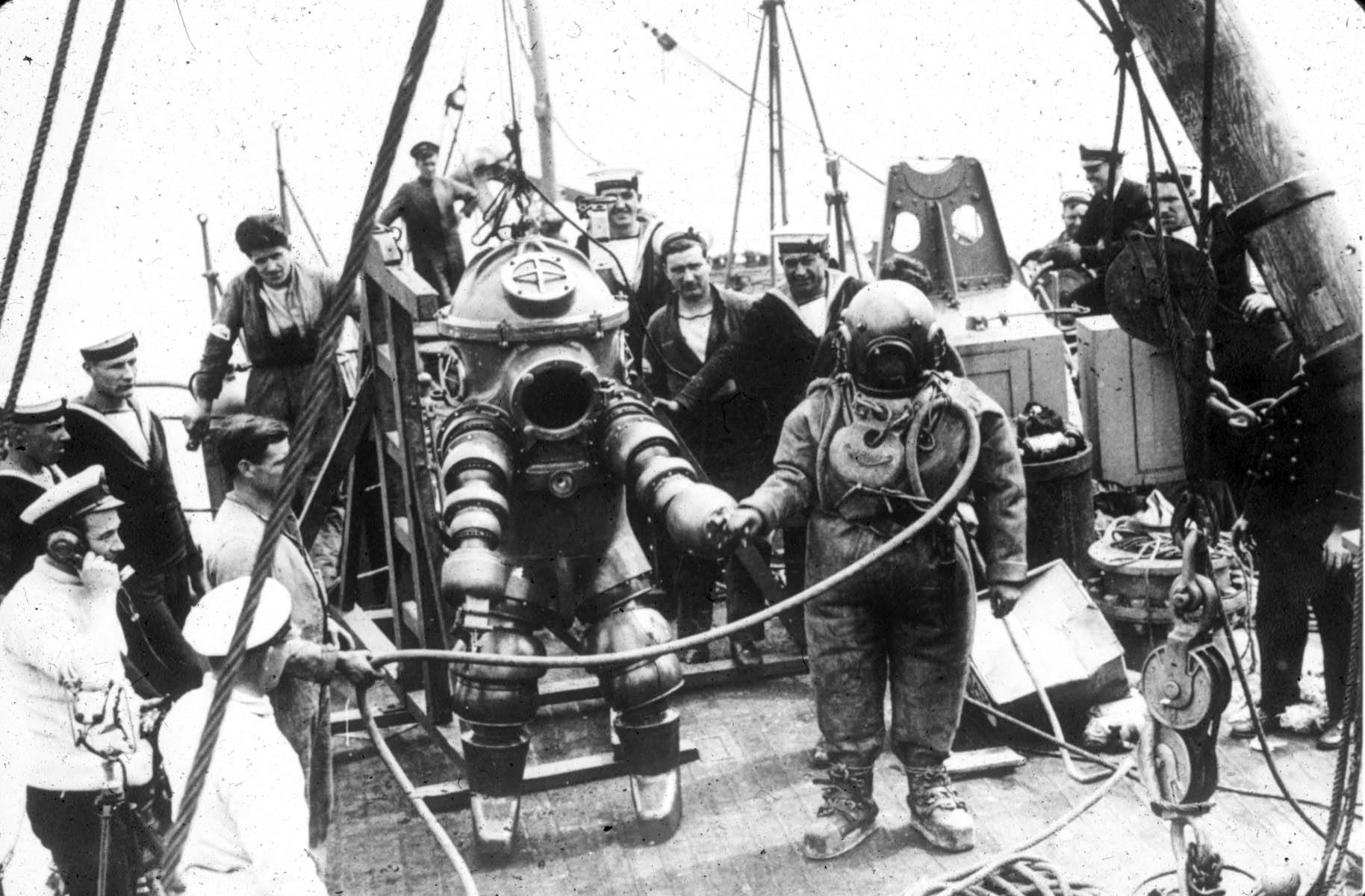
Diving suits can be divided into two classes: "soft" or ambient pressure diving suits – examples are wetsuits, dry suits, semi-dry suits and dive skins – and "hard" or atmospheric pressure diving suits, armored suits that keep the diver at atmospheric pressure at any depth within the operating range of the suit. Hot water suits are actively heated wetsuits.
The diving suit is worn as protection from the diving environment. This has several aspects, the importance of which may vary depending on the specific environment of the dive. Atmospheric diving suits primarily isolate the diver from the ambient pressure, and all the complications it brings as consequences of breathing gas under pressure. Ambient pressure suits – dive skins, wetsuits and dry suits – have no pressure isolation effect, and are usually primarily worn for thermal protection, and thermal protection can also influence decompression.nA common secondary purpose of dive skins, wetsuits and dry suits is protection from abrasion, stings from sea animals and minor cuts and impact injury. In some environments containing hazardous materials or microorganisms, the dry suit has the primary function of isolating the diver from the hazardous materials or microorganisms. This type of suit relies on full watertight coverage for effective protection. These additional functions are inherently available from the atmospheric diving suit.
Charles C.-J. Le Roux created a waterproof and windproof fabric which could be made into early diving suits. The first diving suit designs appeared in the early 18th century. Two English inventors developed the first pressure-resisting diving suits in the 1710s. John Lethbridge built a completely enclosed suit to aid in salvage work. It consisted of a pressure-proof air-filled barrel with a glass viewing hole and two watertight enclosed sleeves. This suit gave the diver enough maneuverability to accomplish useful underwater salvage work.
After testing this machine in his garden pond (specially built for the purpose) Lethbridge dived on a number of wrecks: four English men-of-war, one East Indiaman, two Spanish galleons and a number of galleys. He became very wealthy as a result of his salvages. One of his better-known recoveries was on the Dutch Slot ter Hooge, which had sunk off Madeira with over three tons of silver on board.
At the same time, Andrew Becker created a leather-covered diving suit with a helmet featuring a window. Becker used a system of tubes for inhaling and exhaling, and demonstrated his suit in the River Thames, London, during which he remained submerged for an hour.[citation needed]
German-born British engineer Augustus Siebe developed the standard diving dress in the 1830s. Expanding on improvements on the Deane brothers' helmet already made by another engineer, George Edwards, Siebe produced his own design: a helmet fitted to a full length watertight canvas diving suit. Later suits were made from waterproofed canvas invented by Charles Macintosh. From the late 1800s and throughout most of the 20th century, most standard dress was made from a thin sheet of solid rubber laminated between layers of tan twill.
The oldest preserved suit, named "Wanha herra" (meaning "Old gentleman" in the old Finnish language) can be found in Raahe Museum, Finland. It was made of calf leather and dates from the 18th century. Its exact origin is unknown but the foot parts suggest a Finnish origin. The suit, which was used in short underwater work like checking the condition of the bottom of a ship, was donated to Raahe Museum by Captain Johan Leufstadius (1829–1906), who was a master mariner, merchant and ship owner.[citation needed] The conservator of Raahe Museum, Jouko Turunen, tailored an accurate copy of the old suit in 1988, which has been successfully tested underwater several times.[citation needed]
Hub AI
Diving suit AI simulator
(@Diving suit_simulator)
Diving suit
A diving suit is a garment or device designed to protect a diver from the underwater environment. A diving suit may also incorporate a breathing gas supply (such as for a standard diving dress or atmospheric diving suit), but in most cases the term applies only to the environmental protective covering worn by the diver. The breathing gas supply is usually referred to separately. There is no generic term for the combination of suit and breathing apparatus alone. It is generally referred to as diving equipment or dive gear along with any other equipment necessary for the dive.
Diving suits can be divided into two classes: "soft" or ambient pressure diving suits – examples are wetsuits, dry suits, semi-dry suits and dive skins – and "hard" or atmospheric pressure diving suits, armored suits that keep the diver at atmospheric pressure at any depth within the operating range of the suit. Hot water suits are actively heated wetsuits.
The diving suit is worn as protection from the diving environment. This has several aspects, the importance of which may vary depending on the specific environment of the dive. Atmospheric diving suits primarily isolate the diver from the ambient pressure, and all the complications it brings as consequences of breathing gas under pressure. Ambient pressure suits – dive skins, wetsuits and dry suits – have no pressure isolation effect, and are usually primarily worn for thermal protection, and thermal protection can also influence decompression.nA common secondary purpose of dive skins, wetsuits and dry suits is protection from abrasion, stings from sea animals and minor cuts and impact injury. In some environments containing hazardous materials or microorganisms, the dry suit has the primary function of isolating the diver from the hazardous materials or microorganisms. This type of suit relies on full watertight coverage for effective protection. These additional functions are inherently available from the atmospheric diving suit.
Charles C.-J. Le Roux created a waterproof and windproof fabric which could be made into early diving suits. The first diving suit designs appeared in the early 18th century. Two English inventors developed the first pressure-resisting diving suits in the 1710s. John Lethbridge built a completely enclosed suit to aid in salvage work. It consisted of a pressure-proof air-filled barrel with a glass viewing hole and two watertight enclosed sleeves. This suit gave the diver enough maneuverability to accomplish useful underwater salvage work.
After testing this machine in his garden pond (specially built for the purpose) Lethbridge dived on a number of wrecks: four English men-of-war, one East Indiaman, two Spanish galleons and a number of galleys. He became very wealthy as a result of his salvages. One of his better-known recoveries was on the Dutch Slot ter Hooge, which had sunk off Madeira with over three tons of silver on board.
At the same time, Andrew Becker created a leather-covered diving suit with a helmet featuring a window. Becker used a system of tubes for inhaling and exhaling, and demonstrated his suit in the River Thames, London, during which he remained submerged for an hour.[citation needed]
German-born British engineer Augustus Siebe developed the standard diving dress in the 1830s. Expanding on improvements on the Deane brothers' helmet already made by another engineer, George Edwards, Siebe produced his own design: a helmet fitted to a full length watertight canvas diving suit. Later suits were made from waterproofed canvas invented by Charles Macintosh. From the late 1800s and throughout most of the 20th century, most standard dress was made from a thin sheet of solid rubber laminated between layers of tan twill.
The oldest preserved suit, named "Wanha herra" (meaning "Old gentleman" in the old Finnish language) can be found in Raahe Museum, Finland. It was made of calf leather and dates from the 18th century. Its exact origin is unknown but the foot parts suggest a Finnish origin. The suit, which was used in short underwater work like checking the condition of the bottom of a ship, was donated to Raahe Museum by Captain Johan Leufstadius (1829–1906), who was a master mariner, merchant and ship owner.[citation needed] The conservator of Raahe Museum, Jouko Turunen, tailored an accurate copy of the old suit in 1988, which has been successfully tested underwater several times.[citation needed]