



Community hub
Recent from talks
Knowledge base stats:
Talk channels stats:
Members stats:
Diving support vessel
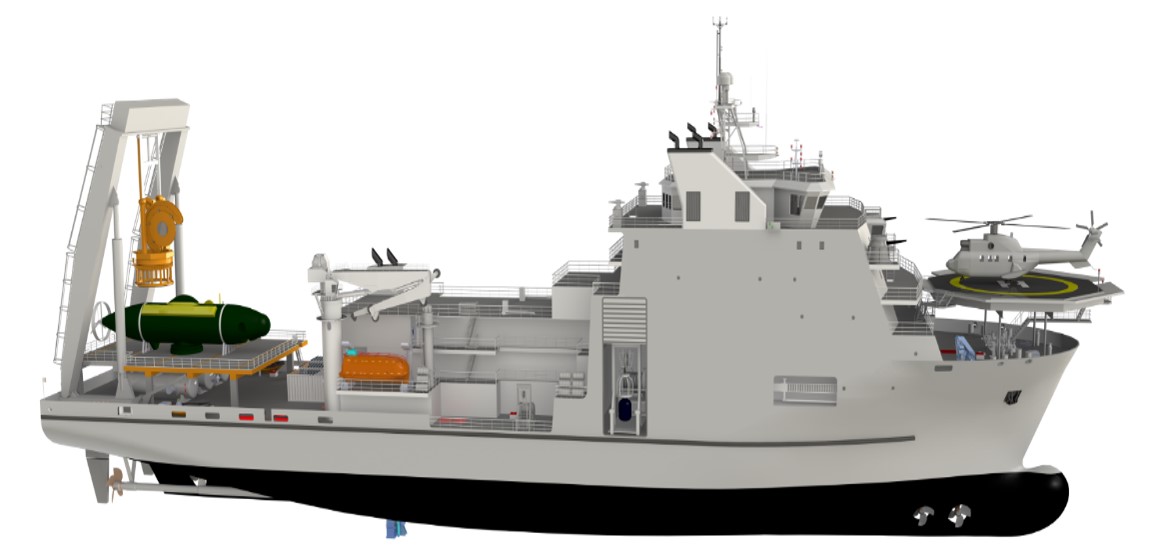
A diving support vessel is a ship that is used as a floating base for professional diving projects. Basic requirements are the ability to keep station accurately and reliably throughout a diving operation, often in close proximity to drilling or production platforms, for positioning to degrade slowly enough in deteriorating conditions to recover divers without excessive risk, and to carry the necessary support equipment for the mode of diving to be used.
Recent offshore diving support vessels tend to be dynamically positioned (DP) and double as remotely operated underwater vehicle (ROV) support vessels, and also be capable of supporting seismic survey operations and cable-laying operations. DP makes a wider range of operations possible, but the platform presents some inherent hazards, particularly the thrusters, making launch and recovery by diving bell widespread. They may use a moonpool to shelter the position where the bell or ROV enters and exits the water, and the launch and recovery system may also use a bell cursor to constrain relative movement through the splash zone, and heave compensation to minimise depth variation of the bell during the dive. Accommodations must be provided for the teams supporting whichever functions the vessel is contracted for.
DSVs for inshore operations tend to be much smaller, and may operate while moored for shallow work. Live-boating operations are considered unacceptably hazardous for surface supplied diving unless a stage or bell is used to keep the divers' umbilicals clear of the vessel's thrusters
A diving support vessel is a ship that is used as a floating base for professional diving projects. Basic requirements are the ability to keep station accurately and reliably throughout a diving operation, often in close proximity to drilling or production platforms, for positioning to degrade slowly enough in deteriorating conditions to recover divers without excessive risk, and to carry the necessary support equipment for the mode of diving to be used.
Commercial diving support vessels emerged during the 1960s and 1970s, when the need arose for offshore diving operations to be performed below and around oil production platforms and associated installations in open water in the North Sea and Gulf of Mexico. Until that point, most diving operations were from mobile oil drilling platforms, pipe-lay, or crane barges. The diving system tended to be modularised and craned on and off the vessels as a package.[citation needed]
As permanent oil and gas production platforms emerged, the owners and operators were not keen to give over valuable deck space to diving systems because after they came on-line the expectation of continuing diving operations was low.[citation needed]
However, equipment fails or gets damaged, and there was a regular if not continuous need for diving operations in and around oil fields. The solution was to put diving packages on ships. Initially these tended to be oilfield supply ships or fishing vessels; however, keeping this kind of ship 'on station', particularly during uncertain weather, made the diving dangerous, problematic and seasonal. Furthermore, seabed operations usually entailed the raising and lowering of heavy equipment, and most such vessels were not equipped for this task.[citation needed]
This is when the dedicated commercial diving support vessel emerged. These were often built from scratch or heavily converted pipe carriers or other utility ships. The key components of the diving support vessel are:
Hub AI
Diving support vessel AI simulator
(@Diving support vessel_simulator)
Diving support vessel
A diving support vessel is a ship that is used as a floating base for professional diving projects. Basic requirements are the ability to keep station accurately and reliably throughout a diving operation, often in close proximity to drilling or production platforms, for positioning to degrade slowly enough in deteriorating conditions to recover divers without excessive risk, and to carry the necessary support equipment for the mode of diving to be used.
Recent offshore diving support vessels tend to be dynamically positioned (DP) and double as remotely operated underwater vehicle (ROV) support vessels, and also be capable of supporting seismic survey operations and cable-laying operations. DP makes a wider range of operations possible, but the platform presents some inherent hazards, particularly the thrusters, making launch and recovery by diving bell widespread. They may use a moonpool to shelter the position where the bell or ROV enters and exits the water, and the launch and recovery system may also use a bell cursor to constrain relative movement through the splash zone, and heave compensation to minimise depth variation of the bell during the dive. Accommodations must be provided for the teams supporting whichever functions the vessel is contracted for.
DSVs for inshore operations tend to be much smaller, and may operate while moored for shallow work. Live-boating operations are considered unacceptably hazardous for surface supplied diving unless a stage or bell is used to keep the divers' umbilicals clear of the vessel's thrusters
A diving support vessel is a ship that is used as a floating base for professional diving projects. Basic requirements are the ability to keep station accurately and reliably throughout a diving operation, often in close proximity to drilling or production platforms, for positioning to degrade slowly enough in deteriorating conditions to recover divers without excessive risk, and to carry the necessary support equipment for the mode of diving to be used.
Commercial diving support vessels emerged during the 1960s and 1970s, when the need arose for offshore diving operations to be performed below and around oil production platforms and associated installations in open water in the North Sea and Gulf of Mexico. Until that point, most diving operations were from mobile oil drilling platforms, pipe-lay, or crane barges. The diving system tended to be modularised and craned on and off the vessels as a package.[citation needed]
As permanent oil and gas production platforms emerged, the owners and operators were not keen to give over valuable deck space to diving systems because after they came on-line the expectation of continuing diving operations was low.[citation needed]
However, equipment fails or gets damaged, and there was a regular if not continuous need for diving operations in and around oil fields. The solution was to put diving packages on ships. Initially these tended to be oilfield supply ships or fishing vessels; however, keeping this kind of ship 'on station', particularly during uncertain weather, made the diving dangerous, problematic and seasonal. Furthermore, seabed operations usually entailed the raising and lowering of heavy equipment, and most such vessels were not equipped for this task.[citation needed]
This is when the dedicated commercial diving support vessel emerged. These were often built from scratch or heavily converted pipe carriers or other utility ships. The key components of the diving support vessel are: