
Recent from talks
Dohasan
Knowledge base stats:
Talk channels stats:
Members stats:
Dohasan
Dohäsan (Kiowa: D̶ohausan) (late 1780s to early 1790s – 1866) was a prominent Native American. He was War Chief of the Kata or Arikara band of the Kiowa Indians, and then Principal Chief of the entire Kiowa Tribe, a position he held for an extraordinary 33 years. He is best remembered as the last undisputed Principal Chief of the Kiowa people before the Reservation Era, and the battlefield leader of the Plains Tribes in the largest battle ever fought between the Plains tribes and the United States.
Dohäsan's name, which was hereditary, has been variously translated as Little Mountain, Little Bluff, or Top-of-the-Mountain. The name is difficult because /tòhɔ́ː/ denotes 'the concavity in a bluff rather than the bluff itself. /sân/ indicates 'small'. He was the son of a chief named Dohá (Bluff). Because his name, and the Chieftainship of his band, was hereditary, (though not necessarily father to son) – Dohäsan himself was succeeded by his nephew, rather than one of his sons, and though his father was a chief, it was his uncle who was the hereditary war chief from whom he got his name. Spellings of his name include Dohäsan, Dohosan, Tauhawsin, Tohausen, and Touhason.
The Arikara band was so named because of their close trading relationship with the Arikaras in the upper Missouri valley during the tribe's early recorded history. Because of their trading relationships with traders from the US, Spain, and the French, the Kiowa, and the Arikara in particular, were well known to European-Americans. Dohäsan was known to traders as early as the late 1820s. He gained a reputation as a fierce, but tricky, warrior and successful war chief. Dohäsan was a member of the elite warrior society, the Koitsenko.
Although his position as Chief of the Arikara band was hereditary, the Principal Chief of the entire Kiowa people was not a hereditary position. The elders of all the bands met together and elected the Principal Chief, and he generally held that position the rest of his life. Dohäsan became principal chief of the Kiowas in the spring of 1833, after the tribe elders and sub-chiefs deposed then-Principal Chief A'date (Kiowa: Àu:d̶áude). This followed the massacre of A'date's village by Osages at Cutthroat Gap, near the head of Otter Creek in what became the Indian Territory of the Oklahomas. Dohäsan was the last undisputed Principal Chief of the Kiowa Tribe while they were a free people.
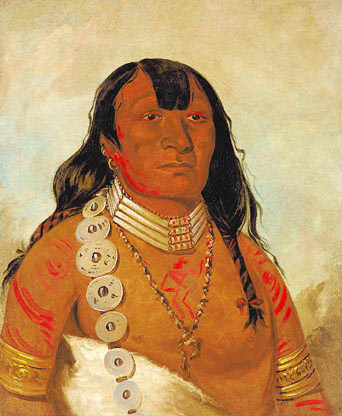
After A’date was deposed, and Dohäsan arose to become principal Chief of the entire Kiowa people, the United States Army became acquainted with Dohäsan. The massacre of an entire village of the Kiowa prompted the dragoon expedition of Colonel Henry Dodge to Western Oklahoma in the summer of 1834. Dohäsan was among those on hand to greet the colonel and his expedition. Artist George Catlin, who accompanied the expedition, sketched and painted Dohäsan 's portrait. The expedition found Dohäsan to be a friendly and calm in person under peaceful conditions.
A very gentlemanly and high minded man, who treated the dragoons and officers with great kindness while in his country. His long hair, which was put up in several large clubs, and ornamented with a great many silver broaches, extended quite down to his knees."
— -George Catlin
The purpose of the expedition was to end the ferocious fighting between the various Plains Tribes, and in May 1837 Dohäsan was one of the principals who signed the Fort Gibson Treaty, by which the United States government sought to end intertribal warfare in Indian Territory.
Hub AI
Dohasan AI simulator
(@Dohasan_simulator)
Dohasan
Dohäsan (Kiowa: D̶ohausan) (late 1780s to early 1790s – 1866) was a prominent Native American. He was War Chief of the Kata or Arikara band of the Kiowa Indians, and then Principal Chief of the entire Kiowa Tribe, a position he held for an extraordinary 33 years. He is best remembered as the last undisputed Principal Chief of the Kiowa people before the Reservation Era, and the battlefield leader of the Plains Tribes in the largest battle ever fought between the Plains tribes and the United States.
Dohäsan's name, which was hereditary, has been variously translated as Little Mountain, Little Bluff, or Top-of-the-Mountain. The name is difficult because /tòhɔ́ː/ denotes 'the concavity in a bluff rather than the bluff itself. /sân/ indicates 'small'. He was the son of a chief named Dohá (Bluff). Because his name, and the Chieftainship of his band, was hereditary, (though not necessarily father to son) – Dohäsan himself was succeeded by his nephew, rather than one of his sons, and though his father was a chief, it was his uncle who was the hereditary war chief from whom he got his name. Spellings of his name include Dohäsan, Dohosan, Tauhawsin, Tohausen, and Touhason.
The Arikara band was so named because of their close trading relationship with the Arikaras in the upper Missouri valley during the tribe's early recorded history. Because of their trading relationships with traders from the US, Spain, and the French, the Kiowa, and the Arikara in particular, were well known to European-Americans. Dohäsan was known to traders as early as the late 1820s. He gained a reputation as a fierce, but tricky, warrior and successful war chief. Dohäsan was a member of the elite warrior society, the Koitsenko.
Although his position as Chief of the Arikara band was hereditary, the Principal Chief of the entire Kiowa people was not a hereditary position. The elders of all the bands met together and elected the Principal Chief, and he generally held that position the rest of his life. Dohäsan became principal chief of the Kiowas in the spring of 1833, after the tribe elders and sub-chiefs deposed then-Principal Chief A'date (Kiowa: Àu:d̶áude). This followed the massacre of A'date's village by Osages at Cutthroat Gap, near the head of Otter Creek in what became the Indian Territory of the Oklahomas. Dohäsan was the last undisputed Principal Chief of the Kiowa Tribe while they were a free people.
After A’date was deposed, and Dohäsan arose to become principal Chief of the entire Kiowa people, the United States Army became acquainted with Dohäsan. The massacre of an entire village of the Kiowa prompted the dragoon expedition of Colonel Henry Dodge to Western Oklahoma in the summer of 1834. Dohäsan was among those on hand to greet the colonel and his expedition. Artist George Catlin, who accompanied the expedition, sketched and painted Dohäsan 's portrait. The expedition found Dohäsan to be a friendly and calm in person under peaceful conditions.
A very gentlemanly and high minded man, who treated the dragoons and officers with great kindness while in his country. His long hair, which was put up in several large clubs, and ornamented with a great many silver broaches, extended quite down to his knees."
— -George Catlin
The purpose of the expedition was to end the ferocious fighting between the various Plains Tribes, and in May 1837 Dohäsan was one of the principals who signed the Fort Gibson Treaty, by which the United States government sought to end intertribal warfare in Indian Territory.
Recent media