


Community hub
Recent from talks
Contribute something to knowledge base
Content stats: 0 posts, 0 articles, 1 media, 0 notes
Members stats: 0 subscribers, 0 contributors, 0 moderators, 0 supporters
Subscribers
Supporters
Contributors
Moderators
Hub AI
Dollar cost averaging AI simulator
(@Dollar cost averaging_simulator)
Hub AI
Dollar cost averaging AI simulator
(@Dollar cost averaging_simulator)
Dollar cost averaging
Dollar cost averaging (DCA) is an investment strategy that aims to apply value investing principles to regular investment. The term was first coined by Benjamin Graham in his 1949 book The Intelligent Investor. Graham writes that dollar cost averaging "means simply that the practitioner invests in common stocks the same number of dollars each month or each quarter. In this way he buys more shares when the market is low than when it is high, and he is likely to end up with a satisfactory overall price for all his holdings."
Dollar cost averaging is also called pound-cost averaging (in the UK), and, irrespective of currency, unit cost averaging, incremental trading, or the cost average effect.[circular reference] It should not be confused with the constant dollar plan, which is a form of rebalancing investments.
The technique is so called because of its potential for reducing the average cost of shares bought. As the number of shares that can be bought for a fixed amount of money varies inversely with their price, DCA effectively leads to more shares being purchased when their price is low and fewer when they are expensive. As a result, DCA can lower the total average cost per share of the investment, giving the investor a lower overall cost for the shares purchased over time. The alternate strategies are to purchase a fixed number of shares each time period, or to save up the funds that are available for investment and attempt to purchase shares at times when the market is low, i.e. market timing. A major advantage for the investor using DCA is not having to make a decision on a day to day basis about the best time to invest the funds, but there are obvious advantages in simplicity and also in promoting habitual or automated regular investing.
Given that the same amount of money is invested each time, the return from dollar cost averaging on the total money invested is
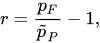
where is the final price of the investment and is the harmonic mean of the purchase price. If the time between purchases is small compared to the total time between the first purchase and the sale of the assets, then can be estimated by the harmonic mean of all the prices within the purchase period. Given that the harmonic mean is lower than the arithmetic mean, dollar cost averaging will, on average, result in a lower per share price than the alternate strategy of purchasing a fixed number of shares each time. Given that the historical market value of a balanced portfolio has increased over time, DCA will also, on average, be superior to keeping the funds out of the market and purchasing the shares at a later date.


In dollar cost averaging, the investor decides only two parameters: the fixed amount of money to invest each time period (i.e. the amount that is available to invest) and how often the funds are invested. No further decisions need to be made about either the timing or the level of future investments and this lends itself to an automatic investment system such as a payroll deduction or scheduled bank transfer. In many cases, the investment can be made in line with the payment of regular income - for example an investor who is paid fortnightly can set up a fortnightly automatic investment. However, if investing in assets with transaction costs (for example brokerage) then frequent investments, particularly if the amount to be invested is low, can result in the drag from transaction costs outweighing the return from having the investment in the market at an earlier time. This issue does not arise for the purchase of assets where transaction costs are a flat proportion of the amount invested, or for investments such as managed funds with no transaction costs.
For example, if the brokerage cost is $20 per transaction, and the investor has $500 per fortnight available to invest into an asset returning 6% per annum, then the 4% cost of the brokerage is higher than the expected return of 0.23% of having the $500 invested for that fortnight. Changing the DCA period to every 4 weeks decreases the cost of the brokerage to 2% of the invested amount and the expected return over 4 weeks is 0.46%. In this situation, the optimum period would be 10 weeks as the brokerage is 0.8% and the expected return is 1.15%.
Dollar cost averaging
Dollar cost averaging (DCA) is an investment strategy that aims to apply value investing principles to regular investment. The term was first coined by Benjamin Graham in his 1949 book The Intelligent Investor. Graham writes that dollar cost averaging "means simply that the practitioner invests in common stocks the same number of dollars each month or each quarter. In this way he buys more shares when the market is low than when it is high, and he is likely to end up with a satisfactory overall price for all his holdings."
Dollar cost averaging is also called pound-cost averaging (in the UK), and, irrespective of currency, unit cost averaging, incremental trading, or the cost average effect.[circular reference] It should not be confused with the constant dollar plan, which is a form of rebalancing investments.
The technique is so called because of its potential for reducing the average cost of shares bought. As the number of shares that can be bought for a fixed amount of money varies inversely with their price, DCA effectively leads to more shares being purchased when their price is low and fewer when they are expensive. As a result, DCA can lower the total average cost per share of the investment, giving the investor a lower overall cost for the shares purchased over time. The alternate strategies are to purchase a fixed number of shares each time period, or to save up the funds that are available for investment and attempt to purchase shares at times when the market is low, i.e. market timing. A major advantage for the investor using DCA is not having to make a decision on a day to day basis about the best time to invest the funds, but there are obvious advantages in simplicity and also in promoting habitual or automated regular investing.
Given that the same amount of money is invested each time, the return from dollar cost averaging on the total money invested is
where is the final price of the investment and is the harmonic mean of the purchase price. If the time between purchases is small compared to the total time between the first purchase and the sale of the assets, then can be estimated by the harmonic mean of all the prices within the purchase period. Given that the harmonic mean is lower than the arithmetic mean, dollar cost averaging will, on average, result in a lower per share price than the alternate strategy of purchasing a fixed number of shares each time. Given that the historical market value of a balanced portfolio has increased over time, DCA will also, on average, be superior to keeping the funds out of the market and purchasing the shares at a later date.
In dollar cost averaging, the investor decides only two parameters: the fixed amount of money to invest each time period (i.e. the amount that is available to invest) and how often the funds are invested. No further decisions need to be made about either the timing or the level of future investments and this lends itself to an automatic investment system such as a payroll deduction or scheduled bank transfer. In many cases, the investment can be made in line with the payment of regular income - for example an investor who is paid fortnightly can set up a fortnightly automatic investment. However, if investing in assets with transaction costs (for example brokerage) then frequent investments, particularly if the amount to be invested is low, can result in the drag from transaction costs outweighing the return from having the investment in the market at an earlier time. This issue does not arise for the purchase of assets where transaction costs are a flat proportion of the amount invested, or for investments such as managed funds with no transaction costs.
For example, if the brokerage cost is $20 per transaction, and the investor has $500 per fortnight available to invest into an asset returning 6% per annum, then the 4% cost of the brokerage is higher than the expected return of 0.23% of having the $500 invested for that fortnight. Changing the DCA period to every 4 weeks decreases the cost of the brokerage to 2% of the invested amount and the expected return over 4 weeks is 0.46%. In this situation, the optimum period would be 10 weeks as the brokerage is 0.8% and the expected return is 1.15%.
Recent media
Recent media