
Recent from talks
Dome car
Knowledge base stats:
Talk channels stats:
Members stats:
Dome car
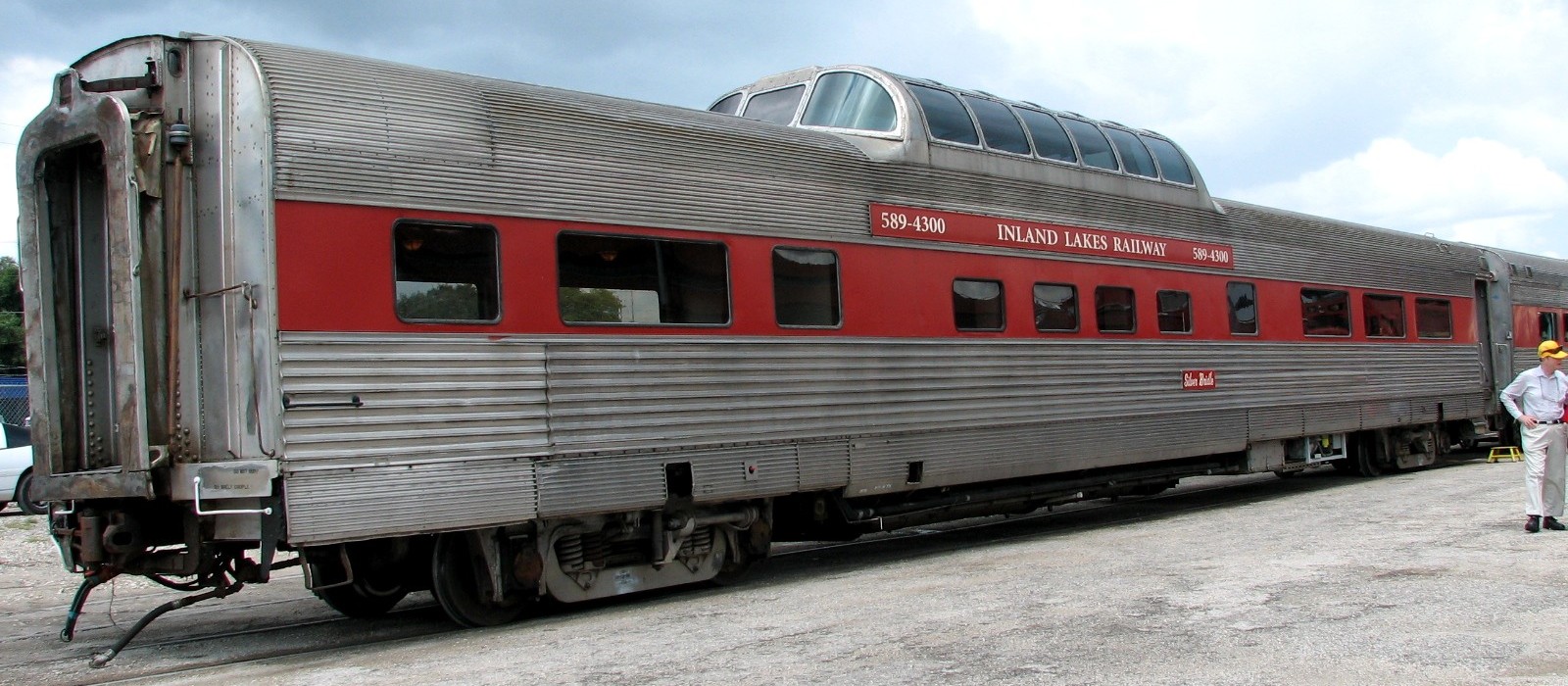
A dome car is a type of railway passenger car that has a glass dome on the top of the car where passengers can ride and see in all directions around the train. It also can include features of a coach, lounge car, dining car, sleeping car or observation. Beginning in 1945, dome cars were primarily used in the United States and Canada, though a small number were constructed in Europe for Trans Europ Express service.
In North America, dome cars were manufactured by the Budd Company, Pullman Standard and American Car & Foundry. Southern Pacific Railroad built its own dome cars in its Sacramento, California, shops. In the 1990s Colorado Railcar began producing dome cars. Generally, seats in the dome were considered "non-revenue" like lounge car seats.
A portion of the car, usually in the center of the car but offset towards one end, is split between two levels. The offset results in floorplans having a "long end" and a "short end" on the main level. Stairs then go up to the dome and down to the lower level, with the lower level below the dome usually offering restrooms or a small lounge area, while the upper portion is usually coach or lounge seating within a "bubble" of glass on the car's roof. Passengers in the upper portion of the dome are able to see in all directions from a vantage point above the train's roofline.
In the United States, the Union Pacific Railroad operated dome dining cars. These cars had a kitchen in the short end, with a pantry in half the space under the dome. The other half of the space under the dome was a private dining room for small groups. Between the pantry and kitchen there was a dumbwaiter to transfer items between the kitchen and the dining area in the dome portion of the car. The "long end" was the main dining area.
The Chicago, Burlington & Quincy Railroad operated mid-train dome-dormitory-buffet-lounge cars on its California Zephyr, Kansas City Zephyr and American Royal Zephyr, and dome-dormitory-coffee shop cars on its Denver Zephyr. The dormitory space was used by on-board train crew such as the dining car staff.
Several railroads operated dome sleeping cars. Those of the Northern Pacific Railway had four bedrooms in the "long end", four roomettes in the "short end" and four duplex single rooms under the dome.[citation needed]
The Wabash Railroad and Chicago, Burlington and Quincy Railroad operated dome parlor cars for first class day service. Wabash's Blue Bird included a Budd dome-parlor-observation as part of its original consist, and later added a Pullman-Standard dome-parlor car. The CB&Q operated dome-parlor-observation cars on the Twin Zephyrs, the Kansas City Zephyr and the Denver Zephyr.
Several railroads operated dome observation cars, usually at the rear of the train. These cars have a dome on top of the car with a rounded-end or flat-end rear "observation" section (on the main floor) where passengers can sit and look out at the receding scenery. These cars often have additional sleeping compartments under the dome and/or in the "short end" as well as a bar and/or additional lounge spaces.
Hub AI
Dome car AI simulator
(@Dome car_simulator)
Dome car
A dome car is a type of railway passenger car that has a glass dome on the top of the car where passengers can ride and see in all directions around the train. It also can include features of a coach, lounge car, dining car, sleeping car or observation. Beginning in 1945, dome cars were primarily used in the United States and Canada, though a small number were constructed in Europe for Trans Europ Express service.
In North America, dome cars were manufactured by the Budd Company, Pullman Standard and American Car & Foundry. Southern Pacific Railroad built its own dome cars in its Sacramento, California, shops. In the 1990s Colorado Railcar began producing dome cars. Generally, seats in the dome were considered "non-revenue" like lounge car seats.
A portion of the car, usually in the center of the car but offset towards one end, is split between two levels. The offset results in floorplans having a "long end" and a "short end" on the main level. Stairs then go up to the dome and down to the lower level, with the lower level below the dome usually offering restrooms or a small lounge area, while the upper portion is usually coach or lounge seating within a "bubble" of glass on the car's roof. Passengers in the upper portion of the dome are able to see in all directions from a vantage point above the train's roofline.
In the United States, the Union Pacific Railroad operated dome dining cars. These cars had a kitchen in the short end, with a pantry in half the space under the dome. The other half of the space under the dome was a private dining room for small groups. Between the pantry and kitchen there was a dumbwaiter to transfer items between the kitchen and the dining area in the dome portion of the car. The "long end" was the main dining area.
The Chicago, Burlington & Quincy Railroad operated mid-train dome-dormitory-buffet-lounge cars on its California Zephyr, Kansas City Zephyr and American Royal Zephyr, and dome-dormitory-coffee shop cars on its Denver Zephyr. The dormitory space was used by on-board train crew such as the dining car staff.
Several railroads operated dome sleeping cars. Those of the Northern Pacific Railway had four bedrooms in the "long end", four roomettes in the "short end" and four duplex single rooms under the dome.[citation needed]
The Wabash Railroad and Chicago, Burlington and Quincy Railroad operated dome parlor cars for first class day service. Wabash's Blue Bird included a Budd dome-parlor-observation as part of its original consist, and later added a Pullman-Standard dome-parlor car. The CB&Q operated dome-parlor-observation cars on the Twin Zephyrs, the Kansas City Zephyr and the Denver Zephyr.
Several railroads operated dome observation cars, usually at the rear of the train. These cars have a dome on top of the car with a rounded-end or flat-end rear "observation" section (on the main floor) where passengers can sit and look out at the receding scenery. These cars often have additional sleeping compartments under the dome and/or in the "short end" as well as a bar and/or additional lounge spaces.
Recent media