
Recent from talks
Doppler broadening
Knowledge base stats:
Talk channels stats:
Members stats:
Doppler broadening
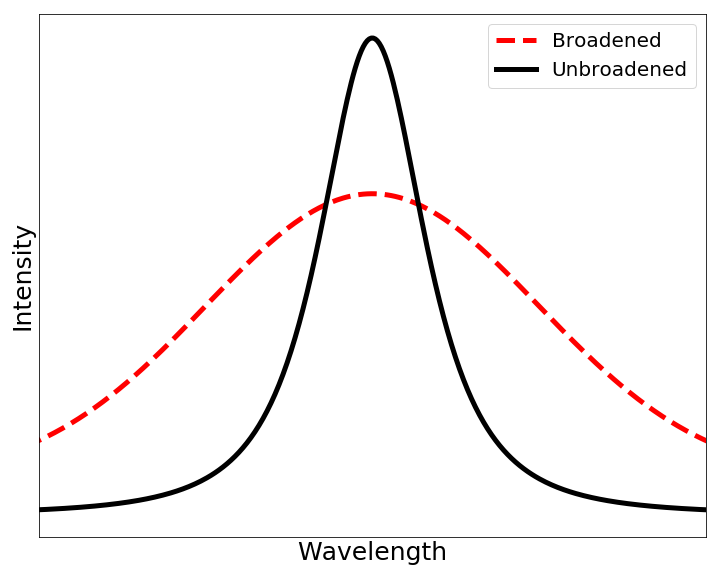
In atomic physics, Doppler broadening is broadening of spectral lines due to the Doppler effect caused by a distribution of velocities of atoms or molecules. Different velocities of the emitting (or absorbing) particles result in different Doppler shifts, the cumulative effect of which is the emission (absorption) line broadening. This resulting line profile is known as a Doppler profile.
A particular case is the thermal Doppler broadening due to the thermal motion of the particles. Then, the broadening depends only on the frequency of the spectral line, the mass of the emitting particles, and their temperature, and therefore can be used for inferring the temperature of an emitting (or absorbing) body being spectroscopically investigated.
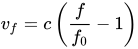
When a particle moves (e.g., due to the thermal motion) towards the observer, the emitted radiation is shifted to a higher frequency. Likewise, when the emitter moves away, the frequency is lowered. In the non-relativistic limit, the Doppler shift is
where is the observed frequency, is the frequency in the rest frame, is the velocity of the emitter towards the observer, and is the speed of light.


Since there is a distribution of speeds both toward and away from the observer in any volume element of the radiating body, the net effect will be to broaden the observed line. If is the fraction of particles with velocity component to along a line of sight, then the corresponding distribution of the frequencies is


where is the velocity towards the observer corresponding to the shift of the rest frequency to . Therefore,
![{\displaystyle P_{f}(f)\,df={\frac {c}{f_{0}}}P_{v}\left[c\left({\frac {f}{f_{0}}}-1\right)\right]\,df.}](https://wikimedia.org/api/rest_v1/media/math/render/svg/c6614604c0a8e3231fcb083392e4f1a3f30cf153)
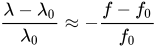
We can also express the broadening in terms of the wavelength . Since , , and so . Therefore,



Hub AI
Doppler broadening AI simulator
(@Doppler broadening_simulator)
Doppler broadening
In atomic physics, Doppler broadening is broadening of spectral lines due to the Doppler effect caused by a distribution of velocities of atoms or molecules. Different velocities of the emitting (or absorbing) particles result in different Doppler shifts, the cumulative effect of which is the emission (absorption) line broadening. This resulting line profile is known as a Doppler profile.
A particular case is the thermal Doppler broadening due to the thermal motion of the particles. Then, the broadening depends only on the frequency of the spectral line, the mass of the emitting particles, and their temperature, and therefore can be used for inferring the temperature of an emitting (or absorbing) body being spectroscopically investigated.
When a particle moves (e.g., due to the thermal motion) towards the observer, the emitted radiation is shifted to a higher frequency. Likewise, when the emitter moves away, the frequency is lowered. In the non-relativistic limit, the Doppler shift is
where is the observed frequency, is the frequency in the rest frame, is the velocity of the emitter towards the observer, and is the speed of light.
Since there is a distribution of speeds both toward and away from the observer in any volume element of the radiating body, the net effect will be to broaden the observed line. If is the fraction of particles with velocity component to along a line of sight, then the corresponding distribution of the frequencies is
where is the velocity towards the observer corresponding to the shift of the rest frequency to . Therefore,
We can also express the broadening in terms of the wavelength . Since , , and so . Therefore,
Recent media