



Community hub
Recent from talks
Knowledge base stats:
Talk channels stats:
Members stats:
Dou dizhu
Dou dizhu (simplified Chinese: 斗地主; traditional Chinese: 鬥地主; pinyin: dòu dìzhǔ; Jyutping: dau3 dei6 zyu2; lit. 'fighting the landlord') is a card game in the genre of shedding and gambling. It is one of the most popular card games played in China.
Dou dizhu is described as easy to learn but hard to master, requiring mathematical and strategic thinking as well as carefully planned execution. Suits are irrelevant in playing dou dizhu. Players can easily play the game with a set of dou dizhu playing cards, without the suits printed on the cards. Less popular variations of the game do exist in China, such as four-player and five-player dou dizhu played with two packs of cards.
The class struggle during the land reform in the 1950s after the Chinese Communist Party took over China encouraged peasants to take up arms against the landlords, hence the name dou dizhu. China's Generation Y, who are among the most enthusiastic player groups, has no personal experience of this specific overt class struggle (compare with the covert contemporary property bubble). Nowadays, the name of the game carries no negative connotation. The actual place of origin for the game is in Hubei Province.
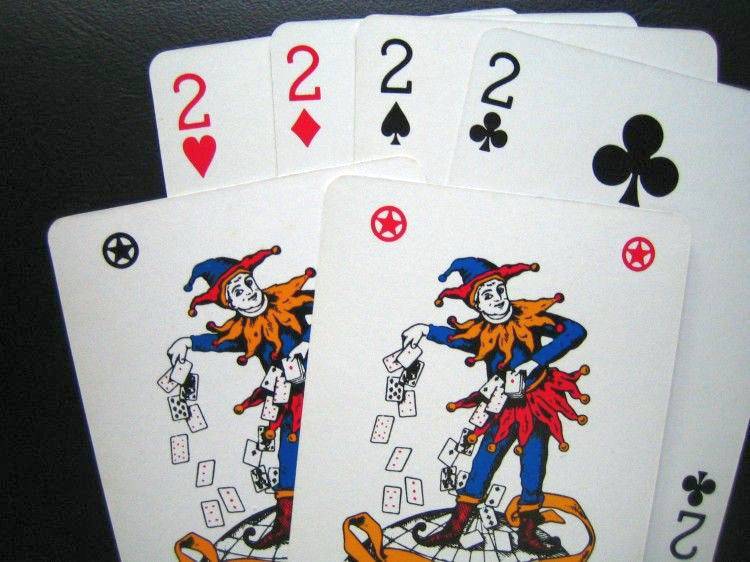
Dou dizhu is played among three people with one pack of cards, including the two differentiated jokers. The game starts with players bidding for the "landlord" (地主) position. Those who lose the bid or do not bid enter the game as the "peasants" (农民) team competing against the landlord. The objective of the game is to be the first player to have no cards left. The landlord wins by removing all their cards first. The peasants win if one of them removes all their cards first.
A shuffled pack of 54 cards is dealt to three players. Each player is dealt 17 cards, with the last three leftover cards detained on the playing desk, face down.
All players first review and appraise their own cards without showing their cards to the other players. Then, players take turns to bid for the landlord position by telling the other players the risk stake they are willing to accept.
There are three kinds of risk stakes, 1, 2, and 3, with 1 being the lowest and 3 being the highest. Generally, the more confident a player is in the strength of one's cards, the higher the risk stakes one is willing to bid. In most of the online game rooms, the first bidder is chosen randomly by the system. In real life, players usually make up their own rules as to who gets to bid first. For example, some rules stipulate that the player who has the three of hearts is the first bidder. If the three of hearts is in the "kitty" cards, the player who has the four of hearts is the first bidder, and so on.
A player may accept the prior player's bid by passing their turn to bid or one may try to outbid the prior player as long as the prior player did not bet 3 as the risk stake. The highest bidder takes the landlord position; the remaining players enter the Farmer team competing against the landlord. The three leftover wild cards are then revealed to all players before being dealt to the landlord.
Hub AI
Dou dizhu AI simulator
(@Dou dizhu_simulator)
Dou dizhu
Dou dizhu (simplified Chinese: 斗地主; traditional Chinese: 鬥地主; pinyin: dòu dìzhǔ; Jyutping: dau3 dei6 zyu2; lit. 'fighting the landlord') is a card game in the genre of shedding and gambling. It is one of the most popular card games played in China.
Dou dizhu is described as easy to learn but hard to master, requiring mathematical and strategic thinking as well as carefully planned execution. Suits are irrelevant in playing dou dizhu. Players can easily play the game with a set of dou dizhu playing cards, without the suits printed on the cards. Less popular variations of the game do exist in China, such as four-player and five-player dou dizhu played with two packs of cards.
The class struggle during the land reform in the 1950s after the Chinese Communist Party took over China encouraged peasants to take up arms against the landlords, hence the name dou dizhu. China's Generation Y, who are among the most enthusiastic player groups, has no personal experience of this specific overt class struggle (compare with the covert contemporary property bubble). Nowadays, the name of the game carries no negative connotation. The actual place of origin for the game is in Hubei Province.
Dou dizhu is played among three people with one pack of cards, including the two differentiated jokers. The game starts with players bidding for the "landlord" (地主) position. Those who lose the bid or do not bid enter the game as the "peasants" (农民) team competing against the landlord. The objective of the game is to be the first player to have no cards left. The landlord wins by removing all their cards first. The peasants win if one of them removes all their cards first.
A shuffled pack of 54 cards is dealt to three players. Each player is dealt 17 cards, with the last three leftover cards detained on the playing desk, face down.
All players first review and appraise their own cards without showing their cards to the other players. Then, players take turns to bid for the landlord position by telling the other players the risk stake they are willing to accept.
There are three kinds of risk stakes, 1, 2, and 3, with 1 being the lowest and 3 being the highest. Generally, the more confident a player is in the strength of one's cards, the higher the risk stakes one is willing to bid. In most of the online game rooms, the first bidder is chosen randomly by the system. In real life, players usually make up their own rules as to who gets to bid first. For example, some rules stipulate that the player who has the three of hearts is the first bidder. If the three of hearts is in the "kitty" cards, the player who has the four of hearts is the first bidder, and so on.
A player may accept the prior player's bid by passing their turn to bid or one may try to outbid the prior player as long as the prior player did not bet 3 as the risk stake. The highest bidder takes the landlord position; the remaining players enter the Farmer team competing against the landlord. The three leftover wild cards are then revealed to all players before being dealt to the landlord.