
Recent from talks
Doyle spiral
Knowledge base stats:
Talk channels stats:
Members stats:
Doyle spiral
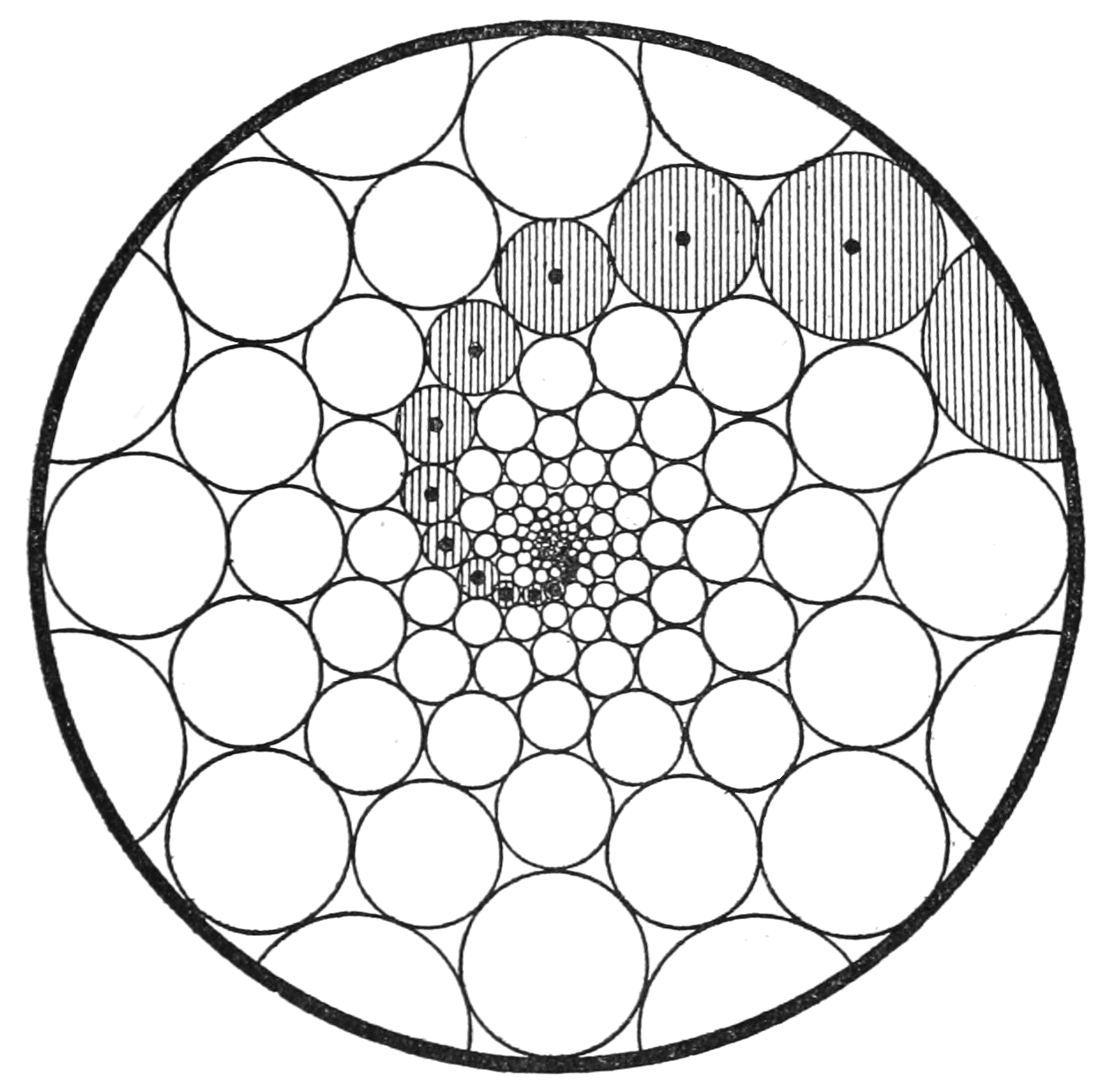
In the mathematics of circle packing, a Doyle spiral is a pattern of non-crossing circles in the plane in which each circle is surrounded by a ring of six tangent circles. These patterns contain spiral arms formed by circles linked through opposite points of tangency, with their centers on logarithmic spirals of three different shapes.
Doyle spirals are named after mathematician Peter G. Doyle, who made an important contribution to their mathematical construction in the late 1980s or early 1990s. However, their study in phyllotaxis (the mathematics of plant growth) dates back to the early 1900s.
A Doyle spiral is defined to be a certain type of circle packing, consisting of infinitely many circles in the plane, with no two circles having overlapping interiors. In a Doyle spiral, each circle is enclosed by a ring of six other circles. The six surrounding circles are tangent to the central circle and to their two neighbors in the ring.
As Doyle observed, the only way to pack circles with the combinatorial structure of a Doyle spiral is to use circles whose radii are also highly structured. Six circles can be packed around a circle of radius if and only if there exist three positive real numbers , , and , so that the surrounding circles have radii (in cyclic order)


Only certain triples of numbers , , and come from Doyle spirals; others correspond to systems of circles that eventually overlap each other.
In a Doyle spiral, one can group the circles into connecting chains of circles through opposite points of tangency. These have been called arms, following the same terminology used for spiral galaxies. Within each arm, the circles have radii in a doubly infinite geometric sequence or a sequence of the same type with common multiplier or . In most Doyle spirals, the centers of the circles on a single arm lie on a logarithmic spiral, and all of the logarithmic spirals obtained in this way meet at a single central point. Some Doyle spirals instead have concentric circular arms (as in the stained glass window shown) or straight arms.


The precise shape of any Doyle spiral can be parameterized by three natural numbers, counting the number of arms of each of its three shapes. When one shape of arm occurs infinitely often, its count is defined as 0, rather than . The smallest arm count equals the difference of the other two arm counts, so any Doyle spiral can be described as being of type , where and are the two largest counts, in the sorted order .


Every pair with determines a Doyle spiral, with its third and smallest arm count equal to . The shape of this spiral is determined uniquely by these counts, up to similarity. For a spiral of type , the radius multipliers are , , and for complex numbers and satisfying the coherence equation and the tangency equations This implies that the radius multipliers are algebraic numbers. The self-similarities of a spiral centered on the origin form a discrete group generated by and . A circle whose center is distance from the central point of the spiral has radius .



Hub AI
Doyle spiral AI simulator
(@Doyle spiral_simulator)
Doyle spiral
In the mathematics of circle packing, a Doyle spiral is a pattern of non-crossing circles in the plane in which each circle is surrounded by a ring of six tangent circles. These patterns contain spiral arms formed by circles linked through opposite points of tangency, with their centers on logarithmic spirals of three different shapes.
Doyle spirals are named after mathematician Peter G. Doyle, who made an important contribution to their mathematical construction in the late 1980s or early 1990s. However, their study in phyllotaxis (the mathematics of plant growth) dates back to the early 1900s.
A Doyle spiral is defined to be a certain type of circle packing, consisting of infinitely many circles in the plane, with no two circles having overlapping interiors. In a Doyle spiral, each circle is enclosed by a ring of six other circles. The six surrounding circles are tangent to the central circle and to their two neighbors in the ring.
As Doyle observed, the only way to pack circles with the combinatorial structure of a Doyle spiral is to use circles whose radii are also highly structured. Six circles can be packed around a circle of radius if and only if there exist three positive real numbers , , and , so that the surrounding circles have radii (in cyclic order)
Only certain triples of numbers , , and come from Doyle spirals; others correspond to systems of circles that eventually overlap each other.
In a Doyle spiral, one can group the circles into connecting chains of circles through opposite points of tangency. These have been called arms, following the same terminology used for spiral galaxies. Within each arm, the circles have radii in a doubly infinite geometric sequence or a sequence of the same type with common multiplier or . In most Doyle spirals, the centers of the circles on a single arm lie on a logarithmic spiral, and all of the logarithmic spirals obtained in this way meet at a single central point. Some Doyle spirals instead have concentric circular arms (as in the stained glass window shown) or straight arms.
The precise shape of any Doyle spiral can be parameterized by three natural numbers, counting the number of arms of each of its three shapes. When one shape of arm occurs infinitely often, its count is defined as 0, rather than . The smallest arm count equals the difference of the other two arm counts, so any Doyle spiral can be described as being of type , where and are the two largest counts, in the sorted order .
Every pair with determines a Doyle spiral, with its third and smallest arm count equal to . The shape of this spiral is determined uniquely by these counts, up to similarity. For a spiral of type , the radius multipliers are , , and for complex numbers and satisfying the coherence equation and the tangency equations This implies that the radius multipliers are algebraic numbers. The self-similarities of a spiral centered on the origin form a discrete group generated by and . A circle whose center is distance from the central point of the spiral has radius .
Recent media