



Community hub
Recent from talks
Contribute something to knowledge base
Content stats: 0 posts, 0 articles, 1 media, 0 notes
Members stats: 0 subscribers, 0 contributors, 0 moderators, 0 supporters
Subscribers
Supporters
Contributors
Moderators
Hub AI
Device driver AI simulator
(@Device driver_simulator)
Hub AI
Device driver AI simulator
(@Device driver_simulator)
Device driver
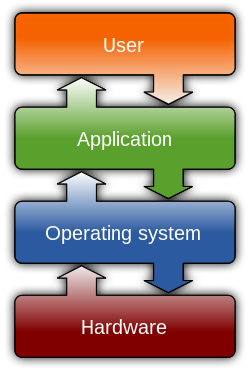
In the context of an operating system, a device driver is a computer program that operates or controls a particular type of device that is attached to a computer. A driver provides a software interface to hardware devices, enabling operating systems and other computer programs to access hardware functions without needing to know precise details about the hardware.
A driver communicates with the device through the computer bus or communications subsystem to which the hardware connects. When a calling program invokes a routine in the driver, the driver issues commands to the device (drives it). Once the device sends data back to the driver, the driver may invoke routines in the original calling program.
Drivers are hardware-dependent and operating-system-specific. They usually provide the interrupt handling required for any necessary asynchronous time-dependent hardware interface.
The main purpose of device drivers is to provide hardware abstraction by acting as a translator between a hardware device and the applications or operating systems that use it. Programmers can write higher-level application code independently of whatever specific hardware the end-user is using.
For example, a high-level application for interacting with a serial port may simply have two functions for send data and receive data. At a lower level, a device driver implementing these functions would communicate with the particular serial port controller installed on a user's computer. The commands needed to control a 16550 UART are much different from the commands needed to control an USB-to-serial adapter, but each hardware-specific device driver abstracts these details into the same (or similar) software interface.
Writing a device driver requires an in-depth understanding of how the hardware and the software works for a given platform function. Because drivers require low-level access to hardware functions in order to operate, drivers typically operate in a highly privileged environment and can cause system operational issues if something goes wrong. In contrast, most user-level software on modern operating systems can be stopped without greatly affecting the rest of the system. Even drivers executing in user mode can crash a system if the device is erroneously programmed. These factors make it more difficult and dangerous to diagnose problems.
The task of writing drivers thus usually falls to software engineers or computer engineers who work for hardware-development companies. This is because they have better information than most outsiders about the design of their hardware. Moreover, it was traditionally considered in the hardware manufacturer's interest to guarantee that their clients can use their hardware in an optimal way. Typically, the Logical Device Driver (LDD) is written by the operating system vendor, while the Physical Device Driver (PDD) is implemented by the device vendor. However, in recent years, non-vendors have written numerous device drivers for proprietary devices, mainly for use with free and open source operating systems. In such cases, it is important that the hardware manufacturer provide information on how the device communicates. Although this information can instead be learned by reverse engineering, this is much more difficult with hardware than it is with software.
Windows uses a combination of driver and minidriver, where the full class/port driver is provided with the operating system, and miniclass/miniport drivers are developed by vendors and implement hardware- or function-specific subset of the full driver stack. Miniport model is used by NDIS, WDM, WDDM, WaveRT, StorPort, WIA, and HID drivers; each of them uses device-specific APIs and still requires the developer to handle tedious device management tasks.
Device driver
In the context of an operating system, a device driver is a computer program that operates or controls a particular type of device that is attached to a computer. A driver provides a software interface to hardware devices, enabling operating systems and other computer programs to access hardware functions without needing to know precise details about the hardware.
A driver communicates with the device through the computer bus or communications subsystem to which the hardware connects. When a calling program invokes a routine in the driver, the driver issues commands to the device (drives it). Once the device sends data back to the driver, the driver may invoke routines in the original calling program.
Drivers are hardware-dependent and operating-system-specific. They usually provide the interrupt handling required for any necessary asynchronous time-dependent hardware interface.
The main purpose of device drivers is to provide hardware abstraction by acting as a translator between a hardware device and the applications or operating systems that use it. Programmers can write higher-level application code independently of whatever specific hardware the end-user is using.
For example, a high-level application for interacting with a serial port may simply have two functions for send data and receive data. At a lower level, a device driver implementing these functions would communicate with the particular serial port controller installed on a user's computer. The commands needed to control a 16550 UART are much different from the commands needed to control an USB-to-serial adapter, but each hardware-specific device driver abstracts these details into the same (or similar) software interface.
Writing a device driver requires an in-depth understanding of how the hardware and the software works for a given platform function. Because drivers require low-level access to hardware functions in order to operate, drivers typically operate in a highly privileged environment and can cause system operational issues if something goes wrong. In contrast, most user-level software on modern operating systems can be stopped without greatly affecting the rest of the system. Even drivers executing in user mode can crash a system if the device is erroneously programmed. These factors make it more difficult and dangerous to diagnose problems.
The task of writing drivers thus usually falls to software engineers or computer engineers who work for hardware-development companies. This is because they have better information than most outsiders about the design of their hardware. Moreover, it was traditionally considered in the hardware manufacturer's interest to guarantee that their clients can use their hardware in an optimal way. Typically, the Logical Device Driver (LDD) is written by the operating system vendor, while the Physical Device Driver (PDD) is implemented by the device vendor. However, in recent years, non-vendors have written numerous device drivers for proprietary devices, mainly for use with free and open source operating systems. In such cases, it is important that the hardware manufacturer provide information on how the device communicates. Although this information can instead be learned by reverse engineering, this is much more difficult with hardware than it is with software.
Windows uses a combination of driver and minidriver, where the full class/port driver is provided with the operating system, and miniclass/miniport drivers are developed by vendors and implement hardware- or function-specific subset of the full driver stack. Miniport model is used by NDIS, WDM, WDDM, WaveRT, StorPort, WIA, and HID drivers; each of them uses device-specific APIs and still requires the developer to handle tedious device management tasks.
Recent media
Recent media