



Community hub
Recent from talks
Knowledge base stats:
Talk channels stats:
Members stats:
Drug resistance
Drug resistance is the reduction in effectiveness of a medication such as an antimicrobial or an antineoplastic in treating a disease or condition. The term is used in the context of resistance that pathogens or cancers have "acquired", that is, resistance has evolved. Antimicrobial resistance and antineoplastic resistance challenge clinical care and drive research. When an organism is resistant to more than one drug, it is said to be multidrug-resistant.
The development of antibiotic resistance in particular stems from the drugs targeting only specific bacterial molecules (almost always proteins). Because the drug is so specific, any mutation in these molecules will interfere with or negate its destructive effect, resulting in antibiotic resistance. Furthermore, there is mounting concern over the abuse of antibiotics in the farming of livestock, which in the European Union alone accounts for three times the volume dispensed to humans – leading to development of super-resistant bacteria.
Bacteria are capable of not only altering the enzyme targeted by antibiotics, but also by the use of enzymes to modify the antibiotic itself and thus neutralize it. Examples of target-altering pathogens are Staphylococcus aureus, vancomycin-resistant enterococci and macrolide-resistant Streptococcus, while examples of antibiotic-modifying microbes are Pseudomonas aeruginosa and aminoglycoside-resistant Acinetobacter baumannii.
In short, the lack of concerted effort by governments and the pharmaceutical industry, together with the innate capacity of microbes to develop resistance at a rate that outpaces development of new drugs, suggests that existing strategies for developing viable, long-term anti-microbial therapies are ultimately doomed to failure. Without alternative strategies, the acquisition of drug resistance by pathogenic microorganisms looms as possibly one of the most significant public health threats facing humanity in the 21st century. Some of the best alternative sources to reduce the chance of antibiotic resistance are probiotics, prebiotics, dietary fibers, enzymes, organic acids, phytogenics.
Escherichia coli, Staphylococcus aureus, Klebsiella pneumoniae, Streptococcus pneumoniae, Acinetobacter baumannii, and P aeruginosa were the six main causes (73%) of AMR-associated mortality in 2019, according to the 2022 Global Burden of Disease research.
AMR not only causes death and disability, but it also has high financial expenses. AMR may lead to US$ 1 trillion in higher healthcare expenses by 2050 and US$ 1 trillion to US$ 3.4 trillion in annual GDP losses by 2030, according to World Bank estimations.
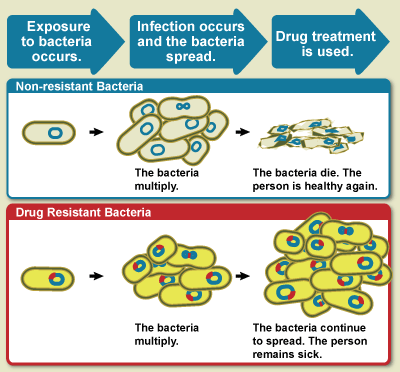
Drug, toxin, or chemical resistance is a consequence of evolution and is a response to pressures imposed on any living organism. Individual organisms vary in their sensitivity to the drug used and some with greater fitness may be capable of surviving drug treatment. Drug-resistant traits are accordingly inherited by subsequent offspring, resulting in a population that is more drug-resistant. Unless the drug used makes sexual reproduction or cell-division or horizontal gene transfer impossible in the entire target population, resistance to the drug will inevitably follow. This can be seen in cancerous tumors where some cells may develop resistance to the drugs used in chemotherapy. Chemotherapy causes fibroblasts near tumors to produce large amounts of the protein WNT16B. This protein stimulates the growth of cancer cells which are drug-resistant. MicroRNAs have also been shown to affect acquired drug resistance in cancer cells and this can be used for therapeutic purposes. Malaria in 2012 has become a resurgent threat in South East Asia and sub-Saharan Africa, and drug-resistant strains of Plasmodium falciparum are posing massive problems for health authorities. Leprosy has shown an increasing resistance to dapsone.
A rapid process of sharing resistance exists among single-celled organisms, and is termed horizontal gene transfer in which there is a direct exchange of genes, particularly in the biofilm state. A similar asexual method is used by fungi and is called "parasexuality". Examples of drug-resistant strains are to be found in microorganisms such as bacteria and viruses, parasites both endo- and ecto-, plants, fungi, arthropods, mammals, birds, reptiles, fish, and amphibians.
Hub AI
Drug resistance AI simulator
(@Drug resistance_simulator)
Drug resistance
Drug resistance is the reduction in effectiveness of a medication such as an antimicrobial or an antineoplastic in treating a disease or condition. The term is used in the context of resistance that pathogens or cancers have "acquired", that is, resistance has evolved. Antimicrobial resistance and antineoplastic resistance challenge clinical care and drive research. When an organism is resistant to more than one drug, it is said to be multidrug-resistant.
The development of antibiotic resistance in particular stems from the drugs targeting only specific bacterial molecules (almost always proteins). Because the drug is so specific, any mutation in these molecules will interfere with or negate its destructive effect, resulting in antibiotic resistance. Furthermore, there is mounting concern over the abuse of antibiotics in the farming of livestock, which in the European Union alone accounts for three times the volume dispensed to humans – leading to development of super-resistant bacteria.
Bacteria are capable of not only altering the enzyme targeted by antibiotics, but also by the use of enzymes to modify the antibiotic itself and thus neutralize it. Examples of target-altering pathogens are Staphylococcus aureus, vancomycin-resistant enterococci and macrolide-resistant Streptococcus, while examples of antibiotic-modifying microbes are Pseudomonas aeruginosa and aminoglycoside-resistant Acinetobacter baumannii.
In short, the lack of concerted effort by governments and the pharmaceutical industry, together with the innate capacity of microbes to develop resistance at a rate that outpaces development of new drugs, suggests that existing strategies for developing viable, long-term anti-microbial therapies are ultimately doomed to failure. Without alternative strategies, the acquisition of drug resistance by pathogenic microorganisms looms as possibly one of the most significant public health threats facing humanity in the 21st century. Some of the best alternative sources to reduce the chance of antibiotic resistance are probiotics, prebiotics, dietary fibers, enzymes, organic acids, phytogenics.
Escherichia coli, Staphylococcus aureus, Klebsiella pneumoniae, Streptococcus pneumoniae, Acinetobacter baumannii, and P aeruginosa were the six main causes (73%) of AMR-associated mortality in 2019, according to the 2022 Global Burden of Disease research.
AMR not only causes death and disability, but it also has high financial expenses. AMR may lead to US$ 1 trillion in higher healthcare expenses by 2050 and US$ 1 trillion to US$ 3.4 trillion in annual GDP losses by 2030, according to World Bank estimations.
Drug, toxin, or chemical resistance is a consequence of evolution and is a response to pressures imposed on any living organism. Individual organisms vary in their sensitivity to the drug used and some with greater fitness may be capable of surviving drug treatment. Drug-resistant traits are accordingly inherited by subsequent offspring, resulting in a population that is more drug-resistant. Unless the drug used makes sexual reproduction or cell-division or horizontal gene transfer impossible in the entire target population, resistance to the drug will inevitably follow. This can be seen in cancerous tumors where some cells may develop resistance to the drugs used in chemotherapy. Chemotherapy causes fibroblasts near tumors to produce large amounts of the protein WNT16B. This protein stimulates the growth of cancer cells which are drug-resistant. MicroRNAs have also been shown to affect acquired drug resistance in cancer cells and this can be used for therapeutic purposes. Malaria in 2012 has become a resurgent threat in South East Asia and sub-Saharan Africa, and drug-resistant strains of Plasmodium falciparum are posing massive problems for health authorities. Leprosy has shown an increasing resistance to dapsone.
A rapid process of sharing resistance exists among single-celled organisms, and is termed horizontal gene transfer in which there is a direct exchange of genes, particularly in the biofilm state. A similar asexual method is used by fungi and is called "parasexuality". Examples of drug-resistant strains are to be found in microorganisms such as bacteria and viruses, parasites both endo- and ecto-, plants, fungi, arthropods, mammals, birds, reptiles, fish, and amphibians.