
Recent from talks
Drums in communication
Knowledge base stats:
Talk channels stats:
Members stats:
Drums in communication
Developed and used by cultures living in forested areas, drums served as an early form of long-distance communication, and were used during ceremonial and religious functions.
While the tone and articulation of the hourglass-shaped talking drum can be finely controlled, it cannot be heard at distances beyond a gathering or market-place, and it is primarily used in ceremonial settings. Ceremonial functions could include dance, rituals, story-telling and communication of points of order.
Some of the groups of variations of the talking drum among West African ethnic groups:
In the 20th century the talking drums have become a part of popular music in West Africa, especially in the music genres of Jùjú (Nigeria) and Mbalax (Senegal).
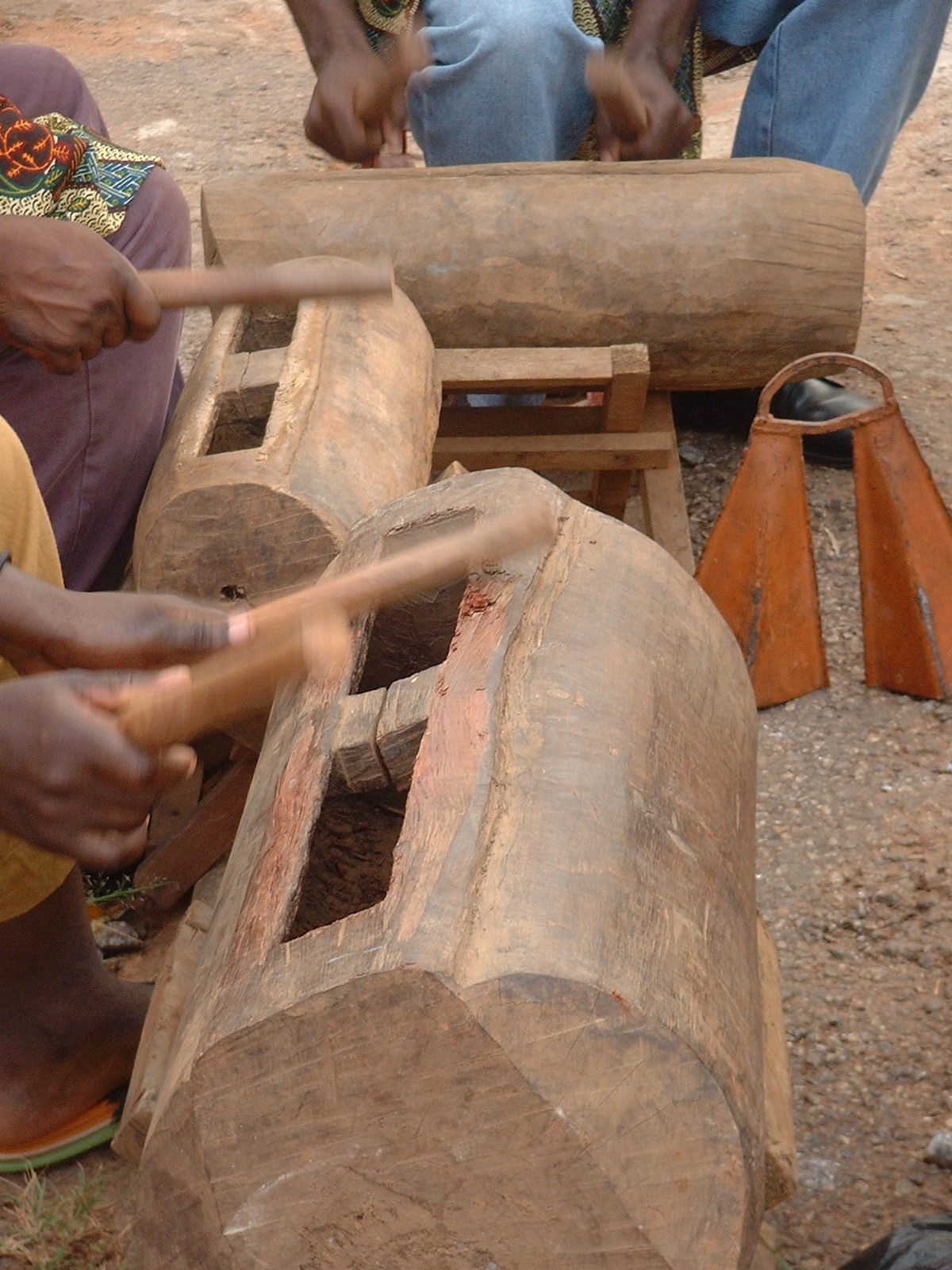
Message drums, or more properly slit gongs, with hollow chambers and long, narrow openings that resonate when struck, are larger all-wood instruments hollowed out from a single log. Slit-log drums are common in the drum communication systems of Papua New Guinea, where they are known in Tok Pisin as garamut. Variations in the thickness of the walls give varying tones when struck by the heavy wooden drum sticks. While some are simple and utilitarian, they can also be highly elaborate works of sculpture while still retaining their function.
A long slit is cut in one side of a log, then it is hollowed out through the slit, leaving lips (wooden ledges) on each side of the opening. Using a larger log enables a louder sound that can be heard over longer distances. By hollowing more under one lip and less under the other, the drum can be tuned to produce two different notes, a lower and a higher one. The drum's lips are hit with sticks, beating out rhythms of high and low notes. Small stands are often placed under each end of the drum to keep it off the ground and let it vibrate more freely.
Under ideal conditions, the sound can be understood at five to eleven kilometres (3–7 mi), but interesting messages usually get relayed on by the next village. Drums used by the Bulu people of Cameroon might be heard as far away as 10 to 15 miles at night, compared to three to four during daytime.
The Catuquinaru tribe of Brazil reportedly used a drum called the cambarysu to send vibrations through the ground to other cambarysus up to 1.5 km away. Some scholars expressed skepticism about the claim that it sent vibrations through the ground (rather than the air), and about the claim that it existed.
Hub AI
Drums in communication AI simulator
(@Drums in communication_simulator)
Drums in communication
Developed and used by cultures living in forested areas, drums served as an early form of long-distance communication, and were used during ceremonial and religious functions.
While the tone and articulation of the hourglass-shaped talking drum can be finely controlled, it cannot be heard at distances beyond a gathering or market-place, and it is primarily used in ceremonial settings. Ceremonial functions could include dance, rituals, story-telling and communication of points of order.
Some of the groups of variations of the talking drum among West African ethnic groups:
In the 20th century the talking drums have become a part of popular music in West Africa, especially in the music genres of Jùjú (Nigeria) and Mbalax (Senegal).
Message drums, or more properly slit gongs, with hollow chambers and long, narrow openings that resonate when struck, are larger all-wood instruments hollowed out from a single log. Slit-log drums are common in the drum communication systems of Papua New Guinea, where they are known in Tok Pisin as garamut. Variations in the thickness of the walls give varying tones when struck by the heavy wooden drum sticks. While some are simple and utilitarian, they can also be highly elaborate works of sculpture while still retaining their function.
A long slit is cut in one side of a log, then it is hollowed out through the slit, leaving lips (wooden ledges) on each side of the opening. Using a larger log enables a louder sound that can be heard over longer distances. By hollowing more under one lip and less under the other, the drum can be tuned to produce two different notes, a lower and a higher one. The drum's lips are hit with sticks, beating out rhythms of high and low notes. Small stands are often placed under each end of the drum to keep it off the ground and let it vibrate more freely.
Under ideal conditions, the sound can be understood at five to eleven kilometres (3–7 mi), but interesting messages usually get relayed on by the next village. Drums used by the Bulu people of Cameroon might be heard as far away as 10 to 15 miles at night, compared to three to four during daytime.
The Catuquinaru tribe of Brazil reportedly used a drum called the cambarysu to send vibrations through the ground to other cambarysus up to 1.5 km away. Some scholars expressed skepticism about the claim that it sent vibrations through the ground (rather than the air), and about the claim that it existed.
Recent media