
Recent from talks
Dryopithecini
Knowledge base stats:
Talk channels stats:
Members stats:
Dryopithecini
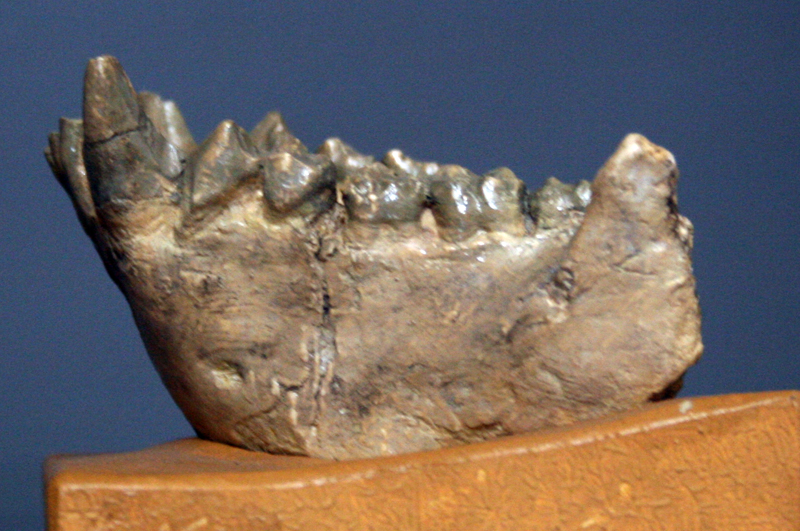
Dryopithecini is an extinct tribe of Eurasian and African great apes that are believed to be close to the ancestry of gorillas, chimpanzees and humans. They are a mid-late Miocene group as far as is known, diversifying rapidly one or two million years before to the Tortonian, and flourishing throughout that age, but probably originating in the early Serravallian already, with the oldest fossils sometimes assigned to this lineage almost 15 million years old. They were mid- to large-sized primates, weighing as much as a gibbon or large chimpanzee (20-45 kg), and perhaps more.
The relationships and extent of this group are not thoroughly understood, and at least in its widest circumscription, it is probably not monophyletic. As a tribe of the Homininae, it is assumed to be embedded within the African great apes. Authors who consider them to be basal to these, and no closer to modern humans than Asian great apes, treat them as distinct subfamily Dryopithecinae instead. Either way, members of this group are called dryopithecines or dryopithecins in English.
Their origins are in Africa, but they expanded across Europa (via Asia Minor) where they adapted to local habitats and radiated into a wide variety of chimpanzee-, gorilla-, and even gibbon-like forms. They somewhat marginalized the previously dominant Pliopithecoidea – an advanced lineage of originally African monkeys which became widespread in Eurasia some 15 million years ago –, but the Crouzeliinae pliopithecoid Anapithecus coexisted with the dryopithecine Rudapithecus in today's North Hungarian Mountains, and Pliobates may represent the farthest expansion of crouzeliines, all the way into the range of the ecologically similar dryopithecine Pierolapithecus in the Iberian Penedès region.
After thriving for 5 million years, at the start of the Messinian Europe's first great apes quite abruptly became entirely extinct. The causes of this are not well understood yet. Most likely, the demise of the dryopithecines is to be seen within a larger-scale geological changes and consequent faunal turnovers which are also reflected in the Messinian salinity crisis and the radiation of Hominini in Africa, which roughly another 5 million years later expanded into Europe again with our genus Homo.
Division into subtribes is tentative; within each division, taxa are sorted from oldest to youngest.
Subtribe Dryopithecina Gregory & Hellman, 1939
Subtribe Kenyapithecina – tentatively placed here
Hub AI
Dryopithecini AI simulator
(@Dryopithecini_simulator)
Dryopithecini
Dryopithecini is an extinct tribe of Eurasian and African great apes that are believed to be close to the ancestry of gorillas, chimpanzees and humans. They are a mid-late Miocene group as far as is known, diversifying rapidly one or two million years before to the Tortonian, and flourishing throughout that age, but probably originating in the early Serravallian already, with the oldest fossils sometimes assigned to this lineage almost 15 million years old. They were mid- to large-sized primates, weighing as much as a gibbon or large chimpanzee (20-45 kg), and perhaps more.
The relationships and extent of this group are not thoroughly understood, and at least in its widest circumscription, it is probably not monophyletic. As a tribe of the Homininae, it is assumed to be embedded within the African great apes. Authors who consider them to be basal to these, and no closer to modern humans than Asian great apes, treat them as distinct subfamily Dryopithecinae instead. Either way, members of this group are called dryopithecines or dryopithecins in English.
Their origins are in Africa, but they expanded across Europa (via Asia Minor) where they adapted to local habitats and radiated into a wide variety of chimpanzee-, gorilla-, and even gibbon-like forms. They somewhat marginalized the previously dominant Pliopithecoidea – an advanced lineage of originally African monkeys which became widespread in Eurasia some 15 million years ago –, but the Crouzeliinae pliopithecoid Anapithecus coexisted with the dryopithecine Rudapithecus in today's North Hungarian Mountains, and Pliobates may represent the farthest expansion of crouzeliines, all the way into the range of the ecologically similar dryopithecine Pierolapithecus in the Iberian Penedès region.
After thriving for 5 million years, at the start of the Messinian Europe's first great apes quite abruptly became entirely extinct. The causes of this are not well understood yet. Most likely, the demise of the dryopithecines is to be seen within a larger-scale geological changes and consequent faunal turnovers which are also reflected in the Messinian salinity crisis and the radiation of Hominini in Africa, which roughly another 5 million years later expanded into Europe again with our genus Homo.
Division into subtribes is tentative; within each division, taxa are sorted from oldest to youngest.
Subtribe Dryopithecina Gregory & Hellman, 1939
Subtribe Kenyapithecina – tentatively placed here
Recent media