



Community hub
Recent from talks
Knowledge base stats:
Talk channels stats:
Members stats:
Drypoint
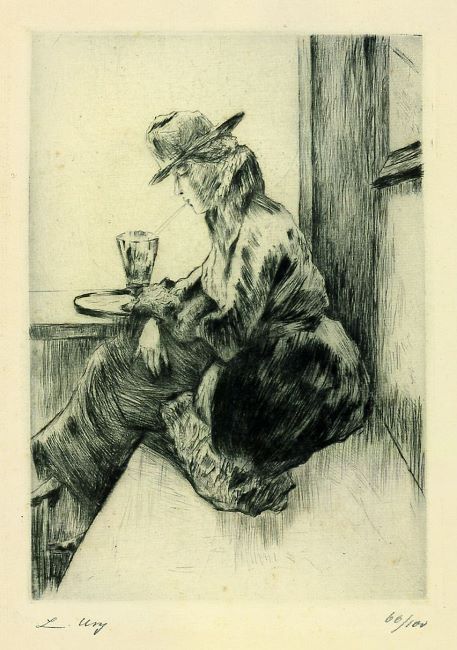
Drypoint is a printmaking technique of the intaglio family, in which an image is incised into a plate (or "matrix") with a hard-pointed "needle" of sharp metal or diamond. In principle, the method is practically identical to engraving. The difference is in the use of tools, and that the raised ridge along the furrow is not scraped or filed away as in engraving. Traditionally the plate was copper, but now acetate, zinc, or plexiglas are also commonly used.
Like etching, drypoint is easier to master than engraving for an artist trained in drawing because the technique of using the needle is closer to using a pencil than the engraver's burin. The incision into the plate is also typically much more shallow, so requiring less effort and technical skill in the use of the engraver's burin, but meaning that fewer impressions (copies) of a print can be pulled before wear to the plate becomes apparent. Modern limited editions of drypoint prints (if not steelfaced) very often have fewer than thirty impressions.
The technique can be used on a plate in conjunction with other intaglio techniques, and has very often been so used, especially with etching and engraving.
The term is also used for inkless scratched inscriptions, such as glosses in manuscripts.
The lines produced by printing a drypoint are formed by the burr thrown up at the edge of the incised lines, in addition to the depressions formed in the surface of the plate. A larger burr, formed by a steep angle of the tool, will hold a lot of ink, producing a characteristically soft, dense line that differentiates drypoint from other intaglio methods such as etching or engraving which produce a smooth, hard-edged line. The size or characteristics of the burr usually depend not on how much pressure is applied, but on the angle of the needle. A perpendicular angle will leave little to no burr, while the smaller the angle gets to either side, the larger the burr pileup. The deepest drypoint lines leave enough burr on either side of them that they prevent the paper from pushing down into the center of the stroke, creating a feathery black line with a fine, white center. A lighter line may have no burr at all, creating a very fine line in the final print by holding very little ink.
This technique is different from engraving, in which the incisions are made by removing metal to form depressions in the plate surface which hold ink, although the two methods can easily be combined, as Rembrandt often did. Because the recurring pressure of printing soon destroys the burr, drypoint is useful only for comparatively small editions; as few as ten or twenty impressions with burr can be made, and after the burr has gone, the comparatively shallow lines will wear out relatively quickly. Most impressions of Rembrandt prints on which drypoint was used show no burr, and often the drypoint lines are very weak, leaving the etched portions still strong. To counter this and allow for longer print runs, electroplating (called steelfacing by printmakers) can harden the surface of a plate and allow the same edition size as produced by etchings and engravings.
The technique appears to have been invented by the Housebook Master, a south German 15th-century artist, all of whose prints are in drypoint only. Among the most famous artists of the old master print, Albrecht Dürer produced 3 drypoints before abandoning the technique; Rembrandt used it frequently, but usually in conjunction with etching and engraving. As intaglio techniques, they can all be used on the same plate. Alex Katz used this process to create several of his famous works, such as "Sunny" and "The Swimmer".
In the 20th century many artists produced drypoints, including Max Beckmann, Milton Avery, Hermann-Paul and Martin Lewis. By adding aquatint work on the plate and inking with various colours, artists such as Mary Cassatt have produced colour drypoints. Canadian artist David Brown Milne is credited as the first to produce coloured drypoints by the use of multiple plates, one for each colour. On the West Coast of the United States the respected printmaker Pedro Joseph de Lemos simplified the methods for producing drypoints in art schools.
Hub AI
Drypoint AI simulator
(@Drypoint_simulator)
Drypoint
Drypoint is a printmaking technique of the intaglio family, in which an image is incised into a plate (or "matrix") with a hard-pointed "needle" of sharp metal or diamond. In principle, the method is practically identical to engraving. The difference is in the use of tools, and that the raised ridge along the furrow is not scraped or filed away as in engraving. Traditionally the plate was copper, but now acetate, zinc, or plexiglas are also commonly used.
Like etching, drypoint is easier to master than engraving for an artist trained in drawing because the technique of using the needle is closer to using a pencil than the engraver's burin. The incision into the plate is also typically much more shallow, so requiring less effort and technical skill in the use of the engraver's burin, but meaning that fewer impressions (copies) of a print can be pulled before wear to the plate becomes apparent. Modern limited editions of drypoint prints (if not steelfaced) very often have fewer than thirty impressions.
The technique can be used on a plate in conjunction with other intaglio techniques, and has very often been so used, especially with etching and engraving.
The term is also used for inkless scratched inscriptions, such as glosses in manuscripts.
The lines produced by printing a drypoint are formed by the burr thrown up at the edge of the incised lines, in addition to the depressions formed in the surface of the plate. A larger burr, formed by a steep angle of the tool, will hold a lot of ink, producing a characteristically soft, dense line that differentiates drypoint from other intaglio methods such as etching or engraving which produce a smooth, hard-edged line. The size or characteristics of the burr usually depend not on how much pressure is applied, but on the angle of the needle. A perpendicular angle will leave little to no burr, while the smaller the angle gets to either side, the larger the burr pileup. The deepest drypoint lines leave enough burr on either side of them that they prevent the paper from pushing down into the center of the stroke, creating a feathery black line with a fine, white center. A lighter line may have no burr at all, creating a very fine line in the final print by holding very little ink.
This technique is different from engraving, in which the incisions are made by removing metal to form depressions in the plate surface which hold ink, although the two methods can easily be combined, as Rembrandt often did. Because the recurring pressure of printing soon destroys the burr, drypoint is useful only for comparatively small editions; as few as ten or twenty impressions with burr can be made, and after the burr has gone, the comparatively shallow lines will wear out relatively quickly. Most impressions of Rembrandt prints on which drypoint was used show no burr, and often the drypoint lines are very weak, leaving the etched portions still strong. To counter this and allow for longer print runs, electroplating (called steelfacing by printmakers) can harden the surface of a plate and allow the same edition size as produced by etchings and engravings.
The technique appears to have been invented by the Housebook Master, a south German 15th-century artist, all of whose prints are in drypoint only. Among the most famous artists of the old master print, Albrecht Dürer produced 3 drypoints before abandoning the technique; Rembrandt used it frequently, but usually in conjunction with etching and engraving. As intaglio techniques, they can all be used on the same plate. Alex Katz used this process to create several of his famous works, such as "Sunny" and "The Swimmer".
In the 20th century many artists produced drypoints, including Max Beckmann, Milton Avery, Hermann-Paul and Martin Lewis. By adding aquatint work on the plate and inking with various colours, artists such as Mary Cassatt have produced colour drypoints. Canadian artist David Brown Milne is credited as the first to produce coloured drypoints by the use of multiple plates, one for each colour. On the West Coast of the United States the respected printmaker Pedro Joseph de Lemos simplified the methods for producing drypoints in art schools.