Hubbry Logo
Dual-purpose gunDual-purpose gunMain
Open search
Dual-purpose gun
Community hub
Dual-purpose gun
logo
8 pages, 0 posts
0 subscribers
Be the first to start a discussion here.
Dual-purpose gun
Dual-purpose gun
from Wikipedia

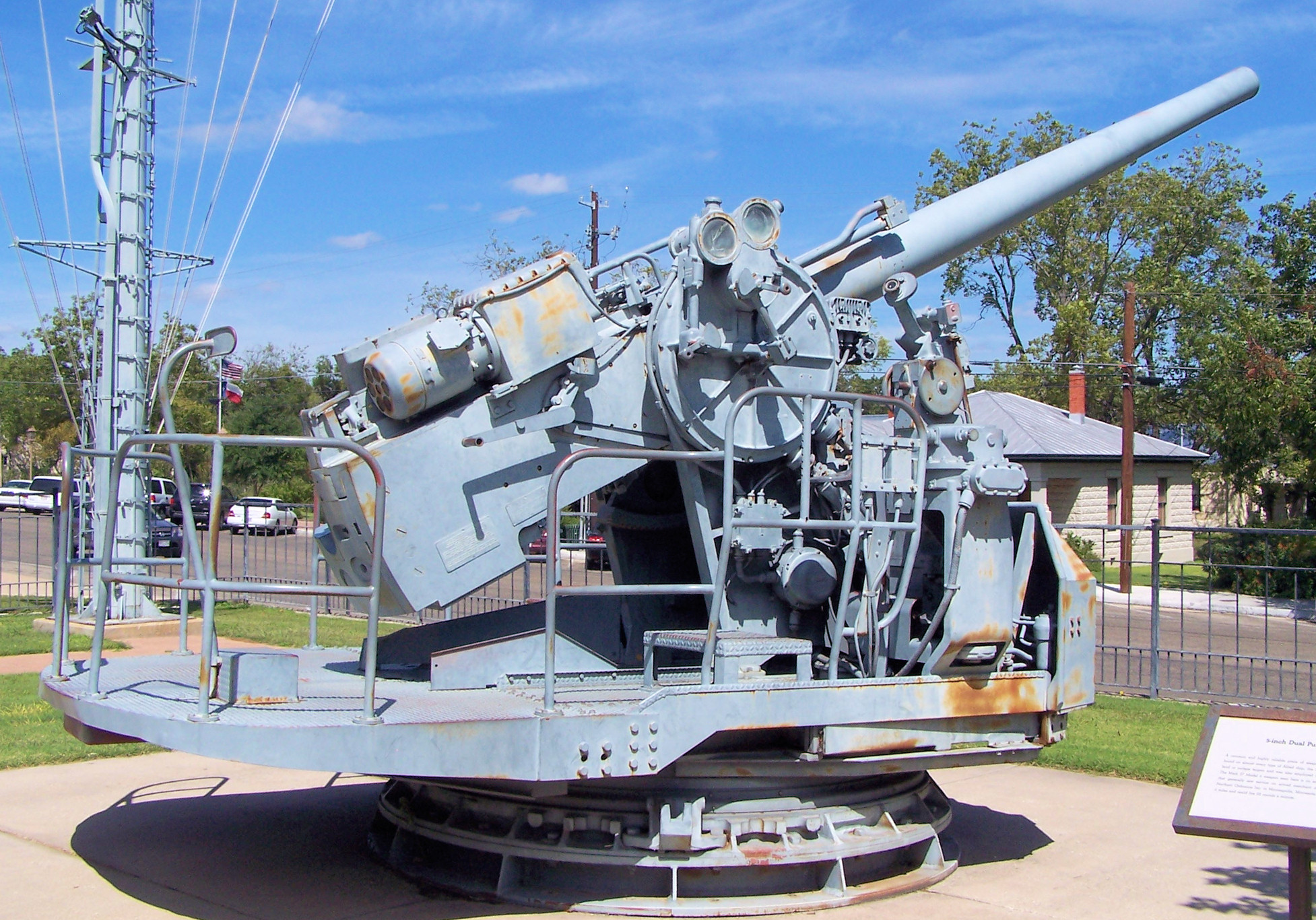
The Mark 37 Modification 6 5-inch dual-purpose gun on display at the National Museum of the Pacific War. The gun had a range of over 6 miles and could fire 22 rounds a minute.

A dual-purpose gun is a naval artillery mounting designed to engage both surface and air targets.

Description

[edit]

Second World War-era capital ships had four classes of artillery: the heavy main battery, intended to engage opposing battleships and cruisers of 305 mm to 457 mm (12 inch to 18 inch); a secondary battery for use against enemy destroyers of 152 mm to 203 mm (6 inch to 8 inch); heavy anti-aircraft guns of 76 mm to 127 mm (3 inch to 5 inch), which could create barrages to knock out airplanes at a distance; finally, light rapid-fire anti-aircraft batteries (A/A) to track and bring down aircraft at close range. The light A/A was dispersed throughout the ship and included both automatic cannons of 20 mm to 40 mm (.787 inch to 1.57 inch) and heavy machine guns of 12.7 mm to 14.5 mm (.50 inch to .58 inch).

During World War II, the US Navy, Royal Navy, the French Navy, and the Imperial Japanese Navy combined the secondary battery with the heavy anti-aircraft guns, creating a dual-purpose secondary battery. They discarded the dedicated, anti-ship secondary batteries altogether, because a battle-line fleet would be screened against cruisers and destroyers most of the time. Also, it was deemed unlikely that a battleship would be simultaneously facing both rushing destroyers and aircraft, and it would take up too much space to have separate types of guns to deal with both threats. Rather, they replaced them with turret-mounted dual-purpose guns that could be used against both aircraft and ships. The space saved from combining the two types of guns added to simplification of supply, increased deck armour coverage, stowage of other equipment, a larger light anti-aircraft battery, and other needs. This arrangement was seen as more efficient, and was deemed adequate to meet anti-surface and anti-aircraft needs under most circumstances.

The Kriegsmarine, in a practice similar to the Italian and Soviet navies, adopted a mixed-calibre secondary battery, with dedicated anti-ship guns, coupled with smaller-calibre heavy anti-aircraft batteries, instead of adopting dual-purpose secondaries like the British or Americans. Both navies were concerned by possible close-range torpedo attacks from enemy (in particular, French) destroyers and torpedo boats, and considered the more powerful, larger calibre anti-ship secondaries a must. The French Navy used a mixed-calibre system, as well, but their secondary battery was dual-purpose. This tended to complicate ammunition supplies and render certain armament useless in some situations.

Dual-purpose guns are designed as a compromise between the heavy main armament of a surface combatant and dedicated anti-aircraft guns. Usually of a mid-range caliber, the gun is heavy enough to prove useful against surface targets including ships, surfaced submarines, and land targets. However, it is compact enough to fit into a mounting capable of good traverse and high elevation, as well as being capable of a high rate of fire, allowing it to successfully engage air targets at all angles. For example, a Royal Navy battleship of the King George V class had sixteen QF Mark I 5.25-inch (133 mm) guns that could engage either enemy ships or high level aircraft, as necessary.

Not all dual-purpose guns have high elevation. The determining factor was whether or not the mounting was provided with an anti-aircraft fire control system and a method for setting the time fuze in the A.A. warhead, fired by the gun. Starting with the Tribal class, the Royal Navy introduced a series of destroyer classes that had dual-purpose guns, but in 4.7 inch QF Mark XII, twin CP Mk. XIX and later mountings limited to 40, 50 or 55 degrees elevation, however, the guns were controlled by an A.A. fire control system and the mountings were provided with A.A. shell fuze setters. The USN had developed a similar class of destroyer, the Porter class with eight Mk 12 5-inch/38-caliber (127 mm) guns in four Mark 22 Single Purpose (surface action only) twin mounts, limited to 35 degrees elevation, but with no provision for A.A. fire control and no on-mount fuze setters.[1] The 40-degree elevation did limit the ability of the Tribal class[2] guns to engage dive and high altitude bombers but they were still effective in engaging low altitude, level, and torpedo bombers and could still provide barrage fire over other ships being attacked by dive bombers. Admiral Sir Philip Vian describes the use of 4.7 inch Mark XII guns against aircraft during the 1940 campaign in Norway:

"It became clear at once that in an attack from the air in narrow waters flanked by mountains, the cards were held by the aircraft. There was too little sea-room for full freedom of manoeuvre, and the aircraft's approach was screened by the rock walls. As often as not, when they did come into view it was at such an angle that our 4.7-inch guns, whose maximum elevation was only forty degrees, could not reach them...Aandalsnes is approached through the Romsdal Fiord, and lies forty miles from the entrance, off which we arrived on the 24th April. The daylight passage of the convoy and escort through this waterway, speed five knots, on a steady course and with mountains rising steeply either side, presented an alluring invitation to enemy aircraft. Junkers attacks persisted to the end, but the fire of the destroyers, although limited to an elevation of forty degrees, was enough to keep the enemy just too high for their standard of marksmanship. Not a ship received a direct hit, though some were damaged by the splinters from near misses."[3]

Dual-purpose guns, often abbreviated to DP guns, were originally designed as a secondary armament for large surface ships such as cruisers and battleships to complement their heavy main armaments. Later, such guns began to be added to smaller vessels as their primary gun armament, and with the progression of ship design away from heavy-caliber guns, today nearly all main gun armaments are of dual-purpose nature.

Most modern dual-purpose guns are in the 76 mm to 127 mm (3-inch to 5-inch) medium-caliber range.

In British service the term HA/LA for "High Angle/Low Angle" was used.

List of dual-purpose guns

[edit]
Calibre Weapon name Country of origin Period
40 millimetres (1.6 in) Bofors 40 mm L/60 gun  Sweden 1930s–present
40 millimetres (1.6 in) Bofors 40 mm Automatic Gun L/70  Sweden 1940s–present
57 millimetres (2.2 in) Finspång 57 mm QF naval gun L/55 model 1889 Sweden Sweden-Norway 1890s–present
57 millimetres (2.2 in) Bofors 57 mm naval gun L/21 model 1916  Sweden 1910s–Cold War
57 millimetres (2.2 in) Bofors 57 mm Naval Automatic Gun L/60  Sweden 1952–1990
57 millimetres (2.2 in) Bofors 57 mm Naval Automatic Gun L/70  Sweden 1970–present
76.2 millimetres (3 in) 76 mm/62 Allargato  Italy 1962–present
76.2 millimetres (3 in) OTO Melara 76 mm  Italy 1964–present
76.2 millimetres (3 in) AK-176  Soviet Union 1976–present
100 millimetres (3.9 in) 10 cm/65 Type 98 naval gun  Japan World War II
100 millimetres (3.9 in) Type 79 100 mm naval gun  People's Republic of China 1973–present
100 millimetres (3.9 in) 100 mm naval gun  France 1961–present
100 millimetres (3.9 in) AK-100 naval gun  Soviet Union 1978–present
4 inches (101.6 mm) QF 4 inch Mk V naval gun  United Kingdom 1914–1940s
4 inches (101.6 mm) QF 4 inch Mk XVI naval gun  United Kingdom 1936–1950s
4 inches (101.6 mm) QF 4 inch Mk XIX naval gun  United Kingdom World War II
4.45 inches (113 mm) QF 4.5-inch Mk I – V naval gun  United Kingdom 1938–Cold War
4.45 inches (113 mm) 4.5-inch Mk 8 naval gun  United Kingdom 1972–present
120 millimetres (4.7 in) Bofors 120 mm Naval Automatic Gun L/50  Sweden 1952–1985
4.7 inches (119 mm) QF 4.7-inch Mk IX & XII  United Kingdom 1928–1970
4.7 inches (119 mm) QF 4.7 inch Mark XI gun  United Kingdom 1941–1970
127 millimetres (5 in) Otobreda 127mm/54 compact gun  Italy Cold War–present
127 millimetres (5 in) Otobreda 127mm/64 gun  Italy 2012–present
127 millimetres (5 in) 12.7 cm/50 Type 3 naval gun  Japan 1928–1966
127 millimetres (5.0 in) 12.7 cm/40 Type 89 naval gun  Japan 1932-1945
5 inches (127 mm) 5"/38-caliber gun  United States 1934–1990s
5 inches (127 mm) 5"/54-caliber Mk 16 gun  United States 1945–1993
5 inches (127 mm) 5"/54-caliber Mark 42 gun  United States 1953–present
5 inches (127 mm) 5"/54-caliber Mk 45 gun  United States 1971–present
5 inches (127 mm) 5"/62-caliber Mk 45 gun  United States 2000–present
130 millimetres (5.1 in) Type H/PJ38 130 mm naval gun  People's Republic of China 2014–present
130 millimetres (5.1 in) Canon de 130 mm Modèle 1932 et 1935  France 1935-1942
5.25 inches (133 mm) QF 5.25-inch Mk 1 gun  United Kingdom 1940–1966
135 millimetres (5.3 in) 135mm/45 gun  Italy 1940–1972
138.6 millimetres (5.46 in) Canon de 138 mm Modèle 1929  France 1934–1954
6 inches (152 mm) 6"/47-caliber Mk 16 gun  United States 1937–1992

Notes

[edit]

See also

[edit]
Revisions and contributorsEdit on WikipediaRead on Wikipedia
from Grokipedia
A dual-purpose gun (often abbreviated as DP gun) is a type of mounting designed to engage both surface targets, such as ships or shore installations, and aerial threats, including and missiles, thereby combining anti-ship and anti-aircraft roles in a single versatile weapon system. These guns typically feature high rates of fire, rapid elevation and traverse capabilities (often exceeding 80 degrees elevation), and compatibility with specialized like proximity-fused shells for anti-aircraft effectiveness, distinguishing them from single-purpose guns optimized solely for surface or air defense. The concept of dual-purpose guns emerged in the of the early , driven by the growing threat of to naval vessels following , which necessitated warships to carry fewer but more adaptable gun batteries rather than separate anti-surface and anti-aircraft armaments. Development accelerated in the as major navies, including the U.S. Navy, , and , sought to standardize medium-caliber guns (typically 76 mm to 127 mm or 3 to 5 inches) that could balance firepower against destroyers and cruisers with the ability to track and engage fast-moving . By the onset of , dual-purpose guns had become a cornerstone of design, addressing the limitations of earlier secondary batteries that were either too slow for anti-aircraft fire or insufficiently elevated for surface engagements. During , dual-purpose guns proved pivotal in naval combat, with the U.S. Navy's 5-inch/38 caliber Mark 12 gun widely regarded as the most effective example due to its rapid firing rate of 15-22 rounds per minute, any-angle loading system, and integration with advanced fire control like the Mark 37 director, enabling it to down aircraft at altitudes up to 13,000 feet while also providing robust shore bombardment support. Other notable implementations included the British 4.5-inch QF Mark I, optimized for destroyer escorts and carriers with a focus on anti-aircraft performance, and Japanese 127 mm Type 89 guns, which equipped cruisers and offered dual-role versatility. These weapons contributed significantly to Allied victories, such as in the Pacific Theater, where they defended carrier task forces against attacks and supported amphibious landings by neutralizing coastal defenses. In the , dual-purpose guns remain integral to naval arsenals, evolving with , guided munitions, and integration into networked combat systems to counter diverse threats including drones, missiles, and littoral targets. The U.S. Navy's 5-inch/54 caliber Mark 45, in service since the 1970s and upgraded through Mod 4, exemplifies this continuity, firing up to 20 rounds per minute with precision-guided rounds like the Hypervelocity Projectile (HVP) for extended reach and multi-mission roles, and deployed on over 70 Arleigh Burke-class destroyers as of 2025. International equivalents, such as the 57 mm Mark 110 (derived from the 57 mm L/70), provide lighter, faster-firing options (up to 220 rounds per minute) for frigates and corvettes, emphasizing anti-air and anti-surface defense in high-threat environments while minimizing crew requirements through remote operation. Despite the dominance of missiles, these guns offer cost-effective, high-volume and serve as backups in electronic warfare scenarios, ensuring their relevance in contemporary fleet operations.

Definition and Role

Definition

A dual-purpose gun (DP gun) is an piece engineered for both anti-aircraft (AA) defense against and anti-surface fire against ships, ground targets, or fortifications, typically in naval contexts but adaptable to . This versatility allows a single mounting to fulfill multiple roles, optimizing space and weight on warships where dedicated single-purpose guns would otherwise be required. Key characteristics of dual-purpose guns include a high range of up to 80-90 degrees to engage overhead aerial threats, a rapid typically between 10-20 rounds per minute to track fast-moving , and a usually between 76 mm and 127 mm to balance , , and projectile weight for both roles. These features enable the gun to switch between high-angle trajectories for AA fire and lower-angle for surface engagements without mechanical reconfiguration. The term "dual-purpose" emerged in the 1920s-1930s to describe guns fulfilling both AA and surface roles, contrasting with dedicated AA guns limited to high-angle fire and surface guns restricted to low-angle trajectories. This nomenclature reflected interwar naval design priorities, particularly under arms limitation treaties that emphasized efficient, multi-role weaponry. Prerequisite to understanding dual-purpose guns are the ballistics differences between AA and surface fire: AA engagements employ high-angle trajectories with time-fuzed or proximity-fuzed shells that detonate at a preset altitude to create shrapnel bursts against , while surface fire uses direct or indirect low-angle paths with impact-fuzed or delayed-action shells that explode on contact or after penetration for damage to armored targets.

Operational Roles

Dual-purpose guns primarily serve in the anti-aircraft role by providing defense against low- to medium-altitude , such as bombers and dive-bombers, through the use of proximity-fuzed or time-fuzed shells that detonate near the target to maximize damage from shrapnel. These guns typically achieve an effective vertical range of 5-10 km, allowing them to engage threats at altitudes where tactical operate, as demonstrated by the U.S. Navy's 5"/38 caliber gun, which had a practical of around 11 km but was optimized for engagements below 7 km with variable-time (VT) fuzes introduced during . This capability was enhanced by high rates of fire, often 15-20 rounds per minute, enabling a barrage effect to saturate the and increase hit probabilities against maneuvering targets. In the anti-surface role, dual-purpose guns engage enemy vessels, coastal installations, or ground forces using high-explosive or armor-piercing shells designed for direct impact or fragmentation effects. Horizontal ranges extend up to 15-20 km, providing standoff without exposing the platform to close-range threats; for instance, the 5"/38 gun could reach 16.6 km at maximum elevation, delivering payloads sufficient against lightly armored targets or unfortified positions. Ammunition versatility allows quick selection of shell types to suit the target, balancing destructive power with the gun's intermediate caliber limitations compared to larger main batteries. Switching between anti-aircraft and anti-surface roles is facilitated by mounts offering rapid elevation and depression adjustments, typically from -10° to +85°, enabling crews to reorient the barrel in seconds without repositioning the entire system. Barrel cooling systems, such as gas ejector systems on guns like the 5"/38, prevent overheating during sustained anti-aircraft barrages, allowing seamless transitions by maintaining firing rates while crews swap fuzes or shell types—mechanical time for air bursts or point-detonating for surface impacts. This operational flexibility minimizes downtime in dynamic combat scenarios. The tactical advantages of dual-purpose guns lie in their cost-efficiency and resource optimization, particularly on warships or fortifications with constrained space and manpower, where a single mounting provides comprehensive all-around defense against both aerial and surface threats. By consolidating roles, navies avoid dedicating separate batteries, reducing logistical burdens and enhancing overall firepower density; for example, intermediate-caliber dual-purpose guns like the 5"/38 proved more weight-efficient than paired single-purpose systems, supporting prolonged engagements without excessive crew requirements. This versatility bolsters defensive postures in fleet actions or shore bombardments, offering reliable, low-cost fire support in environments where precision-guided munitions may be unavailable or jammed. Despite these benefits, dual-purpose guns exhibit limitations in specialized scenarios, showing reduced effectiveness against high-altitude strategic bombers due to extended shell flight times and lower ceilings compared to dedicated heavy anti-aircraft , which can reach beyond 12 km with greater accuracy. Similarly, in anti-surface engagements against heavily armored battleships, their intermediate calibers (typically 76-155 mm) are outgunned by larger naval rifles, limiting penetration to about 127 mm of armor at close ranges and necessitating support from main batteries for major threats.

Historical Development

Origins and Early Use

The concept of dual-purpose naval guns emerged from the evolution of artillery in the late 19th and early 20th centuries, as sought versatile secondary batteries to counter fast torpedo boats while maintaining surface firepower. Early precursors included the British 12-pounder , introduced around 1890 and widely mounted on capital ships and destroyers by the early 1900s for anti-torpedo boat defense. These guns featured fixed ammunition and recoil mechanisms that enabled rapid fire rates of up to 15 rounds per minute, but their low elevation angles—typically limited to 20 degrees—restricted anti-aircraft potential, though they laid the groundwork for multi-role thinking amid emerging threats. During , the first explicit steps toward dual-purpose functionality appeared, driven by the need to defend against both surface and rudimentary air attacks. The British QF 4-inch Mk V gun, introduced in 1914 aboard light cruisers like HMS Arethusa, served primarily on destroyers for repulsion but was adapted late in the war for high-angle anti-aircraft (AA) mountings to engage Zeppelins and early seaplanes, achieving elevations up to 30 degrees in modified versions. Similarly, the German 8.8 cm SK L/45, originally an anti- weapon on pre-dreadnought battleships since 1906, was mounted on U-boats as a and evolved into Germany's initial AA design by 1918, with improved elevation for limited aerial interception. These adaptations reflected initial experiments in balancing surface and air roles, though effectiveness remained constrained by primitive fire control. The (1920s–1930s) accelerated dual-purpose gun development, spurred by naval treaties and heightened awareness of aviation threats. The 1922 imposed strict limits on tonnage and armament—capping cruisers at 10,000 tons with no guns larger than 8 inches—forcing navies to maximize efficiency through versatile secondary batteries rather than specialized fittings. In response, the U.S. Navy designed the 5-inch/25 caliber gun in 1921, entering service by 1926 as its first dedicated heavy AA weapon; this lower-velocity design prioritized rapid elevation to 85 degrees for air defense while retaining surface fire capability, and it was installed on carriers like and battleships like USS Nevada during fleet modernizations. Doctrinal shifts post-World War I emphasized integrated air defense, with higher-angle mountings becoming standard as navies recognized aircraft as a primary threat, influencing designs like the U.S. gun's lightweight construction for quick tracking.

World War II Advancements

During , dual-purpose guns reached their zenith in development and deployment across major naval powers, with the leading in and technological integration. The U.S. Navy's 5-inch/38 caliber gun, developed in the early and entering service by 1934, exemplified this era's focus on versatile weaponry capable of both surface and anti-aircraft roles. Over 8,000 guns were produced between 1934 and 1945, including 2,168 in single mountings and 2,714 in twin mountings on warships, with over 3,000 additional guns in simplified single mountings on auxiliaries and merchant vessels, enabling widespread arming of destroyers, carriers, and battleships. The relied on the 127 mm/40 Type 89 gun, adopted in 1932 as its primary heavy anti-aircraft weapon, with 1,306 units built overall and 836 manufactured during the war years (1941–1945); these equipped most cruisers, carriers, and capital ships for dual-purpose fire. Similarly, the Royal Navy's QF 4.5-inch gun, designed in the mid- for carrier defense, saw production of approximately 770 units across Marks I, III, and IV, serving on destroyers, auxiliaries, and battleships with elevations up to 80 degrees for effective anti-aircraft engagement. Technological advancements significantly enhanced these guns' performance, particularly through radar-directed fire control and improved loading mechanisms. The U.S. Mark 37 director, introduced in 1942, integrated for precise targeting, dramatically boosting anti-aircraft effectiveness when combined with proximity-fuzed shells from 1943 onward; for instance, early tests showed the 5-inch/38 downing at altitudes of 12,000–13,000 feet with minimal rounds. Power-driven mounts and hydraulic ramming systems on the 5-inch/38 allowed sustained rates of 15–22 rounds per minute, far surpassing manual alternatives and enabling prolonged engagements. These innovations extended to adaptations for diverse platforms, with over 3,000 simplified mounts fitted to auxiliaries and merchant vessels by war's end, while Japanese and British systems emphasized high-angle fire for air defense, though lacking comparable radar sophistication. In combat, dual-purpose guns proved pivotal across theaters, balancing surface and aerial threats. In the Pacific, U.S. destroyers at the Naval Battle of Guadalcanal in November 1942 used 5-inch/38 guns to sink Japanese warships like the destroyer Akatsuki while simultaneously downing Zero fighters, showcasing their versatility in chaotic night actions. The Type 89 contributed to Japanese fleet defenses, such as on carriers during early carrier battles, though its shorter effective range limited AA success against coordinated U.S. raids. In the Atlantic, U.S. and British escorts armed with 5-inch/38 and 4.5-inch guns protected convoys from U-boat attacks and Luftwaffe aircraft, with destroyers like those in Escort Division 4 employing dual-purpose fire to repel dive bombers and surface raiders during operations like Operation Torch in 1942. Doctrinally, navies evolved toward integrated anti-aircraft batteries, positioning dual-purpose guns as the critical medium-caliber layer between close-in machine guns (20 mm) and heavier long-range systems. The U.S. refined this approach by 1943, layering 5-inch/38 guns for 12,000+ yard intercepts with 40 mm for medium range, achieving coordinated fire via directors that accounted for 15–16% of kills in late-war battles like Okinawa. This shift, informed by early Pacific losses, emphasized -fused coordination over isolated gun actions, transforming fleet defenses into a unified barrier against multifaceted threats.

Post-War and Modern Applications

Following World War II, dual-purpose guns continued to evolve during the Cold War era, adapting to emerging threats while facing competition from guided missiles. The U.S. Navy introduced the 5-inch/54-caliber Mark 42 gun in the 1950s as a lightweight replacement for earlier mounts like the Mark 38, featuring enhanced radar integration for improved anti-aircraft fire control and surface engagements. This system became standard on post-war destroyers and cruisers, emphasizing rapid fire rates up to 20 rounds per minute for dual roles against aircraft and surface targets. Similarly, the Soviet Union fielded the 100mm KS-19 anti-aircraft gun starting in 1947, designed primarily for high-altitude air defense but adaptable for ground support due to shared ammunition with anti-tank systems like the BS-3. The KS-19 saw widespread use in Soviet and allied forces through the 1980s, often towed for mobile air defense in land-based operations. Despite the rise of surface-to-air missiles, dual-purpose guns persisted on smaller vessels like frigates, where their cost-effectiveness and versatility justified retention over full missile reliance. By the , naval designs increasingly integrated dual-purpose guns with missile systems to form layered defenses on frigates and destroyers. The Italian 76mm gun, entering service in the late and refined through the , exemplified this hybrid approach, mounting on platforms like the U.S. Navy's Oliver Hazard Perry-class frigates alongside Harpoon missiles and for combined anti-surface and anti-air capabilities. Its compact design and 120-round-per-minute rate allowed it to complement short-range SAMs in close-in engagements, extending effective defense envelopes without displacing missile armaments. In the post-Cold War period and into the , dual-purpose guns have found renewed relevance in against asymmetric threats like drones and small boats. The U.S. Navy's Mark 45 5-inch/62-caliber gun, an evolution of the earlier 5-inch/54, equips Arleigh Burke-class destroyers and has been upgraded for precision strikes, as demonstrated by its use in downing Houthi drones during operations in 2024-2025. Evolutions of the , such as the Block 1B variant, incorporate infrared sensors for surface and air threats, enhancing its role in countering low-flying UAVs and fast-attack craft near coastlines. These systems provide economical hard-kill options in scenarios where missile interception proves inefficient against swarms. Contemporary trends emphasize smart munitions to restore extended anti-air ranges, countering the historical decline of guns in favor of missiles. Guided projectiles like Northrop Grumman's 57mm high-explosive rounds, developed since 2023, enable course corrections for ranges exceeding 20 km against aerial targets, integrating with guns like the 57mm on modern frigates. In asymmetric conflicts, Soviet-era dual-purpose guns have resurged; Ukrainian forces reactivated systems from the 2022-2025 war for both anti-aircraft and roles against Russian drones and ground forces, highlighting their adaptability amid shortages. This revival stems from the proliferation of low-cost UAVs, where gun-based defenses offer sustainable alternatives to expensive missiles, prompting reevaluations of kinetic systems for short-range air threats.

Technical Features

Gun Design and Mounting

Dual-purpose guns feature rifled barrels designed to impart spin on projectiles for stability across a wide range of trajectories, typically employing uniform right-hand twist rates such as 1 in 25 to 1 in 30 to ensure consistent gyroscopic stabilization without excessive barrel wear. These barrels are constructed from high-strength alloy steels, with post-1930s advancements incorporating processes and to enhance pressure resistance and longevity, allowing for thousands of rounds before replacement. The breech mechanisms are generally semi-automatic vertical or horizontal sliding wedges, facilitating rapid reloading in both surface and anti-aircraft firing modes. Recoil management is critical for maintaining platform stability during high-rate fire, with hydraulic systems absorbing forces equivalent to 10-20 tons per shot through cylinders and counter-springs that limit travel to 15-18 inches. These systems use fluid-filled pistons to dampen the backward motion, enabling quick return-to-battery for sustained rates of 10-20 rounds per minute. Calibers for dual-purpose guns are optimized in the 76-127 mm (3-5 inch) range to balance muzzle velocities of approximately 750-850 m/s, providing sufficient for surface penetration while achieving high altitudes for anti-aircraft roles. This size range allows projectiles to reach effective ranges of 15-20 km against surface targets and 10-12 km ceilings against aircraft, with barrel lengths of 38-55 calibers contributing to the required velocity without excessive weight. Mountings are engineered for versatility, with naval installations often using twin or quadruple configurations in stabilized turrets or mounts to counter ship roll and pitch, incorporating gyroscopic or hydraulic stabilization for accurate tracking. Land-based variants employ simpler mounts permitting 360-degree traverse, suitable for coastal defense. Traverse capabilities typically span 300-360 degrees, with power-driven systems—hydraulic or electric—achieving rates of 15-20 degrees per second to engage fast-moving threats. Elevation ranges from -10 to -15 degrees depression for surface to +80-85 degrees for anti-aircraft barrages, enabling seamless trajectory shifts. These movements are powered by hydraulic rams and gears, with manual backups for reliability, supporting elevation rates matching traverse speeds. To ensure operational endurance in harsh environments, especially naval, these guns incorporate corrosion-resistant features such as chrome-lined bores and protective coatings on external components, while barrel designs allow for field replacement after 4,000-6,500 rounds of sustained use. Although primarily air-cooled, the robust and modular liners mitigate heat buildup during bursts of 100+ rounds.

Fire Control and Ammunition

Fire control systems for dual-purpose guns evolved significantly to handle both surface and anti-aircraft roles, requiring precise targeting amid dynamic conditions like target speed and altitude. Prior to the 1940s, these systems primarily utilized optical directors equipped with rangefinders to acquire targets visually, allowing gunners to estimate range and bearing manually or semi-automatically. By , integration of —such as the U.S. Navy's 10 cm fire-control radars introduced around 1942—revolutionized accuracy, enabling all-weather operation and automatic tracking even in low visibility. Analog computers, like those in the U.S. Mark 37 system, calculated essential lead angles by processing inputs on target velocity, altitude, and projectile , transmitting corrections via remote power control to the gun mounts. A foundational element in anti-aircraft fire control was the computation of for ballistic trajectories, particularly for vertical engagements against high-altitude targets. The basic formula for the tt in a vertical rise, approximating the ascent under without air resistance, is derived from the kinematic for : t=2hgt = \sqrt{\frac{2h}{g}}
Add your contribution
Related Hubs
User Avatar
No comments yet.