




Community hub
Recent from talks
Contribute something to knowledge base
Content stats: 0 posts, 0 articles, 1 media, 0 notes
Members stats: 0 subscribers, 0 contributors, 0 moderators, 0 supporters
Subscribers
Supporters
Contributors
Moderators
Dulverton
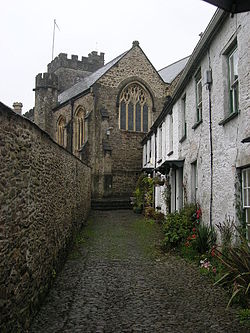
Dulverton is a town and civil parish in west Somerset, England, near the border with Devon. The town had a population of 1,408 at the 2011 Census. The parish includes the hamlets of Battleton and Ashwick which is located approximately 4 miles (6.4 km) north west of Dulverton.
To the west of the hamlet lies Ashwick House, built in the Edwardian style in 1901. Also nearby is the estate of Northmoor, formerly a seat of Sir Frederick Wills, 1st Baronet of Northmoor, one of the four Wills Baronetcys, and the founders of the Imperial Tobacco Company. In 1929 Sir Frederick's son & heir, Sir Gilbert Wills, 2nd Baronet, was raised to the peerage as Baron Dulverton, whose principal seat was at Batsford Park, near Batsford, Gloucestershire.
Dulverton is a popular tourist destination for exploring Exmoor, and is home to the Exmoor National Park Authority headquarters. The town lies on the route of the Exe Valley Way and Land's End Trail.
The name Dulverton was first recorded in 1084 as dieglaford-tun meaning 'the settlement at the hidden ford'. The Domesday Book of 1086 records it as Dolvertune, and suggests it was a royal manor before the Norman Conquest.
The parish also once contained the place Tolchet, noted as one of the relatively rare examples of an English place with a name deriving from Common Brittonic. It seems to comprise the words found in modern Welsh as twll ('hole, cave') and coed ('woodland'), the name being paralleled by several Welsh places called Tyllgoed, the Cornish place-name Tolgus, and the now-lost Breton place-name Toulgoat, along with place-names in England including Olchard.
The town lies below the Iron Age hillforts of Oldberry Castle, Mounsey Castle and Brewer's Castle.
The manor was granted to the Turbervilles by William I and in the late 12th century they gave the church and some land to Taunton Priory. The remainder of the manor passed to the Shete family. The parish of Dulverton was part of the Williton and Freemanners Hundred.
The Middle Ages saw continued growth and the establishment of fairs and markets, with several small industries based upon the traditions of upland farming and the wool trade. These include related works such as laundries; originally used for the washing of sheep fleeces in the leats feeding the wide and fast-flowing River Barle, the surviving 19th-century industrial laundries continue to provide a service to surrounding businesses. The market house in Fore Street, which is believed to date from 1760, was re-modelled to become Dulverton Town Hall in 1866, with the porch and external double staircase being added in 1930 by Sir Albert Richardson.
Dulverton
Dulverton is a town and civil parish in west Somerset, England, near the border with Devon. The town had a population of 1,408 at the 2011 Census. The parish includes the hamlets of Battleton and Ashwick which is located approximately 4 miles (6.4 km) north west of Dulverton.
To the west of the hamlet lies Ashwick House, built in the Edwardian style in 1901. Also nearby is the estate of Northmoor, formerly a seat of Sir Frederick Wills, 1st Baronet of Northmoor, one of the four Wills Baronetcys, and the founders of the Imperial Tobacco Company. In 1929 Sir Frederick's son & heir, Sir Gilbert Wills, 2nd Baronet, was raised to the peerage as Baron Dulverton, whose principal seat was at Batsford Park, near Batsford, Gloucestershire.
Dulverton is a popular tourist destination for exploring Exmoor, and is home to the Exmoor National Park Authority headquarters. The town lies on the route of the Exe Valley Way and Land's End Trail.
The name Dulverton was first recorded in 1084 as dieglaford-tun meaning 'the settlement at the hidden ford'. The Domesday Book of 1086 records it as Dolvertune, and suggests it was a royal manor before the Norman Conquest.
The parish also once contained the place Tolchet, noted as one of the relatively rare examples of an English place with a name deriving from Common Brittonic. It seems to comprise the words found in modern Welsh as twll ('hole, cave') and coed ('woodland'), the name being paralleled by several Welsh places called Tyllgoed, the Cornish place-name Tolgus, and the now-lost Breton place-name Toulgoat, along with place-names in England including Olchard.
The town lies below the Iron Age hillforts of Oldberry Castle, Mounsey Castle and Brewer's Castle.
The manor was granted to the Turbervilles by William I and in the late 12th century they gave the church and some land to Taunton Priory. The remainder of the manor passed to the Shete family. The parish of Dulverton was part of the Williton and Freemanners Hundred.
The Middle Ages saw continued growth and the establishment of fairs and markets, with several small industries based upon the traditions of upland farming and the wool trade. These include related works such as laundries; originally used for the washing of sheep fleeces in the leats feeding the wide and fast-flowing River Barle, the surviving 19th-century industrial laundries continue to provide a service to surrounding businesses. The market house in Fore Street, which is believed to date from 1760, was re-modelled to become Dulverton Town Hall in 1866, with the porch and external double staircase being added in 1930 by Sir Albert Richardson.
Recent media
Recent media