
Recent from talks
Dumaresq
Knowledge base stats:
Talk channels stats:
Members stats:
Dumaresq
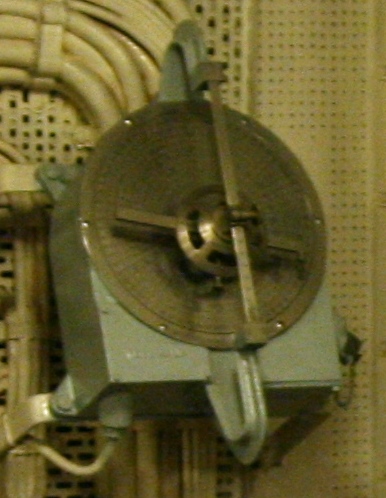
The Dumaresq is a mechanical calculating device invented around 1902 by Lieutenant John Dumaresq of the Royal Navy. It is an analog computer that relates vital variables of the fire control problem to the movement of one's own ship and that of a target ship.
It was often used with other devices, such as a Vickers range clock, to generate range and deflection data so the gun sights of the ship could be continuously set. A number of versions of the Dumaresq were produced of increasing complexity as development proceeded.
The dumaresq relies on sliding and rotating bars and dials to represent the motion of the two ships.
Normally the motion of the ship carrying the dumaresq is represented by a metal bar running above the instrument. Below the bar is a round metal plate inscribed with a coordinate plot, and an angle scale around its outer rim. The fixed bar is mounted on a bearing that allows it to be turned to represent the direction of motion of the ship, measured against the scale. Hanging down from the metal bar is a device that is slid along the bar to represent the speed of the ship. This sliding part is normally in the form of a ring, sometimes referred to as the "inclination ring", that is suspended just above the coordinate plate.
The motion of the enemy ship is represented by a bar connected to the sliding ring, the "enemy bar". This is normally in the form of a long pointer that extends from the ring towards the edge of the plot, which allows the angle of the enemy ship to be input by rotating the pointer (and ring) as measured against the angle scale at the edge of the plot. A smaller pointer connected to this bar, the "enemy pointer", extends downward from the bar, and can slide along it to represent the speed of the enemy ship.
The central coordinate plate also rotates, which is used to represent the current bearing to the target. When correctly set, the enemy pointer will point to a location on the coordinate plate. The coordinates can be read to directly provide the "range rate" (the component of motion along the line of bearing) and "dumaresq deflection" (or "speed across", the component perpendicular to the range rate). This was normally measured as the yards per minute in range and knots in deflection. Based on the time-of-flight using the instantaneous range between the two ships at the time of firing, these two measurements are added to the initial calculation of the firing solution to produce the corrections for motion.
Because the dumaresq is an analogue model of the relative motion of the two ships, it does not intrinsically favour which of its settings is an input and which is an output - one can use the centre bar to represent the enemy ship motion and the moving portions to represent the dumaresq ship. This allows it to be used "backwards", a process called a "cross cut", to take sequential estimates of the range and bearing of an enemy vessel and discover its speed and heading that would be consistent.
To aid the operation of the system, the dumaresq is normally co-located with instruments showing the direction and speed of the ship, while the operators set the enemy bearing, heading and speed based on calls from the rangetellers. In some versions, the rotation of the bar is automated through the use of a gyrocompass and selsyn, in other the speed input was automated using a Forbes Log.
Hub AI
Dumaresq AI simulator
(@Dumaresq_simulator)
Dumaresq
The Dumaresq is a mechanical calculating device invented around 1902 by Lieutenant John Dumaresq of the Royal Navy. It is an analog computer that relates vital variables of the fire control problem to the movement of one's own ship and that of a target ship.
It was often used with other devices, such as a Vickers range clock, to generate range and deflection data so the gun sights of the ship could be continuously set. A number of versions of the Dumaresq were produced of increasing complexity as development proceeded.
The dumaresq relies on sliding and rotating bars and dials to represent the motion of the two ships.
Normally the motion of the ship carrying the dumaresq is represented by a metal bar running above the instrument. Below the bar is a round metal plate inscribed with a coordinate plot, and an angle scale around its outer rim. The fixed bar is mounted on a bearing that allows it to be turned to represent the direction of motion of the ship, measured against the scale. Hanging down from the metal bar is a device that is slid along the bar to represent the speed of the ship. This sliding part is normally in the form of a ring, sometimes referred to as the "inclination ring", that is suspended just above the coordinate plate.
The motion of the enemy ship is represented by a bar connected to the sliding ring, the "enemy bar". This is normally in the form of a long pointer that extends from the ring towards the edge of the plot, which allows the angle of the enemy ship to be input by rotating the pointer (and ring) as measured against the angle scale at the edge of the plot. A smaller pointer connected to this bar, the "enemy pointer", extends downward from the bar, and can slide along it to represent the speed of the enemy ship.
The central coordinate plate also rotates, which is used to represent the current bearing to the target. When correctly set, the enemy pointer will point to a location on the coordinate plate. The coordinates can be read to directly provide the "range rate" (the component of motion along the line of bearing) and "dumaresq deflection" (or "speed across", the component perpendicular to the range rate). This was normally measured as the yards per minute in range and knots in deflection. Based on the time-of-flight using the instantaneous range between the two ships at the time of firing, these two measurements are added to the initial calculation of the firing solution to produce the corrections for motion.
Because the dumaresq is an analogue model of the relative motion of the two ships, it does not intrinsically favour which of its settings is an input and which is an output - one can use the centre bar to represent the enemy ship motion and the moving portions to represent the dumaresq ship. This allows it to be used "backwards", a process called a "cross cut", to take sequential estimates of the range and bearing of an enemy vessel and discover its speed and heading that would be consistent.
To aid the operation of the system, the dumaresq is normally co-located with instruments showing the direction and speed of the ship, while the operators set the enemy bearing, heading and speed based on calls from the rangetellers. In some versions, the rotation of the bar is automated through the use of a gyrocompass and selsyn, in other the speed input was automated using a Forbes Log.
Recent media