
Recent from talks
Dundalk Distillery
Knowledge base stats:
Talk channels stats:
Members stats:
Dundalk Distillery
The Dundalk Distillery was an Irish whiskey distillery that operated in Dundalk, County Louth, Ireland between 1708 and 1926. It is thought to have been one of the old registered distilleries in Ireland. Two of the distillery buildings, the grain store and maltings, still exist and now house the County Museum and Dundalk Library.
The distillery was used as a navigation point by seamen due to its two large chimney stacks, one of which was the largest in Ireland when it was built in 1817.
Dundalk was home to a number of distilleries down through the years. The most notable of which was established in 1780 by James Gilleghan and Peter Godbey at Roden Place on the site of an old tannery and bleach ground. Subsequently, several Scotsmen joined the company. In 1802, the distillery is recorded as operating a 1,514 gallon still, which was quite large for the time. By 1804, the distillery is reported as being operated by James Reid, Malcolm Brown, James Gilleghan, Peter Godbey and William Hamilton. By 1807, the large still, the operation of which was impractical due to the licensing system, had been replaced by a smaller, 520 gallon still. In 1812, Brown married Gillichan's daughter, subsequently gaining control of the company and on the death of his partners, after which the operation became known as Malcolm Brown & Co.
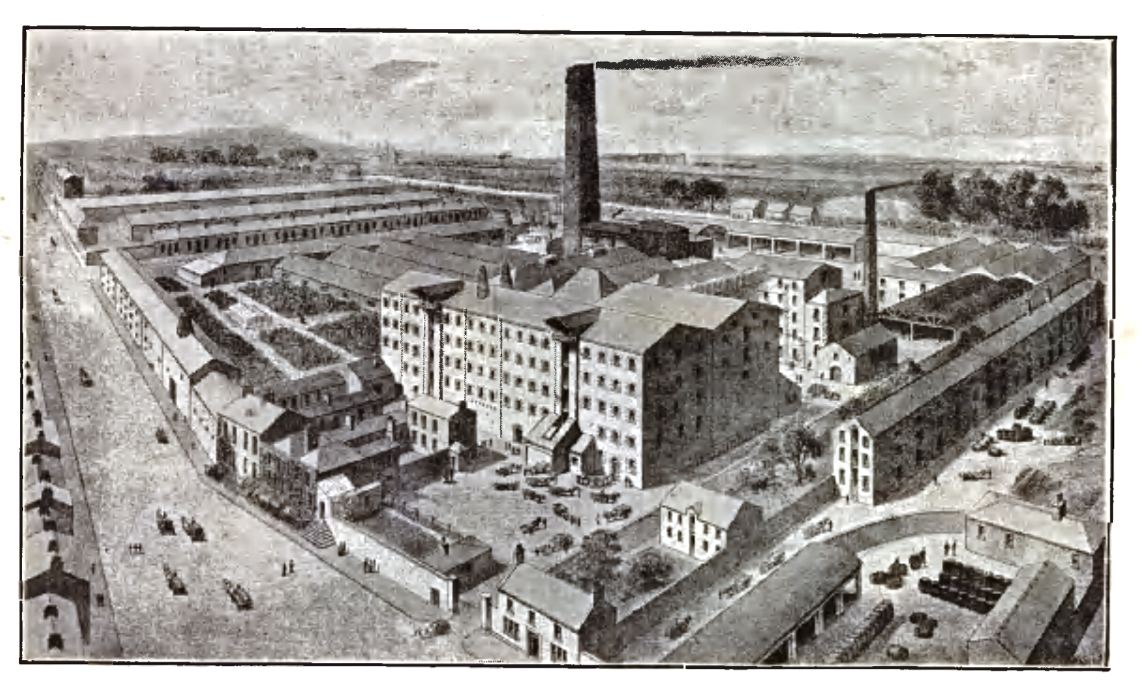
In 1817, Dundalk and its surrounds suffered from a scarcity of food due to a bad harvest. That year, the owners of the distillery, having large stores of grain, generously had the stock ground into meal and sold at a rate which the poor could afford. In the same year, a 162 ft tall, brick chimney stack was constructed at the distillery in that year (visible in the image above), which was the largest in Ireland at the time. Prior to the reform the excise regulations in 1823, distillation was based on the theoretical output of a pot still. The purpose of the large chimney was to allow firing of the pot still in the shortest possible time.
In 1823, Malcolm Brown, then in the trade "nearly twenty years" gave testimony to a British House of Commons inquiry into distilling regulations in Ireland. In his testimony, given in June 1823, Brown stated that his operations had lost money for the preceding two years due to increased competition from illicit unlicensed distillers, which had increased eight- to ten-fold in number in the Dundalk region over the same period. As a result, Brown had ceased distilling at Dundalk the previous December, and that had no intention of resuming operations until the excise regulations were reformed. At the time, Brown stated that illicit spirits could be obtained for 4 - 5 shillings a gallon, and were the duty reduced to 2 shillings sixpence, licit spirit could be sold at around 5 - 6 shillings a gallon. With reduced duties, Brown stated that the price difference between licit and illicit spirits would narrow, prompting consumers to opt for licit spirits rather than risk a penalty by purchasing illicit spirit. Brown stated that whiskey from Dundalk distillery was principally consumed in nearby counties of Armagh, Cavan and Down, and that some of his matured spirit sold at 12 shillings a gallon.
Records show that by 1837, the distillery was consuming 40,000 barrels of grain a year, with a staff of 100, and an output of 300,000 gallons of spirit a year (up from 285,000 gallons in 1826). The distillery prospered, and expanded further through the mid-1800s, with output more than doubling, in part due to the installation of a large Coffey still, becoming one of the most successful distilleries in the country.
In 1854, Brown died without a son, and the distillery passed to his nephews, the Murrays. When Alfred Barnard, a British historian, visited the distillery in 1886, output had reached close to 700,000 gallons per annum. Barnard noted that much of the output from the distillery, was consumed locally, with the remainder exported to England and Scotland. At the time of Barnard's visit, the distillery was being run three brothers (John, Malcolm, and Henry Murray) whose granduncle had come to control the distillery around 1800.
On 22 November 1862, a fire broke out in a corn kiln in the grain stores of the distillery, completely destroying the building which contained several thousand tonnes of grain. After a raising of the alarm, 500 men of the 15th, the King's Hussars (a cavalry regiment), along with fire engines and other constabulary rushed to the scene, preventing the fire from spreading further. At the time, the bonded storehouses contained 400,000 gallons of whiskey. It was estimated that the fire caused £10,000 of damages and 100 redundancies. Unfortunately, one life was lost and several endangered after the incident, as during their efforts some of the hussars had consumed fusel oils, mistaking it for whiskey.
Hub AI
Dundalk Distillery AI simulator
(@Dundalk Distillery_simulator)
Dundalk Distillery
The Dundalk Distillery was an Irish whiskey distillery that operated in Dundalk, County Louth, Ireland between 1708 and 1926. It is thought to have been one of the old registered distilleries in Ireland. Two of the distillery buildings, the grain store and maltings, still exist and now house the County Museum and Dundalk Library.
The distillery was used as a navigation point by seamen due to its two large chimney stacks, one of which was the largest in Ireland when it was built in 1817.
Dundalk was home to a number of distilleries down through the years. The most notable of which was established in 1780 by James Gilleghan and Peter Godbey at Roden Place on the site of an old tannery and bleach ground. Subsequently, several Scotsmen joined the company. In 1802, the distillery is recorded as operating a 1,514 gallon still, which was quite large for the time. By 1804, the distillery is reported as being operated by James Reid, Malcolm Brown, James Gilleghan, Peter Godbey and William Hamilton. By 1807, the large still, the operation of which was impractical due to the licensing system, had been replaced by a smaller, 520 gallon still. In 1812, Brown married Gillichan's daughter, subsequently gaining control of the company and on the death of his partners, after which the operation became known as Malcolm Brown & Co.
In 1817, Dundalk and its surrounds suffered from a scarcity of food due to a bad harvest. That year, the owners of the distillery, having large stores of grain, generously had the stock ground into meal and sold at a rate which the poor could afford. In the same year, a 162 ft tall, brick chimney stack was constructed at the distillery in that year (visible in the image above), which was the largest in Ireland at the time. Prior to the reform the excise regulations in 1823, distillation was based on the theoretical output of a pot still. The purpose of the large chimney was to allow firing of the pot still in the shortest possible time.
In 1823, Malcolm Brown, then in the trade "nearly twenty years" gave testimony to a British House of Commons inquiry into distilling regulations in Ireland. In his testimony, given in June 1823, Brown stated that his operations had lost money for the preceding two years due to increased competition from illicit unlicensed distillers, which had increased eight- to ten-fold in number in the Dundalk region over the same period. As a result, Brown had ceased distilling at Dundalk the previous December, and that had no intention of resuming operations until the excise regulations were reformed. At the time, Brown stated that illicit spirits could be obtained for 4 - 5 shillings a gallon, and were the duty reduced to 2 shillings sixpence, licit spirit could be sold at around 5 - 6 shillings a gallon. With reduced duties, Brown stated that the price difference between licit and illicit spirits would narrow, prompting consumers to opt for licit spirits rather than risk a penalty by purchasing illicit spirit. Brown stated that whiskey from Dundalk distillery was principally consumed in nearby counties of Armagh, Cavan and Down, and that some of his matured spirit sold at 12 shillings a gallon.
Records show that by 1837, the distillery was consuming 40,000 barrels of grain a year, with a staff of 100, and an output of 300,000 gallons of spirit a year (up from 285,000 gallons in 1826). The distillery prospered, and expanded further through the mid-1800s, with output more than doubling, in part due to the installation of a large Coffey still, becoming one of the most successful distilleries in the country.
In 1854, Brown died without a son, and the distillery passed to his nephews, the Murrays. When Alfred Barnard, a British historian, visited the distillery in 1886, output had reached close to 700,000 gallons per annum. Barnard noted that much of the output from the distillery, was consumed locally, with the remainder exported to England and Scotland. At the time of Barnard's visit, the distillery was being run three brothers (John, Malcolm, and Henry Murray) whose granduncle had come to control the distillery around 1800.
On 22 November 1862, a fire broke out in a corn kiln in the grain stores of the distillery, completely destroying the building which contained several thousand tonnes of grain. After a raising of the alarm, 500 men of the 15th, the King's Hussars (a cavalry regiment), along with fire engines and other constabulary rushed to the scene, preventing the fire from spreading further. At the time, the bonded storehouses contained 400,000 gallons of whiskey. It was estimated that the fire caused £10,000 of damages and 100 redundancies. Unfortunately, one life was lost and several endangered after the incident, as during their efforts some of the hussars had consumed fusel oils, mistaking it for whiskey.
Recent media