Hubbry Logo
Dunscaith CastleDunscaith CastleMain
Open search
Dunscaith Castle
Community hub
Dunscaith Castle
logo
8 pages, 0 posts
0 subscribers
Be the first to start a discussion here.
Dunscaith Castle
Dunscaith Castle
from Wikipedia

Dunscaith Castle
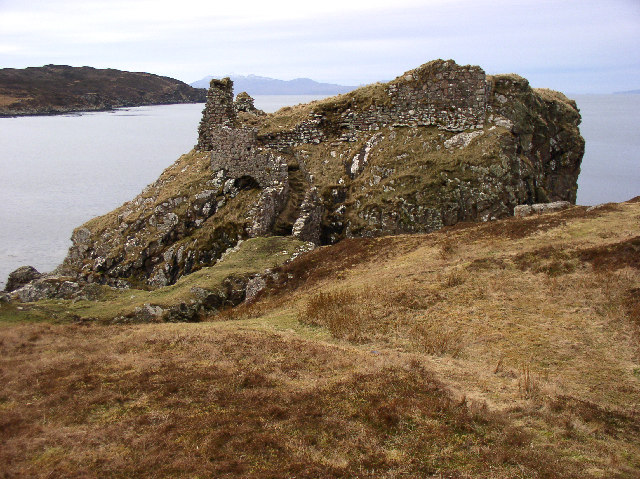
View from below.

Dunscaith Castle also known as Dun Scaich, Dun Sgathaich Castle and Tokavaig, is a ruined castle on the coast of the Isle of Skye, in the north-west of Scotland. It is located in the Parish of Sleat, in the Highland council area, and in the former county of Inverness-shire, at grid reference NG595120. Also called "Fortress of Shadows", it is the legendary home of the warrior maiden Scáthach, after whom it is named.[1][2] It is protected as a scheduled monument.[3]

History

[edit]

The castle itself sits on an off-shore rock. The rock rises 40 feet (12 metres) above sea level and there is a gap of 20 feet (6 metres) between the rock and the mainland. The gap was once spanned by a walled bridge with arches six feet (1.8 metres) apart. This stone walled bridge then led onto a drawbridge, the pivot holes for which are still visible on the far side. Once on the other side of the drawbridge a door opened to a flight of stairs which was also sided by two walls. The flight of stairs led up to the castle.

Parts of the castle curtain wall still survive on the cliff edge but most of the inner buildings have gone. The curtain wall was about five feet (1.5 metres) thick. In the courtyard is a well and the remains of a stairway which once led up a tower.

The castle originated in the 1300s as a stronghold on the Isle of Skye for a Viking group led by Gilbert MacAskill, grandson of the Norse explorer Ascall Mar Ragsnaill. The MacAskills held the castle until at some point before 1395, the castle was taken by the Clan MacDonald of Sleat, a branch of the Clan Donald or MacDonald. In the 14th century it was taken from them by the Clan MacLeod and held briefly back by the MacAskills, allies of the MacLeods, but it was recaptured by the MacDonalds sometime in the 15th century.

In the 15th century the castle was again captured by King James IV of Scotland when the Chief of the Clan Donald, Lord of the Isles was broken by King James IV. The MacDonalds were allowed to keep possession of the castle. The MacDonalds abandoned the castle in the early 17th century, after which it slowly fell into ruin.

Legend

[edit]

The castle is featured in the Ulster Cycle of Irish mythology as the place where Scáthach the Shadow, legendary Scottish warrior woman and martial arts teacher, trained the hero Cú Chulainn in the arts of combat.[4] The Irish name for the fort, Dún Scáthaigh, is derived from hers.[5]

See also

[edit]

Notes

[edit]
[edit]
Revisions and contributorsEdit on WikipediaRead on Wikipedia
from Grokipedia
Dunscaith Castle is a ruined medieval fortress located on a precipitous coastal promontory overlooking Eishort on the of the Isle of Skye, . The structure, dating to the 13th or 14th century and built atop an earlier prehistoric fortification, primarily served as a stronghold for the MacDonalds of , a branch of , who utilized it as a base for controlling maritime approaches and regional power. Renowned for its dramatic setting and defensive features, including near-vertical sea cliffs on three sides, the castle fell into disuse by the 17th century amid shifting clan dynamics and centralization of authority under the Scottish crown. It is also linked in Gaelic legend to , the mythical warrior woman who trained heroes such as , though archaeological evidence underscores its practical role as a feudal power center rather than a site of ancient mythic habitation.

Location and Physical Description

Geographical Position

Dunscaith Castle is situated on a rocky promontory at Tokavaig, on the Peninsula in the southern part of the Isle of Skye, , overlooking the tidal waters of Loch Eishort. The site's approximate coordinates are 57°08′N 5°58′W, positioning it at the mouth of the loch where it connects to the Sound of . This location places the castle within the traditional territories of , adjacent to rival holdings in northern Skye, facilitating oversight of maritime passages critical for local trade and defense. The castle occupies a sea-stack-like outcrop rising approximately 40 feet (12 meters) above , with vertical drops exceeding 10 meters on multiple sides, rendering it highly defensible through natural . Access is restricted to a narrow or the site of a former spanning a 20-foot gap over tidal waters, which would have amplified isolation during high and limited assault options. These environmental features, combined with the promontory's exposure to prevailing westerly winds and proximity to coastal resources, underscored its strategic value in controlling sea routes into Loch Eishort.

Architectural Remains and Features

Dunscaith Castle comprises fragmented remains of a medieval enclosure castle, possibly dating to the 13th century and constructed atop an earlier site. The structure encloses a rock summit measuring approximately 30 by 22 yards (27 by 20 s), defended by a surrounding curtain wall averaging 5 feet (1.5 s) thick and reaching up to 16-17 feet (5 s) high in the southeast corner. At the western end stand remnants of an oblong building, 38 by 16 feet (11.6 by 4.9 s) in plan with 4.5-foot-thick (1.4 ) walls, now reduced to grass-covered mounds; interior fragments include scattered walling, a chute in the northeast corner, a sea-gate piercing the south face, and a debris-filled well within the . A possible tower in the southeast incorporated a stair ascending to a . The walls employ random , roughly coursed with large irregular stones, smaller infill pieces, and —an early documented use of such mortar in the region. Defensive adaptations exploit the site's precipitous rock, rising 30-40 feet (9-12 s) above and isolated by a 20-foot-wide (6 ) and 15-16-foot-deep (4.6-4.9 ) gully from the mainland; original access crossed this via an 8-foot-long (2.4 ) wooden , flanked by two arched walls spaced 6 feet (1.8 s) apart, evidenced by surviving pivot holes and door checks in the rock faces. This configuration represents an atypical enclosure castle with curtain walls for the Western Isles, prioritizing natural cliffs and restricted entry over elaborate bastions. The site's exposed coastal position contributes to ongoing deterioration, with mortar disintegration, loosening stones, and collapsing upper courses noted in assessments; no significant restoration has occurred, preserving the ruins in their decayed state. Dunscaith has held status since 20 June 1934, affording legal protection against alteration.

Historical Ownership and Development

Origins and Early Construction

Dunscaith Castle originated on a site with evidence of prehistoric fortifications, but the surviving stone structure dates to the thirteenth century, marking it as one of the earliest masonry castles on the Isle of Skye. The name's "Dun" prefix suggests Norse influence, consistent with the site's prior use as a stronghold during the period of Norwegian control over the until the mid-thirteenth century. Archaeological interpretations place the initial stone construction around 1300, featuring basic defensive elements like an offshore rock position with a connecting bridge, likely built to exploit the natural defensibility amid regional power shifts following the in 1266. By the late thirteenth century, the castle had passed to the control of , who dominated much of Skye and adapted the site as a strategic outpost. This ownership aligned with the clan's expansion under Norse-Scottish hybrid lords, with the castle serving as a fortified residence rather than a grand hall, evidenced by its compact layout and emphasis on sheer drops for protection exceeding 10 meters. No contemporary charters directly name the builders, but the masonry style and location reflect transitional Gaelic-Norse engineering typical of post-1266 Hebridean sites. Control shifted to the MacDonald kindred, specifically the Uisdean branch, by the mid-fifteenth century under (died 1498), who established it as an early chief's seat before later moves to Duntulm. A of 1495 confirmed Hugh's lordship over Dunscaith amid the fragmenting Lordship of the Isles, indicating initial MacDonald occupation focused on consolidating holdings in rather than major rebuilds at this stage. Clan genealogies portray this as the foundational base for the Sleat MacDonalds, predating their dominance in the region.

Medieval Fortifications and Clan MacDonald Control

In 1469, Hugh MacDonald (Ùisdean), brother of John of Islay, and last , received a grant of lands in , establishing Dunscaith Castle as the primary stronghold and chief seat of the nascent MacDonalds of branch. This marked a period of enhanced fortification and sustained control, transforming the site into a defensible base amid ongoing territorial contests with the MacLeods, who had previously held influence in the area. Successive chieftains, including Hugh's son John (d. 1501) and grandson Archibald, resided there, leveraging its coastal promontory position for oversight of Loch Eishort and rapid mobilization of galleys. The castle's strategic role intensified during the fragmentation of the Lordship of the Isles following its 1476 forfeiture to the Scottish Crown, as the MacDonalds of Sleat navigated internal clan divisions and external pressures to assert autonomy. Fortifications, including thick walls and a commanding rock outcrop, supported defensive postures against feuds, enabling the clan to repel incursions and launch retaliatory raids on rivals like the MacLeods of Lewis and Dunvegan. While specific adaptations for emerging —such as gunports—are not documented at Dunscaith, the era's Highland strongholds generally incorporated provisions for prolonged sieges, reflecting broader shifts in late where clan forces relied on mobility over static gun emplacements. Economically, Dunscaith underpinned self-sufficiency through oversight of local tacksmen managing lands, with revenues from fisheries in adjacent waters and potential tolls on maritime traffic sustaining the chieftain's household and warriors in the isolated Highland environment. This integration of military and economic functions reinforced internal cohesion, as loyalty from dependents was tied to the chieftain's from the castle base, amid the MacDonalds' efforts to consolidate power post-Lordship collapse.

Conflicts, Seizures, and Decline

In the , amid feuds between the MacDonalds of and their rivals, seized Dunscaith Castle, with the allied Clan MacAskill briefly retaining control thereafter. The MacDonalds recaptured the stronghold in the , solidifying it as their primary residence on Skye and a key defensive site during ongoing clan rivalries. Royal intervention followed the 1493 forfeiture of the Lordship of the Isles by King James IV, who subdued the MacDonald chiefs through naval expeditions and land seizures to centralize authority in the . As part of this campaign, James IV captured Dunscaith to assert crown control over MacDonald holdings, though he permitted the to reoccupy the after their submission. The 16th century saw continued raids and skirmishes in broader MacDonald-MacLeod conflicts across Skye, including battles like those at Coire na Creiche in 1601, which eroded clan fortifications through attrition, though specific assaults on Dunscaith remain sparsely documented beyond general patterns of intertribal warfare. These feuds, compounded by royal efforts under James VI to pacify the Highlands via statutes like the 1609 Act of Iona, diminished the strategic necessity of remote coastal strongholds like Dunscaith. By 1619, the MacDonalds of abandoned Dunscaith following a to Sir Donald MacDonald, 8th chief, granting Trotternish lands on condition of establishing as the new seat to affirm territorial claims. Neglect thereafter, exacerbated by from its promontory location on Loch Eishort, led to gradual ruin without records of intentional demolition, unlike more maintained inland contemporaries. This shift reflected broader centralization trends reducing clan autonomy and the viability of exposed sites vulnerable to natural decay.

Legends and Folklore

Mythological Associations with Scáthach

Dunscaith Castle derives its name from Dún Scáith, Gaelic for "Fortress of Shadows," linking it etymologically to the mythological residence of , a legendary warrior woman in the of Irish tales. , whose name translates to "the shadowy one," is depicted as a martial instructor who trained the hero and other warriors at her stronghold on Scotland's , emphasizing skills in spear-throwing, swordplay, and the gáe bolga barbed spear. These narratives, preserved in medieval Irish manuscripts dating from the 8th to 12th centuries, portray Dún Scáith as an impregnable island fortress accessible only by a narrow causeway, symbolizing isolation and rigorous training grounds. The identification of Dunscaith's ruins with Scáthach's domain stems from medieval textual traditions rather than , as the site's strategic location—jutting into Eishort with sheer drops and tidal access—likely inspired later mythic attributions of defensibility. extends this by claiming protections, such as fairy-constructed barriers rendering the fortress unassailable, but such elements appear as post-hoc embellishments rationalizing the natural topography's causal advantages for defense, without material support from excavations. Archaeological assessments confirm the visible remains, including curtain walls, a drawbridge pivot, and a well, belong to medieval construction phases, primarily 14th-15th centuries under Clan MacDonald occupation, with no artifacts or stratigraphy indicating pre-Christian use tied to Scáthach's era. This disconnect underscores the mythological link as a retrospective projection onto a later fortified site, verifiable only through literary sources whose heroic motifs prioritize symbolic over historical fidelity. The association persists in contemporary tourism, drawing visitors to the ruins as Scáthach's purported training ground, though empirical dating constrains it to unverifiable legend rather than causal historical continuity.

Clan-Specific Tales and Superstitions

Oral traditions attributed to during their occupancy of Dunscaith Castle from the 15th to early 17th centuries evoke spectral remnants from inter-clan sieges, particularly against , but these lack substantiation in contemporary accounts and appear to embellish documented conflicts such as the prolonged Skye feuds culminating in the Battle of Coire na Creiche on 5 April 1601, where MacDonald forces decisively defeated a MacLeod raiding party near , capturing Alasdair and over 30 clansmen amid heavy casualties on both sides. Such narratives of ghostly guardians or cursed battlefields likely arose as mnemonic devices to commemorate the clan's defensive struggles at strongholds like Dunscaith, reflecting causal links to real violence rather than intervention, as no eyewitness reports or official records from the period describe phenomena at the site. Superstitions portraying the castle's drawbridge or well as harbingers of clan fortune—rising waters foretelling prosperity or collapse signaling downfall—mirror the fatalistic mindset prevalent in Highland society amid endemic warfare, yet these motifs are absent from primary clan documents and emerge only in later compilations. Transmission of these tales occurred via bardic poetry praising MacDonald chiefs, which emphasized martial prowess over omens, and was amplified in 19th-century antiquarian efforts to preserve oral histories, though the latter's reliance on secondhand recollections undermines their reliability against empirical historical feuds. In evaluating these elements, the absence of verifiable evidence points to psychological and cultural adaptations to chronic insecurity, with Dunscaith's isolation and strategic position amplifying perceptions of otherworldly protection during eras of rival encroachments.

Significance and Modern Context

Role in Scottish Clan History

Dunscaith Castle functioned as the principal stronghold of the , a branch of , reinforcing their feudal sovereignty over the peninsula in Skye during the . Originally contested in feuds with , the site was recaptured from MacLeod forces and their MacAskill allies, enabling the MacDonalds to consolidate regional control and project autonomy in a landscape of rival Highland kindreds. This control extended to oversight of local septs, including former MacAskill holdings, through which the clan mobilized levies and enforced Gaelic lordship patterns resistant to encroaching crown oversight. The castle's role intensified amid the Lordship of the Isles' forfeiture in 1493, when James IV dismantled the overarching MacDonald authority to curb semi-independent Hebridean power. Unlike the main clan's broader territorial losses, the MacDonalds of —descended from Hugh (Ùisdean), a kinsman of the last Lord—secured royal charters retaining Sleat lands, with Dunscaith serving as a base for defensive alliances and localized resistance to Stuart centralization efforts. This localized endurance contrasted with the Lordship's collapse, as the castle facilitated the branch's adaptation to fragmented feudal dynamics, prioritizing kin-based mobilization over unified rebellion. In clan genealogies and historical records, Dunscaith's significance persisted beyond its abandonment around 1618, when the seat shifted to under a to the 8th chief, Sir Donald MacDonald. The fortress epitomized the Highland emphasis on martial heritage and patrilineal identity, where symbolic bastions like Dunscaith sustained and claims to precedence amid physical decay and royal encroachments, outlasting material fortifications in preserving decentralized ethos.

Preservation Status and Accessibility

Dunscaith Castle is protected as a scheduled (SM954) under the guardianship of , with designation established on 20 June 1934 to preserve its archaeological integrity. The ruins exhibit no ongoing physical restoration programs, leaving the structure exposed to natural degradation processes such as coastal weathering and . Its precarious position on a tidal rock promontory heightens vulnerability to accelerated from rising sea levels, a risk documented for comparable Scottish coastal heritage sites where wave action undermines foundational cliffs. Public access to the site is permitted via a rugged coastal originating from Tokavaig village, approximately 1.5 kilometers distant, traversing uneven that demands sturdy and awareness of conditions. Visitors must contend with empirical hazards including tidal surges that intermittently isolate the , structural instability in the remnants, and a void where the medieval once spanned a 12-meter drop, rendering entry into the ruins inadvisable and prompting official advisories against climbing or internal exploration to mitigate injury risks. Despite promotion in regional resources for its scenic isolation, such materials consistently emphasize safety precautions over unrestricted access. Scholarly engagement in recent years has centered on non-invasive digital initiatives, including a 2020 virtual reconstruction project depicting the castle circa 1300, developed through collaborative efforts in visualization for educational dissemination via online platforms, without any modification to the physical monument. The site's lands remain in with no active ownership conflicts, facilitating open approach rights under Scottish access principles while upholding monument safeguards.

References

Add your contribution
Related Hubs
User Avatar
No comments yet.