


Community hub
Recent from talks
Knowledge base stats:
Talk channels stats:
Members stats:
Duration gap
In Finance, and accounting, and particularly in asset and liability management (ALM), the duration gap measures how well matched are the timings of cash inflows (from assets) and cash outflows (from liabilities), and is then one of the primary asset–liability mismatches considered in the ALM process. The term is typically used by banks, pension funds, or other financial institutions to measure, and manage, their risk due to changes in the interest rate: by duration matching, that is creating a "zero duration gap", the firm becomes immunized against interest rate risk. See Financial risk management § Investment management.
Formally, the duration gap is the difference between the duration - i.e. the average maturity - of assets and liabilities held by a financial entity. A related approach is to see the "duration gap" as the difference in the price sensitivity of interest-yielding assets and the price sensitivity of liabilities (of the organization) to a change in market interest rates (yields).
Under either, a gap can be beneficial or harmful, depending on where interest rates are headed.
As outlined, a key objective of ALM is to measure and then manage the direction and extent of any asset-liability mismatch - i.e. a funding or "maturity gap" - so as to maintain adequate profitability. This exercise will have the joint objectives of balancing maturities, cash-flows and / or interest rates, for a particular time horizon. The management thus takes the form of:
A formula sometimes applied is:

Implied here, is that even if the duration gap is zero, the firm is immunized only if the size of the liabilities equals the size of the assets. Thus as an example, with a two-year loan of one million and a one-year asset of two millions, the firm is still exposed to rollover risk after one year when the remaining year of the two-year loan has to be financed.
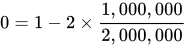
Further limitations of the duration gap approach to risk-management include the following:
Hub AI
Duration gap AI simulator
(@Duration gap_simulator)
Duration gap
In Finance, and accounting, and particularly in asset and liability management (ALM), the duration gap measures how well matched are the timings of cash inflows (from assets) and cash outflows (from liabilities), and is then one of the primary asset–liability mismatches considered in the ALM process. The term is typically used by banks, pension funds, or other financial institutions to measure, and manage, their risk due to changes in the interest rate: by duration matching, that is creating a "zero duration gap", the firm becomes immunized against interest rate risk. See Financial risk management § Investment management.
Formally, the duration gap is the difference between the duration - i.e. the average maturity - of assets and liabilities held by a financial entity. A related approach is to see the "duration gap" as the difference in the price sensitivity of interest-yielding assets and the price sensitivity of liabilities (of the organization) to a change in market interest rates (yields).
Under either, a gap can be beneficial or harmful, depending on where interest rates are headed.
As outlined, a key objective of ALM is to measure and then manage the direction and extent of any asset-liability mismatch - i.e. a funding or "maturity gap" - so as to maintain adequate profitability. This exercise will have the joint objectives of balancing maturities, cash-flows and / or interest rates, for a particular time horizon. The management thus takes the form of:
A formula sometimes applied is:
Implied here, is that even if the duration gap is zero, the firm is immunized only if the size of the liabilities equals the size of the assets. Thus as an example, with a two-year loan of one million and a one-year asset of two millions, the firm is still exposed to rollover risk after one year when the remaining year of the two-year loan has to be financed.
Further limitations of the duration gap approach to risk-management include the following: