Hubbry Logo
logo
Dutch roll
Community hub

Dutch roll

logo
0 subscribers
Read side by side
from Wikipedia
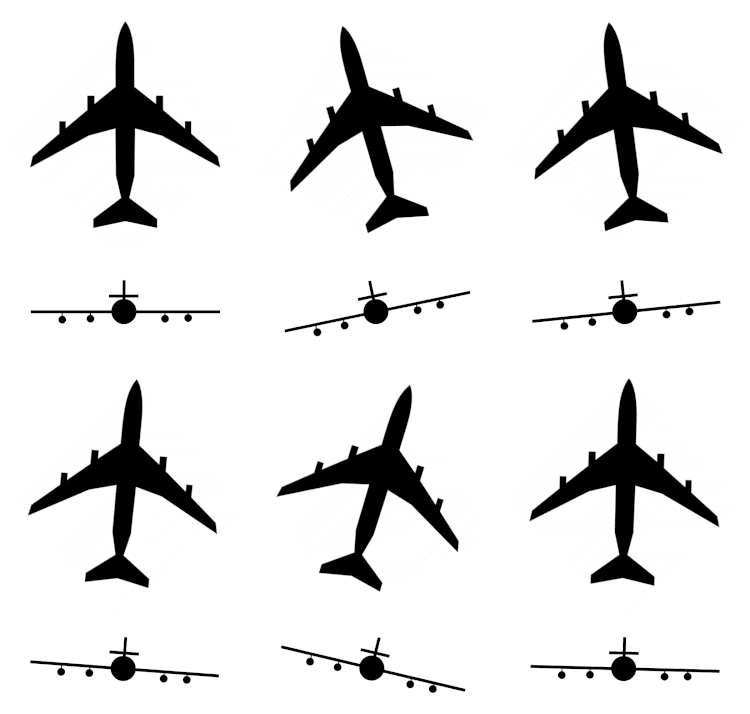
An animated illustration of the two motions which combine into a Dutch roll
Dutch roll damping technique, scanned from U.S. Air Force flight manual

Dutch roll is an aircraft motion consisting of an out-of-phase combination of "tail-wagging" (yaw) and rocking from side to side (roll). This yaw-roll coupling is one of the basic flight dynamic modes (others include phugoid, short period, and spiral divergence). This mode resembles the motion of an aircraft that is simultaneously yawing and rolling from side to side.[1] This motion is normally well damped in most light aircraft, though some aircraft with well-damped Dutch roll modes can experience a degradation in damping as airspeed decreases and altitude increases. Dutch roll stability can be artificially increased by the installation of a yaw damper.[2] Wings placed well above the center of gravity, swept wings, and dihedral wings tend to increase the roll restoring force, and therefore increase the Dutch roll tendencies; this is why high-winged aircraft often are slightly anhedral, and transport-category swept-wing aircraft are equipped with yaw dampers. A similar phenomenon can happen in a trailer pulled by a car.

Stability

[edit]

In aircraft design, Dutch roll results from relatively weaker positive directional stability as opposed to positive lateral stability. When an aircraft rolls around the longitudinal axis, a sideslip is introduced into the relative wind in the direction of the rolling motion (due to the lateral component of lift when the wings are not level). Strong lateral stability (due to the more-direct airflow past the down wing, which has been pivoted forward by the slip) begins to restore the aircraft to level flight. At the same time, somewhat weaker directional stability (due both to greater drag from the wing which is now generating greater lift, and by aerodynamic force on the vertical fin due to the yaw) attempts to correct the sideslip by aligning the aircraft with the perceived relative wind. Since directional stability is weaker than lateral stability for the particular aircraft, the restoring yaw motion lags significantly behind the restoring roll motion. The aircraft passes through level flight as the yawing motion is continuing in the direction of the original roll. At that point, the sideslip is introduced in the opposite direction and the process is reversed.

There is a trade-off between directional and lateral stability. Greater lateral stability leads to greater spiral stability and lower oscillatory stability. Greater directional stability leads to spiral instability but greater oscillatory stability.[3]

Mechanism

[edit]

The most common mechanism of Dutch roll occurrence is a yawing motion which can be caused by a number of factors. As a swept-wing aircraft yaws (to the right, for instance), the left wing becomes less-swept than the right wing in reference to the relative wind. Because of this, the left wing develops more lift than the right wing causing the aircraft to roll to the right. This motion continues until the yaw angle of the aircraft reaches the point where the vertical stabilizer effectively becomes a wind vane and reverses the yawing motion. As the aircraft yaws back to the left, the right wing then becomes less swept than the left resulting in the right wing developing more lift than the left. The aircraft then rolls to the left as the yaw angle again reaches the point where the aircraft wind-vanes back the other direction and the whole process repeats itself. The average duration of a Dutch roll half-cycle is 2 to 3 seconds.

The Dutch roll mode can be excited by any use of aileron or rudder, but for flight test purposes it is usually excited with a rudder singlet (a short sharp motion of the rudder to a specified angle, and then back to the centered position) or doublet (a pair of such motions in opposite directions). Some larger aircraft are better excited with aileron inputs. Periods can range from a few seconds for light aircraft to a minute or more for airliners.[citation needed]

Tex Johnston describes the Dutch roll as "...an inherent characteristic of swept-wing aircraft. It starts with a yaw. In a 35-degree swept-wing airplane, a yaw is accompanied by a simultaneous roll in the direction of yaw. The roll is caused by changing lift factors as the airflow path over the wing changes. For example, in a left yaw the left wing slews toward the rear so that airflow is displaced spanwise from its normal front-to-rear path over the airfoil section. That reduces lift. Simultaneously, the advancing right wing gets more chordwise flow, and so its lift is increased. In combination the two conditions create a left roll. Similarly, a yaw to the right results in a roll to the right. An oscillation is set up."[4]

Rolling on a heading

[edit]

Dutch roll is also the name (considered by professionals to be a misnomer) given to a coordination maneuver generally taught to student pilots to improve their "stick-and-rudder" technique. The aircraft is alternately rolled as much as 60 degrees left and right while rudder is applied to keep the nose of the aircraft pointed at a fixed point. More correctly, this is a rudder coordination practice exercise, to teach a student pilot how to correct for the effect known as adverse aileron yaw during roll inputs.

This coordination technique is better referred to as "rolling on a heading", wherein the aircraft is rolled in such a way as to maintain an accurate heading without the nose moving from side-to-side (or yawing). The yaw motion is induced through the use of ailerons alone due to aileron drag, wherein the lifting wing (aileron down) is doing more work than the descending wing (aileron up) and therefore creates more drag, forcing the lifting wing back, yawing the aircraft toward it. This yawing effect produced by rolling motion is known as adverse yaw. This has to be countered precisely by application of rudder in the same direction as the aileron control (left stick, left rudder – right stick, right rudder). This is known as synchronised controls when done properly, and is difficult to learn and apply well. The correct amount of rudder to apply with aileron is different for each aircraft.

Name

[edit]

The origin of the name Dutch roll is uncertain. However, it is likely that this term, describing a lateral asymmetric motion of an airplane, was borrowed from a reference to similar-appearing motion in ice skating. In 1916, aeronautical engineer Jerome C. Hunsaker published: "Dutch roll – the third element in the [lateral] motion [of an airplane] is a yawing to the right and left, combined with rolling. The motion is oscillatory of period for 7 to 12 seconds, which may or may not be damped. The analogy to 'Dutch Roll' or 'Outer Edge' in ice skating is obvious."[5] In 1916, Dutch Roll was the term used for skating repetitively to right and left (by analogy to the motion described for the aircraft) on the outer edge of one's skates. By 1916, the term had been imported from skating to aeronautical engineering, perhaps by Hunsaker himself. 1916 was only five years after G. H. Bryan did the first mathematical analysis of lateral motion of aircraft in 1911.[6]

Notable incidents

[edit]
  • On October 19, 1959, on a Boeing 707 on customer-acceptance flight, the yaw damper was turned off to familiarize the new pilots with flying techniques. A trainee pilot's actions violently exacerbated the Dutch roll motion and caused three of the aircraft's four engines to be torn from its wings. The plane, a brand new 707-227, N7071, destined for Braniff, crash-landed on a river bed north of Seattle at Arlington, Washington, killing four of the eight occupants.[7][8]
  • On August 12, 1985, Japan Air Lines Flight 123, a Boeing 747SR, exhibited a Dutch roll in combination with phugoid cycles after losing all hydraulics following the loss of its vertical stabiliser due to an improperly-repaired rear pressure bulkhead rupturing from metal fatigue. It would ultimately crash in the deadliest single-aircraft accident in history.
  • On March 6, 2005, Air Transat Flight 961, an Airbus A310, was involved in a Dutch roll incident following structural failure of the rudder at cruising altitude after departure from Juan Gualberto Gomez Airport, Varadero, Cuba. The aircraft returned to the airport with serious structural damage and one flight attendant slightly injured.[9]
  • On May 3, 2013, a McConnell AFB, KS (USAF) KC-135R, 63-8877, flown by a Fairchild AFB, Washington aircrew, broke up in flight about eleven minutes after taking off from Manas Air base in Kyrgyzstan, killing all three crew members.[10][11] It was determined that a rudder power control unit malfunction led to a Dutch roll oscillatory instability. Not recognizing the Dutch roll, the crew used the rudder to stay on course, which exacerbated the instability, leading to an unrecoverable flight condition. The over-stressed tail section detached and the rest of the aircraft broke apart soon after. The aircraft was at cruise altitude about 200 km west of Bishkek before it crashed in a mountainous area near the village of Chorgolu, close to the border between Kyrgyzstan and Kazakhstan.[12][13][14][15]
  • On October 30, 2015 a Leonardo-Finmeccanica-Helicopters Division (formerly AgustaWestland) AW609 prototype crashed in Italy killing its two pilots. The Italian ANSV established that Dutch roll during a high-speed test was the probable cause.[16][17]
  • On May 25, 2024, Southwest Flight 746, a Boeing 737 MAX 8, registration N8825Q, experienced a Dutch roll during a flight from Phoenix Sky Harbor International Airport to Oakland International Airport. Post-flight inspection revealed damage to the standby power control unit (PCU). There were no injuries among the 175 passengers and six crew members.[18][19][20][21]

See also

[edit]

References

[edit]
[edit]
Revisions and contributorsEdit on WikipediaRead on Wikipedia
from Grokipedia
Dutch roll is an oscillatory motion in aircraft involving coupled rolling and yawing, where the wings alternately bank left and right while the nose yaws side to side, typically triggered when the dihedral effects providing lateral stability overpower the directional stability from the vertical tail.[1] This dynamic lateral-directional mode is usually stable and self-damps over a few cycles in well-designed aircraft, but it can feel objectionable to pilots due to its wavelike, figure-eight path traced by the nose on the horizon, especially in swept-wing designs at high speeds or altitudes.[2] The term "Dutch roll" originated in the early 20th century, likely borrowed from the side-to-side rolling motion of Dutch ice skaters, evoking the aircraft's rhythmic oscillation.[3] It became a focal point in aeronautical engineering during the 1940s and 1950s as high-speed aircraft revealed coupled stability challenges, formalized in analyses like the Dutch roll stability equation $ C_n^* = C_{n\beta} \cos\alpha - \frac{I_z}{I_x} C_{l\beta} $, which accounts for yaw and roll moments influenced by sideslip angle and moments of inertia.[3] Causes include excessive effective dihedral from wing sweep or fuselage design, reduced damping at transonic speeds, and imbalances in control surface authority, leading to potential pilot-induced oscillations if undamped.[3][2] Mitigation strategies prioritize enhancing directional stability through larger vertical stabilizers or ventral/dorsal fins, while modern aircraft employ yaw dampers—gyroscopic systems that automatically apply rudder inputs to suppress the mode without pilot intervention.[4] Designers often favor slight spiral instability over strong Dutch roll tendencies for safer handling, as seen in general aviation and commercial jets where the mode's frequency and damping are tuned for Level 1 flying qualities per military standards.[2] In extreme cases, like the X-15 rocket plane, adverse dihedral caused severe Dutch roll, resolved by modifying ventral fins to restore balance.[3] Overall, understanding and controlling Dutch roll remains essential for ensuring lateral-directional stability across subsonic to hypersonic flight regimes.

Overview

Definition

Dutch roll is a coupled lateral-directional oscillatory motion in aircraft, consisting of an out-of-phase combination of yaw (rotation about the vertical axis, causing the nose to swing left or right) and roll (rotation about the longitudinal axis, tilting the wings such that one dips relative to the other).[2][5] This dynamic mode typically features light damping, resulting in sustained oscillations that can affect handling if not adequately controlled.[3] In aircraft stability analysis, Dutch roll represents one of the primary lateral-directional modes, distinct from the longitudinal phugoid (a slow, low-frequency oscillation involving speed and altitude variations) and short-period (a rapid pitching oscillation) modes.[5] It emerges from the inherent coupling between yaw and roll responses to disturbances, such as gusts, and is influenced by factors like the aircraft's directional stability and inertial properties.[3] The mode's characteristics underscore its importance in ensuring safe flight dynamics, with implications for pilot workload and overall stability that are addressed through design features like yaw dampers.[2]

Characteristics

Dutch roll manifests as a coupled oscillation involving yaw and roll motions, where the aircraft alternately yaws and banks in opposing directions. The typical period of this oscillation ranges from 2 to 4 seconds per cycle, depending on the aircraft type, speed, and altitude; for instance, general aviation airplanes often exhibit periods between 2.1 and 4.8 seconds, corresponding to frequencies of 1.3 to 3.0 radians per second.[6][7][8] The amplitude of Dutch roll oscillations generally decreases over time due to natural damping in well-designed aircraft, where the damping ratio typically exceeds 0.1, allowing the motion to subside within a few cycles. However, if damping is insufficient (e.g., ratio below 0.1), the amplitude may persist or grow, leading to larger excursions in roll and yaw that can degrade handling qualities. At higher speeds, the dihedral effect enhances roll stability, which increases the oscillation frequency and can amplify the mode's prominence if directional stability is marginal.[6][7][8] Excitation of Dutch roll commonly arises from external disturbances such as gusts or turbulence, which induce initial sideslip, or from pilot inputs like rudder or aileron deflections that couple into yaw-roll motion. Lateral gusts, in particular, generate yaw disturbances proportional to the aircraft's directional stability derivative, exciting the mode near its natural frequency.[6][8][7] Pilots experience Dutch roll through sensory cues including alternating sideslip and bank angles, resulting in a rhythmic side-to-side rocking sensation and visual horizon motion resembling a figure-eight pattern. These cues can include noticeable wingtip oscillations and heading deviations of 10 degrees or more, often accompanied by increased control workload to maintain stability.[6][8][7]

Etymology and History

Origin of the Name

The term "Dutch roll" originates from a traditional ice skating maneuver, particularly associated with Dutch long-distance skating styles, where skaters perform a rhythmic side-to-side swaying motion on the outer edges of their blades while maintaining forward speed.[9] This technique, known as schoonrijden or "clean riding," allows efficient travel over frozen canals and emphasizes a rolling gait to conserve energy during extended tours.[10] In 1916, aeronautical engineer Jerome C. Hunsaker, an early pioneer in aircraft design and stability analysis, coined the term for aviation to analogize the coupled oscillations in yaw and roll exhibited by airplanes.[11] Hunsaker explicitly drew the comparison in his seminal paper, describing the motion as akin to the skating figure: "The second type of motion has been called a 'Dutch roll' from analogy to a figure in ice skating. The aeroplane takes up an oscillation in yaw and roll simultaneously." As a naval constructor and instructor at the Massachusetts Institute of Technology, Hunsaker's work marked one of the first formal recognitions of such dynamic instabilities in powered flight.[11] The prefix "Dutch" in this context likely stems from the maneuver's roots in Dutch skating traditions, rather than any colloquial implication of unsteadiness, though the evocative imagery of swaying motion bridged the two domains effectively.[12] This etymological transfer highlighted the intuitive parallels between human athleticism and emerging aeronautical phenomena during the nascent era of airplane development.

Early Development

The coupled lateral-directional oscillation now known as Dutch roll was first mathematically described in 1911 by British aerodynamicist George Hartley Bryan in his seminal work Stability in Aviation, where he analyzed the dynamic stability of early aeroplanes and identified oscillatory modes involving roll and yaw. Bryan's equations laid the foundational framework for understanding these interactions, though the term "Dutch roll" emerged later during World War I, around 1916, as pilots observed the motion in nascent fighter aircraft such as the Sopwith Pup and early biplanes, where slight disturbances led to persistent side-to-side rocking combined with yawing. These initial observations were qualitative, drawn from flight reports, and highlighted the mode's presence even in straight-wing designs, predating widespread swept-wing experimentation. In the 1920s and 1930s, the National Advisory Committee for Aeronautics (NACA) conducted systematic wind-tunnel and flight tests to investigate lateral stability, revealing yaw-roll coupling as a critical factor in high-speed flight regimes. NACA Report No. 26 (1920) by Edwin Bidwell Wilson quantified yawing moments induced by rolling, demonstrating how dihedral effects amplified the oscillation in tailed aircraft. Subsequent studies in the 1930s further delineated the coupling mechanisms through free-flight models, emphasizing the need for balanced directional and roll damping to prevent divergent modes. Pioneering aerodynamicists like Edward P. Warner, who served as a key consultant and authored influential texts including Airplane Design: Aerodynamics (1927), contributed to these efforts by advocating for integrated stability criteria in aircraft configuration, influencing NACA's emphasis on empirical data over pure theory. Following World War II, the advent of jet aircraft intensified focus on Dutch roll due to rearward mass shifts from engine placements, exacerbating the mode in high-subsonic designs like the North American F-86 Sabre. NACA (later NASA) research in the late 1940s identified these trends, leading to standardized flight testing protocols by the 1950s that incorporated yaw damper evaluations and spectral analysis of oscillations during certification trials. This era marked a shift toward proactive mitigation, with figures like Jerome C. Hunsaker—credited with popularizing the "Dutch roll" nomenclature—overseeing broader stability advancements at MIT and NACA.

Flight Dynamics

Mechanism

The Dutch roll in aircraft arises from a coupled oscillatory motion involving yaw and roll, initiated by an aerodynamic disturbance that creates a sideslip angle. This sideslip occurs when the aircraft yaws slightly off its flight path, causing the relative wind to strike the fuselage and wings at an angle. The dihedral effect of the wings—either geometric dihedral or the effective dihedral induced by wing sweep—then generates a rolling moment, as the lower wing experiences increased lift due to the angled airflow, prompting the aircraft to roll toward the sideslip direction.[2][13] This roll, in turn, induces a secondary yaw through the aircraft's directional stability, as the rolling motion shifts the relative wind and creates a yawing moment in the opposite direction via the vertical tail or fuselage. The process forms a feedback loop: the initial yaw disturbance leads to sideslip, which drives roll via the dihedral effect; the ensuing roll then generates counter-yawing forces, perpetuating the oscillation as the aircraft alternately yaws and rolls out of phase. In this loop, the sideslip-to-roll coupling (via dihedral) and roll-to-yaw coupling (via directional stability) reinforce each other, resulting in a rhythmic, undamped or lightly damped motion resembling a figure-eight path on the horizon.[14][13][2] Swept wings exacerbate this coupling because the sweep angle directs airflow with a forward component during sideslip, effectively increasing the dihedral-like stability and amplifying the differential lift between wings. This makes Dutch roll more pronounced in swept-wing designs compared to straight-wing aircraft, where the coupling is weaker due to more uniform airflow distribution. The phenomenon is particularly evident at higher cruise speeds, where dynamic pressure intensifies the aerodynamic forces, though it is less severe in low-speed, straight-wing configurations.[2][14]

Mathematical Modeling

The lateral-directional equations of motion for an aircraft provide the quantitative foundation for modeling Dutch roll, a coupled oscillatory mode involving sideslip, roll, and yaw. These equations are derived from Newton's laws applied to the aircraft's body axes under small perturbation assumptions, linearizing the nonlinear flight dynamics around a steady trimmed condition. The relevant state variables typically include the sideslip angle β (in radians), roll angle φ (in radians), roll rate p (in rad/s), and yaw rate r (in rad/s), with the yaw angle ψ integrated from r for trajectory analysis. In state-space form, the dynamics are expressed as x˙=Ax+Bu\dot{x} = A x + B u, where x=[β,ϕ,p,r]Tx = [\beta, \phi, p, r]^T is the state vector, uu includes control inputs such as aileron deflection δa\delta_a and rudder deflection δr\delta_r, and the system matrix AA incorporates dimensional stability derivatives like YβY_\beta (side force due to sideslip), LβL_\beta (rolling moment due to sideslip, also denoted LvL_v), LpL_p (rolling moment due to roll rate), LrL_r (rolling moment due to yaw rate), NβN_\beta (yawing moment due to sideslip), NpN_p (yawing moment due to roll rate), and NrN_r (yawing moment due to yaw rate). The kinematic relations are ϕ˙=p+rtanθ0\dot{\phi} = p + r \tan \theta_0 (approximated as ϕ˙p\dot{\phi} \approx p for small pitch angle θ0\theta_0) and ψ˙=r/cosθ0\dot{\psi} = r / \cos \theta_0, while the force and moment equations yield:
β˙=Yβu0β+Ypu0p+Yru0u0r+gu0ϕcosθ0+1u0(Yδaδa+Yδrδr), \dot{\beta} = \frac{Y_\beta}{u_0} \beta + \frac{Y_p}{u_0} p + \frac{Y_r - u_0}{u_0} r + \frac{g}{u_0} \phi \cos \theta_0 + \frac{1}{u_0} (Y_{\delta_a} \delta_a + Y_{\delta_r} \delta_r),
p˙=Lββ+Lpp+Lrr+Lδaδa+Lδrδr, \dot{p} = L_\beta \beta + L_p p + L_r r + L_{\delta_a} \delta_a + L_{\delta_r} \delta_r,
r˙=Nββ+Npp+Nrr+Nδaδa+Nδrδr, \dot{r} = N_\beta \beta + N_p p + N_r r + N_{\delta_a} \delta_a + N_{\delta_r} \delta_r,
where u0u_0 is the trimmed forward speed and gg is gravitational acceleration.[15][16] The full fourth-order characteristic equation arises from det(λIA)=0\det(\lambda I - A) = 0, yielding roots corresponding to the spiral, roll subsidence, and Dutch roll modes. For the Dutch roll mode, a second-order approximation is often used by neglecting the aperiodic roll subsidence (assuming LpL_p dominates and decouples quickly) and focusing on the coupled β-r dynamics, resulting in the characteristic equation
λ2(Nr+Yβ/u0)λ+[Nβ(1Yr/u0)+NrYβ/u0]=0. \lambda^2 - (N_r + Y_\beta / u_0) \lambda + [N_\beta (1 - Y_r / u_0) + N_r Y_\beta / u_0] = 0.
This is recast in standard form as λ2+2ζωλ+ω2=0\lambda^2 + 2 \zeta \omega \lambda + \omega^2 = 0, where the natural frequency is ω=Nβ(1Yr/u0)+NrYβ/u0\omega = \sqrt{N_\beta (1 - Y_r / u_0) + N_r Y_\beta / u_0} (typically positive due to directional stability from Nβ<0N_\beta < 0) and the damping ratio is ζ=(Nr+Yβ/u0)/(2ω)\zeta = -(N_r + Y_\beta / u_0) / (2 \omega) (positive for stability, with Nr<0N_r < 0 and Yβ/u01Y_\beta / u_0 \approx -1 contributing to damping). The key derivatives driving the mode are LβL_\beta (dihedral effect, influencing roll-sideslip coupling) and NβN_\beta (weathercock stability, promoting yaw return), with high |L_\beta| and low |N_\beta| often leading to lightly damped oscillations in swept-wing designs, as the strong roll-sideslip coupling from dihedral overpowers the yaw restoring moment.[17][15] Eigenvalue analysis of the full system reveals the Dutch roll as a pair of complex conjugate roots λ=ζω±iω1ζ2\lambda = -\zeta \omega \pm i \omega \sqrt{1 - \zeta^2}, indicating an oscillatory mode with decay rate ζω\zeta \omega and frequency ω1ζ2\omega \sqrt{1 - \zeta^2}; real parts near zero signal marginal stability, while positive real parts denote divergence. For commercial jet transports without yaw damping, typical bare-airframe values are ω0.5\omega \approx 0.5--11 rad/s (period of 6--12 s) and ζ<0.1\zeta < 0.1 (lightly damped or nearly undamped), as seen in examples like a generic fighter model with roots 0.033±0.947i-0.033 \pm 0.947i (ζ0.035\zeta \approx 0.035, ω0.95\omega \approx 0.95 rad/s). Yaw dampers are essential to increase ζ\zeta to 0.2--0.4 for passenger comfort.[16][17] Simulations of Dutch roll employ this linearized state-space model, solved numerically (e.g., via eigenvalue decomposition or time integration in tools like MATLAB) around trimmed straight-and-level flight conditions, where perturbations in β or r initiate the mode. Nonlinear effects, such as large amplitudes or varying speed, require full six-degree-of-freedom models, but the linear approximation suffices for stability assessment and control design near cruise.[15][16]

Stability and Control

Directional and Lateral Stability

Directional stability in aircraft refers to the tendency to maintain or return to coordinated flight in yaw following a sideslip disturbance, quantified by the yawing moment derivative $ C_{n_\beta} $, where $ C_{n_\beta} > 0 $ indicates stability. This "weathercock" effect is primarily contributed by the vertical tail fin, which generates a restoring yaw moment proportional to the sideslip angle $ \beta $, with additional influences from the fuselage (often destabilizing) and wing-body interactions.[18] Larger vertical tail surfaces enhance $ C_{n_\beta} $, improving yaw recovery but increasing drag and structural weight.[2] Lateral stability, conversely, describes the roll response to sideslip, captured by the rolling moment derivative $ C_{l_\beta} $, where $ C_{l_\beta} < 0 $ promotes a restoring roll moment toward level wings. This dihedral effect arises mainly from wing geometry, such as upward dihedral angle or sweep, which causes differential lift during sideslip; high-wing configurations and keel effects from the fuselage further augment it.[18] Increasing wing dihedral strengthens $ |C_{l_\beta}| $, aiding roll stability but potentially compromising other performance aspects like stall characteristics.[2] The inherent trade-off between these stabilities critically influences Dutch roll susceptibility: strong directional stability relative to lateral (high $ C_{n_\beta} / |C_{l_\beta}| $ ratio) favors the non-oscillatory spiral mode, which can diverge into a tightening turn if unchecked, whereas weaker directional stability promotes the coupled oscillatory Dutch roll, where yaw and roll responses phase oppositely.[19] Aircraft designers balance fin size against wing dihedral to optimize this ratio, often targeting $ C_{n_\beta} $ values around 0.1–0.2 for transport aircraft to ensure adequate damping without spiral divergence.[18] These derivatives vary with flight conditions, affecting Dutch roll characteristics. At higher altitudes, reduced air density diminishes dynamic pressure-dependent terms, lengthening the Dutch roll period and reducing damping, which can make the mode more persistent.[20] Similarly, increasing speed or Mach number alters stability: subsonic speeds enhance tail effectiveness, but transonic and supersonic regimes introduce compressibility effects, potentially reducing $ C_{n_\beta} $ due to shock-induced flow separation on the vertical tail, thereby exacerbating Dutch roll tendencies in high-speed cruise.[21]

Damping and Mitigation

Natural damping of Dutch roll arises primarily from aerodynamic forces acting on the aircraft's vertical tail and fuselage, including viscous drag and weathercock stability provided by the fin, which generates a restoring yaw moment proportional to sideslip angle.[2] These effects contribute to the damping ratio ζ through derivatives such as the yaw damping coefficient C_{n_r} and roll damping C_{l_p}, but in swept-wing jet aircraft, the inherent low dihedral effect and high speed reduce this natural damping, often making it insufficient for passenger comfort or precise control without augmentation.[20] For instance, early jet designs exhibited Dutch roll modes with ζ as low as 0.1, leading to prolonged oscillations that could degrade handling qualities.[22] Yaw dampers address this by providing artificial damping through a feedback control system that senses aircraft yaw rate via gyroscopes and applies corrective rudder inputs to counteract oscillations.[23] This closed-loop mechanism effectively increases the Dutch roll damping ratio by introducing a yaw rate feedback gain, suppressing the mode without pilot intervention.[20] Yaw dampers became standard on commercial airliners in the 1960s, following the introduction of swept-wing jets like the Boeing 707, where natural damping proved inadequate during high-speed flight; by the mid-1960s, they were integral to type certification for transport aircraft to ensure rapid decay of oscillations.[22] Aircraft design mitigations further enhance Dutch roll damping through optimized vertical tail volume coefficient V_v, typically ranging from 0.04 to 0.08 for jets, which boosts directional stability and the yaw damping derivative to promote quicker mode convergence.[24] Wing twist, or washout, adjusts the effective dihedral angle to balance lateral stability, reducing the coupling between roll and yaw that exacerbates undamped oscillations in swept-wing configurations.[25] In modern fly-by-wire aircraft, such as the Boeing 777 and Airbus A320, active control systems integrate yaw damping into the flight control computers, using multiple sensors and actuators to dynamically allocate rudder and aileron deflections for enhanced suppression, often achieving near-instantaneous response to disturbances.[26][27] For certification under FAA Part 25, Dutch roll must be heavily damped between 1.13 V_{SR} and maximum speed.[28] Handling qualities standards like MIL-HDBK-1797 recommend ζ ≥ 0.15 for Level 1 performance in transport aircraft to ensure passenger comfort and pilot workload remains low. Boeing and Airbus designs typically target ζ > 0.4 with yaw dampers engaged, as demonstrated in flight tests where unaugmented modes show ζ ≈ 0.1 but augmented systems reduce oscillation amplitude by over 90% within 2-3 cycles.[29] These metrics underscore the effectiveness of combined passive and active mitigations in maintaining lateral-directional stability across the flight envelope.[30]

Rolling on a Heading

The rolling on a heading maneuver is a coordinated flight exercise in which the pilot uses ailerons and rudder inputs to roll the aircraft left and right while maintaining a fixed heading, thereby preventing any yaw excursion of the nose.[31] This training technique focuses on developing precise control coordination to counteract the natural tendency of the aircraft to yaw opposite to the roll direction.[32] It is routinely practiced at safe altitudes in light general aviation aircraft to build pilots' ability to execute smooth turns without slipping or skidding.[31] The primary purpose of the maneuver is to train pilots in countering adverse yaw during banked turns, fostering an instinctive feel for integrated aileron and rudder use that enhances overall flight precision and safety.[32] By emphasizing visual reference to the horizon rather than relying solely on the turn coordinator or inclinometer, pilots learn to anticipate and correct for control inputs in real-time, which is crucial for maintaining coordinated flight in varying conditions.[31] This exercise indirectly relates to understanding yaw-roll coupling in aircraft dynamics, a key aspect of stability modes such as Dutch roll.[33] To execute the procedure, the pilot begins in straight-and-level flight at a cruise speed, selects a clear visual reference point on the horizon, and initiates a roll with aileron deflection toward a moderate bank of about 30 degrees while applying rudder in the same direction to keep the nose steady on the reference.[31] As the bank is held momentarily, the pilot maintains altitude with elevator pressure and then reverses the inputs—neutralizing aileron and rudder to pass through level flight before banking in the opposite direction with corresponding rudder to sustain the heading.[31] The cycle is repeated several times, with smooth transitions emphasizing minimal overcontrol, and the aircraft is returned to level flight upon completion.[32] This maneuver is a common element of flight training programs.[34] It remains a core component in contemporary FAA-recommended curricula, helping novice pilots transition from basic turns to more advanced coordinated maneuvers.[32]

Connection to Adverse Yaw

Adverse yaw refers to the initial yawing moment generated in the direction opposite to the intended roll when ailerons are deflected, resulting from the asymmetry in induced drag between the wings. When the aileron on one wing is deflected downward to increase lift and initiate a roll, it also increases the angle of attack and induced drag on that wing compared to the opposite wing, where the aileron is deflected upward. This drag differential causes the aircraft nose to yaw away from the direction of the bank, particularly noticeable in aircraft with long wingspans or at low speeds where large aileron deflections are required.[35] This phenomenon directly contributes to the excitation of the Dutch roll mode, as uncoordinated aileron inputs without corresponding rudder correction create a sideslip angle that couples with the roll motion, initiating the oscillatory yaw-roll response characteristic of Dutch roll. The adverse yaw-induced sideslip feeds into the lateral-directional dynamics, where the resulting yaw rate generates a rolling moment due to dihedral effects or sweep, perpetuating the oscillation. In particular, aileron deflections produce a yaw moment coefficient $ n_{\delta_a} < 0 $, indicating a negative (adverse) contribution that can reduce overall directional stability and amplify the mode's amplitude if not damped.[5][3] In swept-wing aircraft, adverse yaw has a more pronounced effect on Dutch roll susceptibility because the wing sweep enhances roll-yaw coupling through weathercock stability and differential lift distribution, making the mode lightly damped without intervention. For instance, historical analyses of vehicles like the X-15 showed that adverse yaw from aileron inputs at high angles of attack could destabilize the Dutch roll, requiring additional control measures to maintain stability. To mitigate this in pilot training, emphasis is placed on coordinated use of rudder with ailerons during roll maneuvers, ensuring minimal sideslip buildup and preventing inadvertent excitation of the Dutch roll oscillation.[3][35]

Notable Incidents

Pre-2000 Incidents

One of the earliest documented fatal incidents involving Dutch roll occurred on October 19, 1959, during a customer acceptance and training flight of a Boeing 707-227 (N7071) near Arlington, Washington. The flight crew, including pilots from Braniff International Airways, intentionally initiated a series of Dutch rolls to familiarize themselves with the aircraft's handling characteristics without the yaw damper engaged. One maneuver exceeded the design limit of a 40-degree bank angle, reaching 40 to 60 degrees, which amplified the oscillations and led to loss of control. The resulting violent rolling motion caused structural failure, tearing off three engines and prompting an emergency landing attempt along the Stillaguamish River; the aircraft was destroyed by impact and fire, killing 4 of the 8 occupants. The Civil Aeronautics Board (CAB) investigation determined that improper recovery from the excessive Dutch roll was the primary cause, as the undamped mode generated loads beyond the airframe's tolerance.[36] This accident underscored the vulnerability of early swept-wing jet designs to undamped lateral-directional oscillations, particularly during deliberate maneuvers at high speeds. In the absence of active damping systems, the Boeing 707's inherent Dutch roll tendency—stemming from its high aspect ratio and swept wings—could rapidly escalate into uncontrollable motions.[22] The CAB report recommended stricter adherence to bank angle limits during flight testing and emphasized the critical role of yaw dampers in preventing such instabilities, influencing subsequent design and training protocols for the 707 series.[36] A far more devastating pre-2000 incident occurred on August 12, 1985, involving Japan Airlines Flight 123, a Boeing 747SR-46 (JA8119) en route from Tokyo to Osaka. Shortly after takeoff, an explosive decompression resulted from the rupture of the aft pressure bulkhead, which had been improperly repaired following a tail strike during a 1978 landing incident; this failure severed the vertical stabilizer, No. 4 engine, and all four hydraulic lines. The resulting loss of directional stability and control authority caused the aircraft to enter pronounced Dutch roll oscillations combined with phugoid cycles, making sustained flight control nearly impossible despite the crew's use of engine thrust asymmetry for steering. The plane flew erratically for 32 minutes before crashing into Mount Takamagahara at 6:56 p.m., killing 520 of the 524 passengers and crew aboard and marking the deadliest single-aircraft accident in aviation history.[37] The Japanese Aircraft Accident Investigation Commission report attributed the crash primarily to the bulkhead failure but noted that the ensuing Dutch roll exacerbated the loss of control, as the aircraft's auxiliary power unit-driven hydraulic systems proved inadequate for damping the motions without the main systems.[37] This event highlighted how Dutch roll could compound catastrophic structural damage in wide-body jets, prompting global scrutiny of maintenance practices for pressure bulkheads and reinforcing the necessity of robust stability augmentation in designs prone to such modes. These incidents from the pre-yaw damper era for commercial jets revealed the acute risks of unmitigated Dutch roll, especially in high-speed, swept-wing aircraft like the Boeing 707 and 747, where lateral instability could propagate to structural overload or control loss when combined with other failures. Early jets often operated without mandatory damping systems, relying on pilot intervention that proved insufficient in aggressive or degraded conditions.[22] In response, the FAA and other regulators updated certification standards under 14 CFR Part 25, incorporating requirements for demonstrated controllability and stability that effectively mandated yaw dampers for transport-category airplanes exhibiting Dutch roll tendencies, ensuring their integration as standard equipment to prevent recurrence. This shift marked a pivotal advancement in aviation safety, reducing the incidence of such oscillations through active electronic augmentation.[22]

Post-2000 Incidents

On March 6, 2005, Air Transat Flight 961, an Airbus A310-308 operating from Varadero, Cuba, to Quebec City, Canada, experienced a catastrophic rudder structural failure approximately 17 minutes after takeoff at 35,000 feet, initiating a sustained Dutch roll oscillation that intensified despite crew interventions, including disengaging the autopilot and attempting manual control.[38] The aircraft, carrying 162 passengers and 9 crew, was safely diverted for an emergency landing at Halifax International Airport with no injuries or fatalities, though post-flight inspection revealed the entire rudder had separated in flight due to fatigue cracking from prior manufacturing defects.[38] This incident prompted the Transportation Safety Board of Canada to recommend enhanced rudder inspections and design reviews across the A310 fleet, influencing global regulatory scrutiny on composite rudder durability in high-cycle operations.[39] In Kyrgyzstan on May 3, 2013, a U.S. Air Force KC-135R Stratotanker (call sign Shell 77) crashed shortly after takeoff from Manas Air Base, killing all three crew members when the aircraft entered an unrecognized Dutch roll oscillation that escalated into structural failure, resulting in the loss of the tail and right wing during a high-speed descent.[40] The official U.S. Air Force Accident Investigation Board report attributed the mishap primarily to the crew's failure to identify and mitigate the Dutch roll, which began about nine minutes into the flight amid routine aerial refueling mission preparations, exacerbated by inadequate training on such dynamic instabilities in the aging tanker fleet. Investigations highlighted deficiencies in de-icing procedures and cold-weather operations at the base, though no direct icing was confirmed on the airframe; the incident led to updated USAF protocols for Dutch roll recognition, yaw damper functionality checks, and enhanced simulator training for KC-135 pilots.[40] During a high-speed test flight on October 30, 2015, near Santhià, Italy, the second prototype of the AgustaWestland AW609 tiltrotor (N609AG) disintegrated in mid-air, killing both test pilots when flight control laws inadvertently induced a divergent Dutch roll oscillation during a maximum-speed dive in airplane mode.[41] The Italian National Agency for the Safety of Flight (ANSV) investigation determined that uncommanded yaw and roll inputs from the stability augmentation system amplified the motion, leading to proprotor blade contact with the wings and subsequent breakup at around 7,000 feet. With the program already facing certification delays, this crash significantly impacted the AW609's development timeline, prompting Leonardo (formerly AgustaWestland) to revise flight control software, augment damping algorithms, and conduct extensive revalidation testing before resuming flights in 2017.[42] Southwest Airlines Flight 746, a Boeing 737 MAX 8 (N8825Q), encountered a sudden Dutch roll at approximately 32,000 feet en route from Phoenix to Oakland on May 25, 2024, resulting in substantial damage to the rudder system but allowing the crew to regain control and land safely at Phoenix Sky Harbor Airport with 171 passengers and 6 crew aboard and no injuries.[43] The National Transportation Safety Board (NTSB) preliminary report identified anomalous secondary power unit-driven rudder movements as the initiating factor, potentially linked to latent damage from prior ground turbulence, with ongoing FAA and NTSB probes examining Boeing's 737 MAX rudder design and hydraulic integration for vulnerabilities in modern fly-by-wire architectures. This event underscores persistent challenges in automated stability systems despite post-MCAS enhancements. Post-2000 Dutch roll incidents reflect a shift from inherent airframe design flaws prevalent in earlier aviation eras to failures in advanced systems, such as control laws, yaw dampers, and environmental factors like undetected icing or turbulence, though widespread adoption of active damping technologies has generally mitigated severity and prevented fatalities in commercial operations.[40]

References

User Avatar
No comments yet.