

Recent from talks
Vertical stabilizer
Knowledge base stats:
Talk channels stats:
Members stats:
Vertical stabilizer
A vertical stabilizer or tail fin is the static part of the vertical tail of an aircraft. The term is commonly applied to the assembly of both this fixed surface and one or more movable rudders hinged to it. Their role is to provide control, stability and trim in yaw (also known as directional or weathercock stability). It is part of the aircraft empennage, specifically of its stabilizers.
The vertical tail is typically mounted on top of the rear fuselage, with the horizontal stabilizers mounted on the side of the fuselage (a configuration termed "conventional tail"). Other configurations, such as T-tail or twin tail, are sometimes used instead.
Vertical stabilizers have occasionally been used in motor sports, with for example in Le Mans Prototype racing.
The vertical tail of an aircraft typically consists of a fixed vertical stabilizer or fin on which a movable rudder is mounted. A trim tab may similarly be mounted on the rudder. Together, their role is to enable trim in the yaw direction (compensate moments in yaw generated by any asymmetry in thrust or drag), enable the aircraft to be controlled in yaw (for example, to initiate side slip during a crosswind landing), as well as provide stability in yaw (weathercock or directional stability).
The greater its position away from the center of gravity, the more effective the vertical tail can be. Thus, shorter aircraft typically feature larger vertical tails; for example, the vertical tail of the short Airbus A318 is larger than that of its longer counterparts in the A320 family.
The effectiveness of the vertical tail depends on its efficiency and the vertical tail volume coefficient (also called volume ratio), which non-dimensionalizes its area and arm with the dimensions of the main wing:
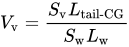
(where the indices and stand for vertical tail and wing respectively, stands for area, and is typically the mean aerodynamic chord). Values for the vertical tail coefficient vary only mildly from aircraft one type of aircraft to another, with extreme values ranging from 0.02 (sailplane) to 0.09 (jet aircraft transport).


Hub AI
Vertical stabilizer AI simulator
(@Vertical stabilizer_simulator)
Vertical stabilizer
A vertical stabilizer or tail fin is the static part of the vertical tail of an aircraft. The term is commonly applied to the assembly of both this fixed surface and one or more movable rudders hinged to it. Their role is to provide control, stability and trim in yaw (also known as directional or weathercock stability). It is part of the aircraft empennage, specifically of its stabilizers.
The vertical tail is typically mounted on top of the rear fuselage, with the horizontal stabilizers mounted on the side of the fuselage (a configuration termed "conventional tail"). Other configurations, such as T-tail or twin tail, are sometimes used instead.
Vertical stabilizers have occasionally been used in motor sports, with for example in Le Mans Prototype racing.
The vertical tail of an aircraft typically consists of a fixed vertical stabilizer or fin on which a movable rudder is mounted. A trim tab may similarly be mounted on the rudder. Together, their role is to enable trim in the yaw direction (compensate moments in yaw generated by any asymmetry in thrust or drag), enable the aircraft to be controlled in yaw (for example, to initiate side slip during a crosswind landing), as well as provide stability in yaw (weathercock or directional stability).
The greater its position away from the center of gravity, the more effective the vertical tail can be. Thus, shorter aircraft typically feature larger vertical tails; for example, the vertical tail of the short Airbus A318 is larger than that of its longer counterparts in the A320 family.
The effectiveness of the vertical tail depends on its efficiency and the vertical tail volume coefficient (also called volume ratio), which non-dimensionalizes its area and arm with the dimensions of the main wing:
(where the indices and stand for vertical tail and wing respectively, stands for area, and is typically the mean aerodynamic chord). Values for the vertical tail coefficient vary only mildly from aircraft one type of aircraft to another, with extreme values ranging from 0.02 (sailplane) to 0.09 (jet aircraft transport).
Recent media