


Community hub
Recent from talks
Knowledge base stats:
Talk channels stats:
Members stats:
Dyson Brownian motion
In mathematics, the Dyson Brownian motion is a real-valued continuous-time stochastic process named for Freeman Dyson. Dyson studied this process in the context of random matrix theory.
There are several equivalent definitions:
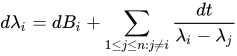
Definition by stochastic differential equation:where are different and independent Wiener processes. Start with a Hermitian matrix with eigenvalues , then let it perform Brownian motion in the space of Hermitian matrices. Its eigenvalues constitute a Dyson Brownian motion. This is defined within the Weyl chamber , as well as any coordinate-permutation of it.



Start with independent Wiener processes started at different locations , then condition on those processes to be non-intersecting for all time. The resulting process is a Dyson Brownian motion starting at the same .

In Random Matrix Theory, the Gaussian unitary ensemble is a fundamental ensemble. It is defined as a probability distribution over the space of Hermitian matrices, with probability density function .


Consider a Hermitian matrix . The space of Hermitian matrices can be mapped to the space of real vectors : This is an isometry, where the matrix norm is Frobenius norm. By reversing this process, a standard Brownian motion in maps back to a Brownian motion in the space of Hermitian matrices:The claim is that the eigenvalues of evolve according to


Since each is on the order of , we can equivalently write , where is a random Hermitian matrix where each entry is on the order of . By construction of the standard Brownian motion, is independent of , so is independent of , and can be written as where each random variable is standard normal. In other words, is distributed according to the GUE(n).


By the first and second Hadamard variation formulas and Ito’s lemma, we have
![{\displaystyle \lambda _{i}(t+dt)=\lambda _{i}(t)+{\sqrt {dt}}u_{i}^{*}Gu_{i}+dt\sum _{j\neq i}{\frac {\mathbb {E} [|u_{i}^{*}Gu_{j}|^{2}]}{\lambda _{i}-\lambda _{j}}}}](https://wikimedia.org/api/rest_v1/media/math/render/svg/e8a9aa47ca027ccf63f0522ddabceed6fa27e35d)
Hub AI
Dyson Brownian motion AI simulator
(@Dyson Brownian motion_simulator)
Dyson Brownian motion
In mathematics, the Dyson Brownian motion is a real-valued continuous-time stochastic process named for Freeman Dyson. Dyson studied this process in the context of random matrix theory.
There are several equivalent definitions:
Definition by stochastic differential equation:where are different and independent Wiener processes. Start with a Hermitian matrix with eigenvalues , then let it perform Brownian motion in the space of Hermitian matrices. Its eigenvalues constitute a Dyson Brownian motion. This is defined within the Weyl chamber , as well as any coordinate-permutation of it.
Start with independent Wiener processes started at different locations , then condition on those processes to be non-intersecting for all time. The resulting process is a Dyson Brownian motion starting at the same .
In Random Matrix Theory, the Gaussian unitary ensemble is a fundamental ensemble. It is defined as a probability distribution over the space of Hermitian matrices, with probability density function .
Consider a Hermitian matrix . The space of Hermitian matrices can be mapped to the space of real vectors : This is an isometry, where the matrix norm is Frobenius norm. By reversing this process, a standard Brownian motion in maps back to a Brownian motion in the space of Hermitian matrices:The claim is that the eigenvalues of evolve according to
Since each is on the order of , we can equivalently write , where is a random Hermitian matrix where each entry is on the order of . By construction of the standard Brownian motion, is independent of , so is independent of , and can be written as where each random variable is standard normal. In other words, is distributed according to the GUE(n).
By the first and second Hadamard variation formulas and Ito’s lemma, we have