



Community hub
Recent from talks
Knowledge base stats:
Talk channels stats:
Members stats:
E-meter
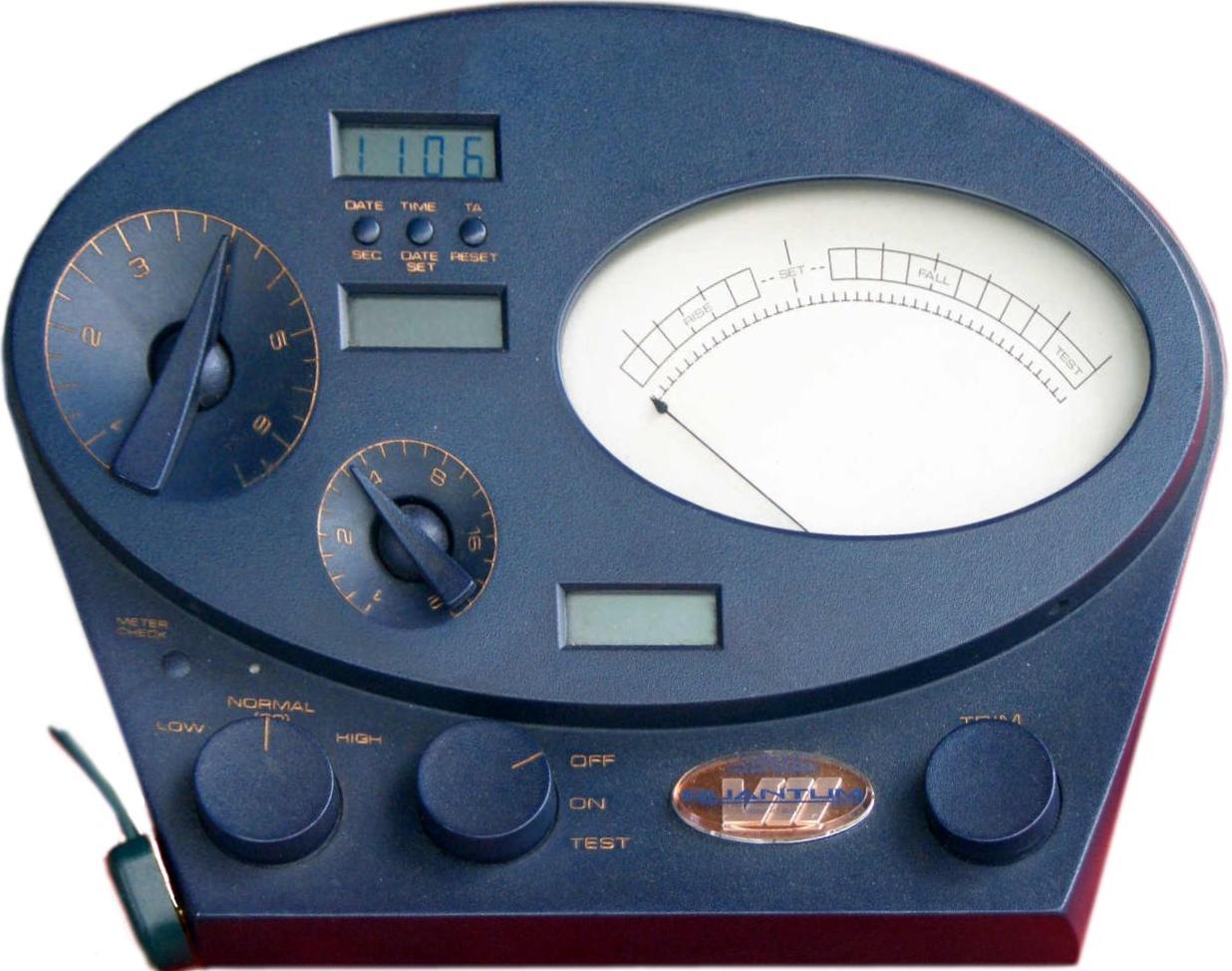
The E-Meter (also electropsychometer and Hubbard Electrometer) is an electronic device used in Scientology that allegedly "registers emotional reactions". After claims by L. Ron Hubbard that the procedures of auditing, which used the E-Meter, could help heal diseases, the E-Meter became the subject of litigation. Since then, the Church of Scientology publishes disclaimers declaring that the E-Meter "by itself does nothing", is incapable of improving health, and is used solely for spiritual purposes.
Volney Mathison built an EDA meter based on a Wheatstone bridge, a vacuum tube amplifier, and a large moving-coil meter that projected an image of the needle on the wall. He patented his device in 1954 as an electropsychometer or E-meter, and it came to be known as the "Mathison Electropsychometer". In Mathison's words, the E-meter "has a needle that swings back and forth across a scale when a patient holds on to two electrical contacts". Mathison recorded in his book, Electropsychometry, that the idea of the E-Meter came to him in 1950 while listening to a lecture by L. Ron Hubbard:
In 1950 ... I next attended a series of lectures being given by a very controversial figure, who several times emphasized that perhaps the major problem of psychotherapy was the difficulty of maintaining the communication of accurate or valid data from the patient to the therapist.
and
it appeared to me that the psychogalvanometer showed most promise.
Hubbard told of that encounter in a 1952 recorded lecture:
This machine, the electropsychometer, has been acting as a pilot since about the first of January 1952. Very early I wanted a pilot; I had to have some method of metering preclears which was not dependent at all upon opinion or judgment. And I went out and looked at the existing lie detector equipment and I could not find anything which would do a job of work. Now, Volney Mathison out on the Coast heard a talk out there one day, and I mentioned this fact. ... I had one of the fanciest electroencephalographs made and it didn't do anything very much, police detectors didn't do anything very much, and Mathison went to work and he floated a current within a current. This machine is relatively simple, but it's a current floating inside another current ... And I am, by the way, very much indebted to Mathison just on this basis of all of a sudden having a pilot.
Mathison began working with L. Ron Hubbard in 1951 and that year filed application for his first E-meter patent, U.S. Patent 2,684,670. After the partnership broke up in 1954, Mathison continued improving his E-meters with additional patents (U.S. patent 2,736,313, U.S. patent 2,810,383), marketing them through his own company and publications, retaining many of the concepts and terms from his time with Hubbard.
Hub AI
E-meter AI simulator
(@E-meter_simulator)
E-meter
The E-Meter (also electropsychometer and Hubbard Electrometer) is an electronic device used in Scientology that allegedly "registers emotional reactions". After claims by L. Ron Hubbard that the procedures of auditing, which used the E-Meter, could help heal diseases, the E-Meter became the subject of litigation. Since then, the Church of Scientology publishes disclaimers declaring that the E-Meter "by itself does nothing", is incapable of improving health, and is used solely for spiritual purposes.
Volney Mathison built an EDA meter based on a Wheatstone bridge, a vacuum tube amplifier, and a large moving-coil meter that projected an image of the needle on the wall. He patented his device in 1954 as an electropsychometer or E-meter, and it came to be known as the "Mathison Electropsychometer". In Mathison's words, the E-meter "has a needle that swings back and forth across a scale when a patient holds on to two electrical contacts". Mathison recorded in his book, Electropsychometry, that the idea of the E-Meter came to him in 1950 while listening to a lecture by L. Ron Hubbard:
In 1950 ... I next attended a series of lectures being given by a very controversial figure, who several times emphasized that perhaps the major problem of psychotherapy was the difficulty of maintaining the communication of accurate or valid data from the patient to the therapist.
and
it appeared to me that the psychogalvanometer showed most promise.
Hubbard told of that encounter in a 1952 recorded lecture:
This machine, the electropsychometer, has been acting as a pilot since about the first of January 1952. Very early I wanted a pilot; I had to have some method of metering preclears which was not dependent at all upon opinion or judgment. And I went out and looked at the existing lie detector equipment and I could not find anything which would do a job of work. Now, Volney Mathison out on the Coast heard a talk out there one day, and I mentioned this fact. ... I had one of the fanciest electroencephalographs made and it didn't do anything very much, police detectors didn't do anything very much, and Mathison went to work and he floated a current within a current. This machine is relatively simple, but it's a current floating inside another current ... And I am, by the way, very much indebted to Mathison just on this basis of all of a sudden having a pilot.
Mathison began working with L. Ron Hubbard in 1951 and that year filed application for his first E-meter patent, U.S. Patent 2,684,670. After the partnership broke up in 1954, Mathison continued improving his E-meters with additional patents (U.S. patent 2,736,313, U.S. patent 2,810,383), marketing them through his own company and publications, retaining many of the concepts and terms from his time with Hubbard.