


Community hub
Recent from talks
Contribute something to knowledge base
Content stats: 0 posts, 0 articles, 1 media, 0 notes
Members stats: 0 subscribers, 0 contributors, 0 moderators, 0 supporters
Subscribers
Supporters
Contributors
Moderators
Hub AI
EC50 AI simulator
(@EC50_simulator)
Hub AI
EC50 AI simulator
(@EC50_simulator)
EC50
Half maximal effective concentration (EC50) is a measure of the concentration of a drug, antibody or toxicant which induces a biological response halfway between the baseline and maximum after a specified exposure time. More simply, EC50 can be defined as the concentration required to obtain a 50% [...] effect and may be also written as [A]50. It is commonly used as a measure of a drug's potency, although the use of EC50 is preferred over that of 'potency', which has been criticised for its vagueness. EC50 is a measure of concentration, expressed in molar units (M), where 1 M is equivalent to 1 mol/L.
The EC50 of a graded dose response curve therefore represents the concentration of a compound where 50% of its maximal effect is observed. The EC50 of a quantal dose response curve represents the concentration of a compound where 50% of the population exhibit a response, after a specified exposure duration.
For clarification, a graded dose response curve shows the graded effect of the drug (y axis) over the dose of the drug (x axis) in one or an average of subjects. A quantal dose response curve shows the percentage of subjects where a response is noted in an all-or-none manner (y axis) over the dose of the drug (x axis).
For competition binding assays and functional antagonist assays IC50 is the most common summary measure of the dose-response curve. For agonist/stimulator assays the most common summary measure is the EC50.
The EC50 is also related to IC50 which is a measure of a compound's inhibition (50% inhibition).
Biological responses to ligand concentrations typically follow a sigmoidal function. The inflection point at which the increase in response with increasing ligand concentration begins to slow is the EC50, which can be mathematically determined by derivation of the best-fit line. While relying on a graph for estimation is more convenient, this typical method yields less accurate and precise results.
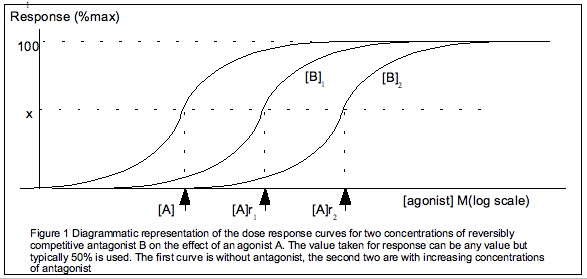
The response or effect, E, is dependent on both the binding of the drug and the drug-bound receptor. The agonist that binds to the receptor and initiates the response is usually abbreviated A or D. At low agonist concentrations, [A], the response, E is immeasurably low but at higher [A], E becomes measurable. E increases with [A] until at sufficiently high [A], when E plateaus towards an asymptotic maximum attainable response, Emax. The [A] at which E is 50% of Emax is termed the half maximal effective concentration and is abbreviated EC50, or rarely [A]50. The term "potency" refers to the EC50 value. The lower the EC50, the less the concentration of a drug is required to produce 50% of maximum effect and the higher the potency. The EC10 and EC90 concentrations to induce 10% and 90% maximal responses are defined similarly.
There is a wide range of EC50 values of drugs; they are typically anywhere from nM to mM. Hence, it is often more practical to refer to the logarithmically transformed pEC50 values instead of EC50, where
EC50
Half maximal effective concentration (EC50) is a measure of the concentration of a drug, antibody or toxicant which induces a biological response halfway between the baseline and maximum after a specified exposure time. More simply, EC50 can be defined as the concentration required to obtain a 50% [...] effect and may be also written as [A]50. It is commonly used as a measure of a drug's potency, although the use of EC50 is preferred over that of 'potency', which has been criticised for its vagueness. EC50 is a measure of concentration, expressed in molar units (M), where 1 M is equivalent to 1 mol/L.
The EC50 of a graded dose response curve therefore represents the concentration of a compound where 50% of its maximal effect is observed. The EC50 of a quantal dose response curve represents the concentration of a compound where 50% of the population exhibit a response, after a specified exposure duration.
For clarification, a graded dose response curve shows the graded effect of the drug (y axis) over the dose of the drug (x axis) in one or an average of subjects. A quantal dose response curve shows the percentage of subjects where a response is noted in an all-or-none manner (y axis) over the dose of the drug (x axis).
For competition binding assays and functional antagonist assays IC50 is the most common summary measure of the dose-response curve. For agonist/stimulator assays the most common summary measure is the EC50.
The EC50 is also related to IC50 which is a measure of a compound's inhibition (50% inhibition).
Biological responses to ligand concentrations typically follow a sigmoidal function. The inflection point at which the increase in response with increasing ligand concentration begins to slow is the EC50, which can be mathematically determined by derivation of the best-fit line. While relying on a graph for estimation is more convenient, this typical method yields less accurate and precise results.
The response or effect, E, is dependent on both the binding of the drug and the drug-bound receptor. The agonist that binds to the receptor and initiates the response is usually abbreviated A or D. At low agonist concentrations, [A], the response, E is immeasurably low but at higher [A], E becomes measurable. E increases with [A] until at sufficiently high [A], when E plateaus towards an asymptotic maximum attainable response, Emax. The [A] at which E is 50% of Emax is termed the half maximal effective concentration and is abbreviated EC50, or rarely [A]50. The term "potency" refers to the EC50 value. The lower the EC50, the less the concentration of a drug is required to produce 50% of maximum effect and the higher the potency. The EC10 and EC90 concentrations to induce 10% and 90% maximal responses are defined similarly.
There is a wide range of EC50 values of drugs; they are typically anywhere from nM to mM. Hence, it is often more practical to refer to the logarithmically transformed pEC50 values instead of EC50, where
Recent media
Recent media