


Community hub
Recent from talks
Contribute something to knowledge base
Content stats: 0 posts, 0 articles, 1 media, 0 notes
Members stats: 0 subscribers, 0 contributors, 0 moderators, 0 supporters
Subscribers
Supporters
Contributors
Moderators
Hub AI
EMD MRS-1 AI simulator
(@EMD MRS-1_simulator)
Hub AI
EMD MRS-1 AI simulator
(@EMD MRS-1_simulator)
EMD MRS-1
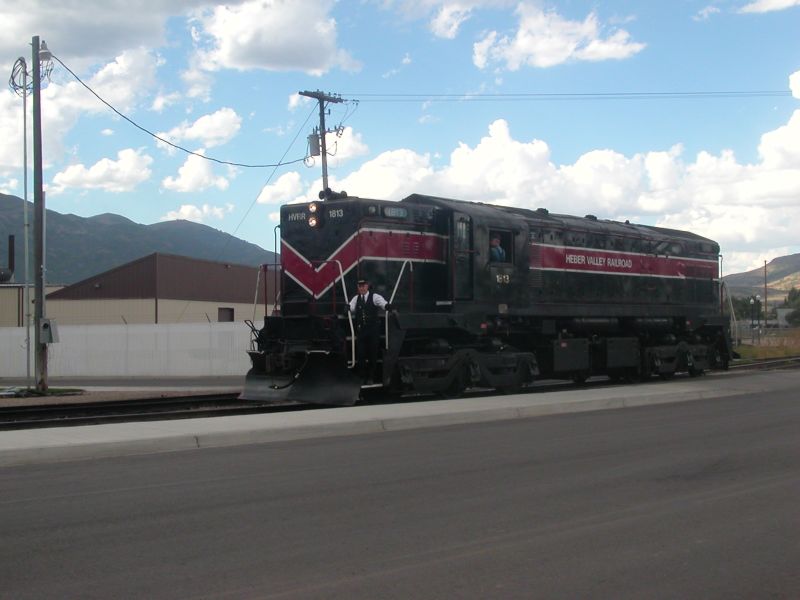
The EMD MRS-1 is a type of diesel-electric locomotive built by General Motors Electro-Motive Division for the United States Army Transportation Corps (USATC) in 1952. They were built with multigauge trucks and to a narrow loading gauge for service anywhere in the world in the event of war. Thirteen of the locomotives were built, with serial numbers 15873–15885. At almost $500,000 each in 1952 dollars, more than three times the price of a standard locomotive of the period, these were very expensive locomotives.
Declared un-needed for wartime operations in about 1970, they were then used on various military bases around the United States, with some serving on the Alaska Railroad. Five locomotives are preserved, three currently in operating condition.
The Korean War and the intensification of the Cold War at the beginning of the 1950s caused the USATC to consider what it might need for a new land war in Europe. They came up with a requirement for a locomotive capable of running on the existing tracks of a wide variety of railway systems. Key parts of the specification included adjustable-gauge trucks, compact bodywork to fit restrictive loading gauges and structure gauges, replaceable couplers to fit a variety of systems, and a power output of 1,600 hp (1,200 kW). The trucks' wheelsets adjusted between standard gauge (4 ft 8+1⁄2 in (1,435 mm)) and Indian gauge (5 ft 6 in (1,676 mm)), which encompasses the vast majority of the broad gauges in use worldwide, including those of the then Soviet Union (1,520 mm (4 ft 11+27⁄32 in) Russian gauge ) and of the Iberian Peninsula (Iberian gauge 1,668 mm (5 ft 5+21⁄32 in)).
The specification was put out to tender, and two companies responded; GM and GE. Both companies were given contracts to produce a batch of thirteen locomotives which would be evaluated by the USATC; the vendor providing the better locomotive would then produce the rest of the required locomotives.
Both manufacturers delivered their sample batch in 1952, and after testing the GE locomotives, which were actually produced by Alco as a subcontractor, were declared the winner, and a further batch of 70 Alco MRS-1 locomotives were ordered. No more EMD locomotives were built.
As delivered, they were painted in gloss black with white numbering and lettering. They were numbered as 1808–1820 in US Army service.
The initial fate of most of the MRS-1 locomotives was to be placed in storage at the USATC's Transportation Materiel Command facility at Marietta, Pennsylvania awaiting a war to use them in; they had not been purchased for peacetime use. These brand-new locomotives, with at most a couple of weeks' actual use, sat preserved until approximately 1970, when the Pentagon concluded that their plans for a future, large-scale land war no longer included the capture and use of the enemy's railway system.
Thus the 96 locomotives were redundant for their original purpose. Many of the units were taken out of storage and assigned to various military installations around the country, where locomotives of that size and power were required. Five EMD MRS-1s were sent to the Naval Ammunition Depot in Hawthorne, Nevada (now the Hawthorne Army Depot), but were unsuccessful there and placed into storage.
EMD MRS-1
The EMD MRS-1 is a type of diesel-electric locomotive built by General Motors Electro-Motive Division for the United States Army Transportation Corps (USATC) in 1952. They were built with multigauge trucks and to a narrow loading gauge for service anywhere in the world in the event of war. Thirteen of the locomotives were built, with serial numbers 15873–15885. At almost $500,000 each in 1952 dollars, more than three times the price of a standard locomotive of the period, these were very expensive locomotives.
Declared un-needed for wartime operations in about 1970, they were then used on various military bases around the United States, with some serving on the Alaska Railroad. Five locomotives are preserved, three currently in operating condition.
The Korean War and the intensification of the Cold War at the beginning of the 1950s caused the USATC to consider what it might need for a new land war in Europe. They came up with a requirement for a locomotive capable of running on the existing tracks of a wide variety of railway systems. Key parts of the specification included adjustable-gauge trucks, compact bodywork to fit restrictive loading gauges and structure gauges, replaceable couplers to fit a variety of systems, and a power output of 1,600 hp (1,200 kW). The trucks' wheelsets adjusted between standard gauge (4 ft 8+1⁄2 in (1,435 mm)) and Indian gauge (5 ft 6 in (1,676 mm)), which encompasses the vast majority of the broad gauges in use worldwide, including those of the then Soviet Union (1,520 mm (4 ft 11+27⁄32 in) Russian gauge ) and of the Iberian Peninsula (Iberian gauge 1,668 mm (5 ft 5+21⁄32 in)).
The specification was put out to tender, and two companies responded; GM and GE. Both companies were given contracts to produce a batch of thirteen locomotives which would be evaluated by the USATC; the vendor providing the better locomotive would then produce the rest of the required locomotives.
Both manufacturers delivered their sample batch in 1952, and after testing the GE locomotives, which were actually produced by Alco as a subcontractor, were declared the winner, and a further batch of 70 Alco MRS-1 locomotives were ordered. No more EMD locomotives were built.
As delivered, they were painted in gloss black with white numbering and lettering. They were numbered as 1808–1820 in US Army service.
The initial fate of most of the MRS-1 locomotives was to be placed in storage at the USATC's Transportation Materiel Command facility at Marietta, Pennsylvania awaiting a war to use them in; they had not been purchased for peacetime use. These brand-new locomotives, with at most a couple of weeks' actual use, sat preserved until approximately 1970, when the Pentagon concluded that their plans for a future, large-scale land war no longer included the capture and use of the enemy's railway system.
Thus the 96 locomotives were redundant for their original purpose. Many of the units were taken out of storage and assigned to various military installations around the country, where locomotives of that size and power were required. Five EMD MRS-1s were sent to the Naval Ammunition Depot in Hawthorne, Nevada (now the Hawthorne Army Depot), but were unsuccessful there and placed into storage.
Recent media
Recent media