
Recent from talks
EMI 2001
Knowledge base stats:
Talk channels stats:
Members stats:
EMI 2001
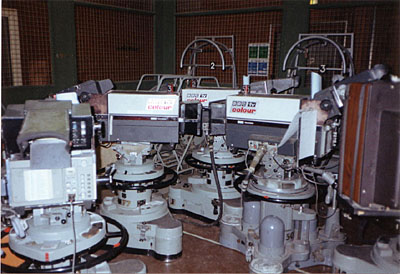
The EMI 2001 broadcast studio camera was an early, very successful British made Plumbicon studio camera that included the lens within the body of the camera. Four 30 mm tubes allowed one tube to be dedicated solely to producing a relatively high resolution monochrome signal, with the other three tubes each providing red, green and blue signals. Even though semiconductors were used in most of the camera, the highly sensitive head amplifiers still used thermionic valves in the first generation of the design.
Integrating the lens within the body of the camera had both positive and negative effects. On the positive side, it meant the optical nodal point of the camera was close to the centre of gravity, which could make operation easier and more instinctive when used on movable camera mounts such as pedestals. The downside was that lens manufacturers were limited to which lenses they could adapt to fit to the camera. This made the 2001 less attractive for outside broadcasts.
The 2001 was both heavy and large. The pull-out handles at each corner needed four people to safely move the camera with the lens in place. It also required a separate remote camera control unit and the cable connecting the two was over 2 inches thick. The standard servo-controlled studio zoom lens had a 5 to 50° horizontal angle of view, with a minimum focus distance of either 36 inches (J type) or 18 inches (K type).
The EMI 2001 used a four-way prism assembly to split the light into its components, using the same novel principles that had been developed by Philips for its three-way splitter. These new assemblies used the property of total internal reflection, within the prisms, to direct the light to the pick-up tubes. The techniques were described in a patent first filed in 1961. The three-way prism was also described in a description of the LDK3 camera.
The technique of using a prism assembly in this way was far superior to the earlier light-splitting arrangements, since the prism assembly was neat and compact and reproducibility in manufacture was much improved. The problems previously experienced with double imaging (common with plate glass dichroic mirrors) were also eliminated. Furthermore, because of the near-normal incidence of light onto the dichroic surfaces, sensitivity to polarised light was reduced.
Consequently, EMI chose to use a four-tube version of the prism splitter for its new colour camera, in order to retain all the advantages of the method. However, devising a single prism arrangement for four tubes was less easy than for three and several alternatives were initially considered.
In an early configuration of the prism block, shown in the thumbnail, three of the pick-up tubes were envisaged to be in a common plane, but with the fourth (red) tube sticking up, nearly at right angles to the other three. (This configuration was to be used in the Russian four-tube camera type KT-116M.)
For the final optical arrangement in the EMI 2001, the green prism was changed to have a fully silvered mirror at about 45 degrees, to deflect the green light sideways, resulting in the final four-spoke arrangement. (When viewed from the back of a camera the four tubes were seen as a diagonal cross). This optical arrangement defined the cross-section dimensions of the camera (which was not small – 380 × 380 mm), but it did allow the zoom lens to be located within the camera body. Also the removal of individual pick-up tubes was possible without any need to remove the scanning coils, as the tube bases were easily accessible at the outer corners.
Hub AI
EMI 2001 AI simulator
(@EMI 2001_simulator)
EMI 2001
The EMI 2001 broadcast studio camera was an early, very successful British made Plumbicon studio camera that included the lens within the body of the camera. Four 30 mm tubes allowed one tube to be dedicated solely to producing a relatively high resolution monochrome signal, with the other three tubes each providing red, green and blue signals. Even though semiconductors were used in most of the camera, the highly sensitive head amplifiers still used thermionic valves in the first generation of the design.
Integrating the lens within the body of the camera had both positive and negative effects. On the positive side, it meant the optical nodal point of the camera was close to the centre of gravity, which could make operation easier and more instinctive when used on movable camera mounts such as pedestals. The downside was that lens manufacturers were limited to which lenses they could adapt to fit to the camera. This made the 2001 less attractive for outside broadcasts.
The 2001 was both heavy and large. The pull-out handles at each corner needed four people to safely move the camera with the lens in place. It also required a separate remote camera control unit and the cable connecting the two was over 2 inches thick. The standard servo-controlled studio zoom lens had a 5 to 50° horizontal angle of view, with a minimum focus distance of either 36 inches (J type) or 18 inches (K type).
The EMI 2001 used a four-way prism assembly to split the light into its components, using the same novel principles that had been developed by Philips for its three-way splitter. These new assemblies used the property of total internal reflection, within the prisms, to direct the light to the pick-up tubes. The techniques were described in a patent first filed in 1961. The three-way prism was also described in a description of the LDK3 camera.
The technique of using a prism assembly in this way was far superior to the earlier light-splitting arrangements, since the prism assembly was neat and compact and reproducibility in manufacture was much improved. The problems previously experienced with double imaging (common with plate glass dichroic mirrors) were also eliminated. Furthermore, because of the near-normal incidence of light onto the dichroic surfaces, sensitivity to polarised light was reduced.
Consequently, EMI chose to use a four-tube version of the prism splitter for its new colour camera, in order to retain all the advantages of the method. However, devising a single prism arrangement for four tubes was less easy than for three and several alternatives were initially considered.
In an early configuration of the prism block, shown in the thumbnail, three of the pick-up tubes were envisaged to be in a common plane, but with the fourth (red) tube sticking up, nearly at right angles to the other three. (This configuration was to be used in the Russian four-tube camera type KT-116M.)
For the final optical arrangement in the EMI 2001, the green prism was changed to have a fully silvered mirror at about 45 degrees, to deflect the green light sideways, resulting in the final four-spoke arrangement. (When viewed from the back of a camera the four tubes were seen as a diagonal cross). This optical arrangement defined the cross-section dimensions of the camera (which was not small – 380 × 380 mm), but it did allow the zoom lens to be located within the camera body. Also the removal of individual pick-up tubes was possible without any need to remove the scanning coils, as the tube bases were easily accessible at the outer corners.
Recent media