


Community hub
Recent from talks
Contribute something to knowledge base
Content stats: 0 posts, 0 articles, 1 media, 0 notes
Members stats: 0 subscribers, 0 contributors, 0 moderators, 0 supporters
Subscribers
Supporters
Contributors
Moderators
Hub AI
Eagle MkIII AI simulator
(@Eagle MkIII_simulator)
Hub AI
Eagle MkIII AI simulator
(@Eagle MkIII_simulator)
Eagle MkIII
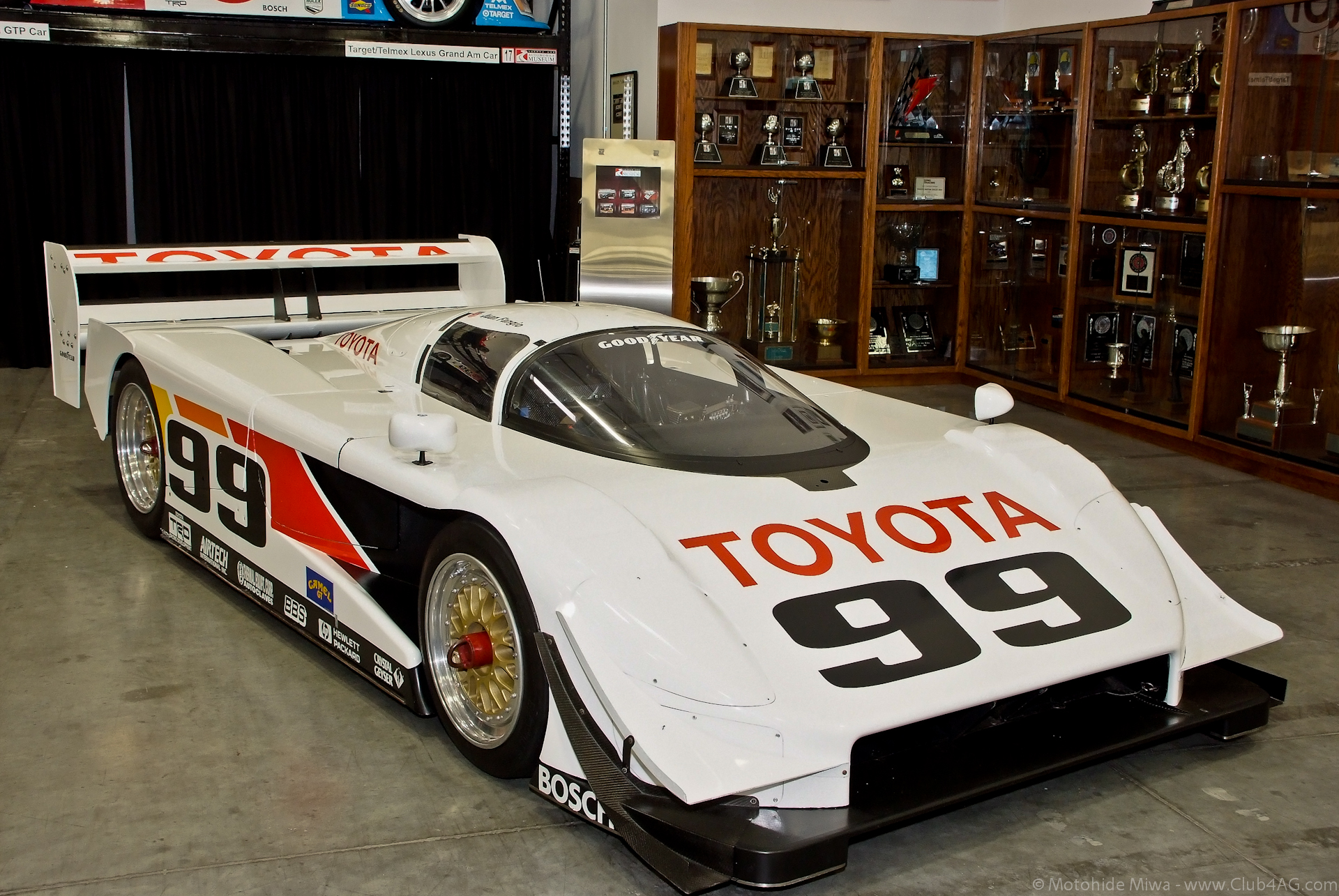
The Eagle MkIII is a sports prototype racing car built by All American Racers in 1991 to IMSA GTP specifications. Powered by a turbocharged Toyota inline-4 engine, the car was campaigned in the IMSA Camel GT series by Dan Gurney's Toyota-sponsored AAR team from 1991 through to the end of 1993. The Eagle MkIII won 21 out of the 27 races in which it was entered and is considered one of the most successful and technologically advanced designs of the IMSA GTP era — "a car that proved so overwhelmingly dominant that the class for which it was created has now been assigned to history", according to Racer magazine.
From 1989 through 1991, AAR campaigned the Eagle HF89 (also known as the MkII), the team's first in-house, race-ready IMSA GTP design. While some success was had with the HF89 and its HF90 evolution, the chassis had a very small margin for setup error — in the words of driver Juan Manuel Fangio II, "When we were in the window, the car was good in every way, but out of the window, the car was not right at all." It was clear to the team that a clean-sheet design was needed to significantly advance the chassis and provide the best platform for competing against the Nissan and Jaguar factory entries.
Two veteran AAR designers were tasked with leading the design of the MkIII chassis. John Ward focused on the tub and mechanical aspects of the car, while Hiro Fujimori was responsible for aerodynamics and styling — hence, the car was internally codenamed WFO 91 for Ward, Fujimori and Others, 1991. Team members nicknamed the project "Wide F'n Open". The design parameters given to the team were not groundbreaking and the designers looked to avoid risky, cutting-edge solutions wherever possible; rather, for reliability's sake, the mantra was to make the chassis simple while taking full advantage of proven technologies. However, there was one significant technological advance planned: the MkIII would be the first carbon-fiber monocoque manufactured in-house by AAR.
"What we did with the MkIII was to address just about every weakness of the MkII," Gurney said. "It was not a styling exercise; everything was driven by functional considerations, and it was really a clean sheet of paper from virtually every standpoint."
One of the primary flaws with the HF89/90 had been a persistent lack of front grip; combined with overwhelming amounts of rear downforce, this created an intractably imbalanced car with a significant tendency to understeer. On the slower, more technical circuits on the IMSA schedule, this was a major competitive disadvantage. Thus, on the MkIII, the team first focused on creating more front downforce. This led to the inclusion of an integral front diffuser in the nose to stabilize underbody airflow and create a low-pressure zone directly under the front wheels. This was a break from the tradition of GTP and Group C cars, which had almost exclusively adhered to a single underbody with one set of tunnels running from front to rear. Working in tandem with the standard ground effect tunnels under the rear of the car, the nose diffuser would balance front and rear grip while minimizing drag.
To test and refine the design, a 20%-scale wind tunnel model was built, accurately replicating not just the car's external features but internal components as well — detailed down to the car's wiring, air ducting and engine bay plumbing. Several different nose concepts were modeled and discarded before settling on a final design. In an effort to conceal the innovative nose air extractors, the bodywork immediately behind the front wheels was painted black.
Racing car designer and aerodynamics expert Michael Fuller wrote that "the most striking feature of the MkIII was the single nose air inlet that channeled air through massive ducting to midmounted water, water-to-oil and turbo intercooler radiators." By using a single aperture to feed several cooling systems, surface turbulence and drag created by air inlets was minimized. This contributed to a clean, uncluttered design that provided for smooth airflow to the rear wing, enhancing its efficiency. The front cross-section of the monocoque was also minimized as much as possible within the rules, in order to reduce drag.
The turbocharged Toyota engine was largely carried over from the HF90, with the addition of a new electronic engine management system. By applying a high level of boost to the 2.1-litre stock-block engine, Toyota Racing Development's shop in Torrance, California was able to wring more than 800 horsepower out of what was the smallest-displacement powerplant used in the GTP series at that point. "I was told that (TRD) blew up four dynamometers... (they) didn't spare the horses," Gurney later said.
Eagle MkIII
The Eagle MkIII is a sports prototype racing car built by All American Racers in 1991 to IMSA GTP specifications. Powered by a turbocharged Toyota inline-4 engine, the car was campaigned in the IMSA Camel GT series by Dan Gurney's Toyota-sponsored AAR team from 1991 through to the end of 1993. The Eagle MkIII won 21 out of the 27 races in which it was entered and is considered one of the most successful and technologically advanced designs of the IMSA GTP era — "a car that proved so overwhelmingly dominant that the class for which it was created has now been assigned to history", according to Racer magazine.
From 1989 through 1991, AAR campaigned the Eagle HF89 (also known as the MkII), the team's first in-house, race-ready IMSA GTP design. While some success was had with the HF89 and its HF90 evolution, the chassis had a very small margin for setup error — in the words of driver Juan Manuel Fangio II, "When we were in the window, the car was good in every way, but out of the window, the car was not right at all." It was clear to the team that a clean-sheet design was needed to significantly advance the chassis and provide the best platform for competing against the Nissan and Jaguar factory entries.
Two veteran AAR designers were tasked with leading the design of the MkIII chassis. John Ward focused on the tub and mechanical aspects of the car, while Hiro Fujimori was responsible for aerodynamics and styling — hence, the car was internally codenamed WFO 91 for Ward, Fujimori and Others, 1991. Team members nicknamed the project "Wide F'n Open". The design parameters given to the team were not groundbreaking and the designers looked to avoid risky, cutting-edge solutions wherever possible; rather, for reliability's sake, the mantra was to make the chassis simple while taking full advantage of proven technologies. However, there was one significant technological advance planned: the MkIII would be the first carbon-fiber monocoque manufactured in-house by AAR.
"What we did with the MkIII was to address just about every weakness of the MkII," Gurney said. "It was not a styling exercise; everything was driven by functional considerations, and it was really a clean sheet of paper from virtually every standpoint."
One of the primary flaws with the HF89/90 had been a persistent lack of front grip; combined with overwhelming amounts of rear downforce, this created an intractably imbalanced car with a significant tendency to understeer. On the slower, more technical circuits on the IMSA schedule, this was a major competitive disadvantage. Thus, on the MkIII, the team first focused on creating more front downforce. This led to the inclusion of an integral front diffuser in the nose to stabilize underbody airflow and create a low-pressure zone directly under the front wheels. This was a break from the tradition of GTP and Group C cars, which had almost exclusively adhered to a single underbody with one set of tunnels running from front to rear. Working in tandem with the standard ground effect tunnels under the rear of the car, the nose diffuser would balance front and rear grip while minimizing drag.
To test and refine the design, a 20%-scale wind tunnel model was built, accurately replicating not just the car's external features but internal components as well — detailed down to the car's wiring, air ducting and engine bay plumbing. Several different nose concepts were modeled and discarded before settling on a final design. In an effort to conceal the innovative nose air extractors, the bodywork immediately behind the front wheels was painted black.
Racing car designer and aerodynamics expert Michael Fuller wrote that "the most striking feature of the MkIII was the single nose air inlet that channeled air through massive ducting to midmounted water, water-to-oil and turbo intercooler radiators." By using a single aperture to feed several cooling systems, surface turbulence and drag created by air inlets was minimized. This contributed to a clean, uncluttered design that provided for smooth airflow to the rear wing, enhancing its efficiency. The front cross-section of the monocoque was also minimized as much as possible within the rules, in order to reduce drag.
The turbocharged Toyota engine was largely carried over from the HF90, with the addition of a new electronic engine management system. By applying a high level of boost to the 2.1-litre stock-block engine, Toyota Racing Development's shop in Torrance, California was able to wring more than 800 horsepower out of what was the smallest-displacement powerplant used in the GTP series at that point. "I was told that (TRD) blew up four dynamometers... (they) didn't spare the horses," Gurney later said.
Recent media
Recent media