
Recent from talks
Early 1980s recession
Knowledge base stats:
Talk channels stats:
Members stats:
Early 1980s recession
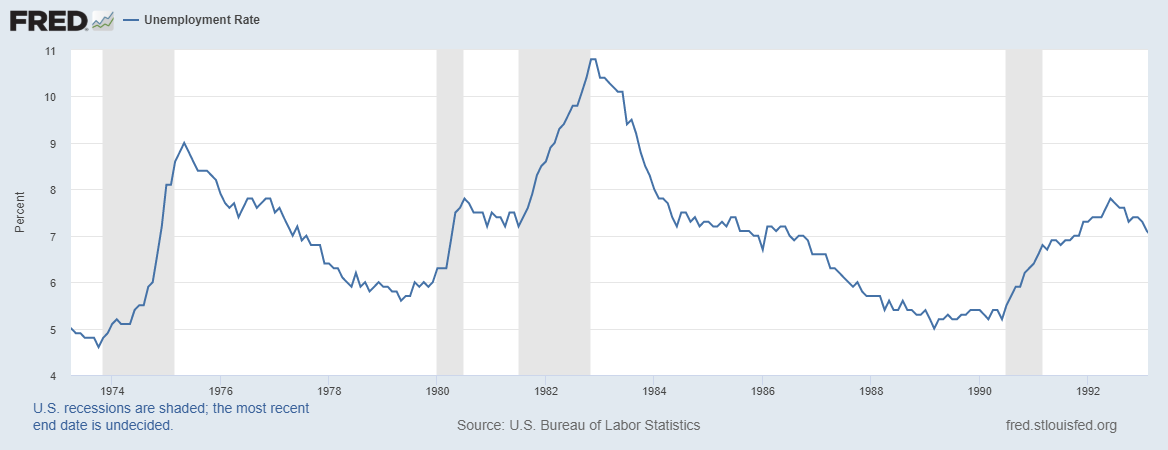
The early 1980s recession was a severe economic recession that affected much of the world between approximately the start of 1980 and 1982. Long-term effects of the early 1980s recession contributed to the Latin American debt crisis, long-lasting slowdowns in the Caribbean and Sub-Saharan African countries, the US savings and loan crisis, and a general adoption of neoliberal economic policies throughout the 1990s. It is widely considered to have been the most severe recession since World War II until the 2008 financial crisis.
The recession had multiple causes including the tightening of monetary policies by the United States and other developed nations. This was exacerbated by the 1979 energy crisis, mostly caused by the Iranian Revolution which saw oil prices rising sharply in 1979 and early 1980. The sharp rise in oil prices pushed the already high rates of inflation in several major advanced countries to new double-digit highs, with countries such as the United States, Canada, West Germany, Italy, the United Kingdom, and Japan tightening their monetary policies by increasing interest rates in order to control the inflation. These G7 countries each had "double-dip recessions" involving short declines in economic output in parts of 1980 followed by a short period of expansion, in turn followed by a steeper longer period of economic contraction starting sometime in 1981 and ending in November 1982. Most of these countries experienced stagflation, a situation of both high inflation rates and high unemployment rates. Globally, while some countries experienced downturns in economic output in 1980 and/or 1981, the broadest and sharpest worldwide decline of economic activity and the largest increase in unemployment was in 1982, with the World Bank naming the recession the "global recession of 1982". Even after major economies, such as the United States and Japan exited the recession relatively early, many countries were in recession into 1983 and high unemployment would continue to affect most OECD nations until at least 1985.
The Canadian economy experienced overall weakness from the start of 1980 to the end of 1983, with low yearly real GDP growth rates of 2.1% and 2.6% in 1980 and 1983, respectively, and a steep 3.2% decline in real GDP for 1982. As with other G7 countries, Canada had two separate economic contractions in the early 1980s. These were a shallow drop in GDP and a slowing in employment growth for five months between February and June 1980, and a deeper 17-month contraction in both GDP and employment between July 1981 and October 1982, although both contractions were driven by the same desire of governments to reduce inflation by increasing interest rates. Real Canadian GDP declined by 5% during the 17-month 1981-82 recession with the unemployment rate peaking at 12%. In-between the two downturns, Canada had 12 months of economic growth. With growth between October 1980 and June 1981 being relatively robust, the total GDP and employment in June 1981 was surpassing their pre-recession peaks, and 1981 had a yearly increase in real GDP of 3.5%.
Canada had higher inflation, interest rates, and unemployment than the United States during the early 1980s recession. While inflation accelerated across North America in the late 1970s, it was higher in Canada because of the US decision to switch to a floating exchange rate, which lowered the value of the Canadian dollar to US$0.85 by 1979, which made US imports more expensive for Canadians to purchase. Canada's inflation rate was 10.2% for 1980 overall, rising to 12.5% for 1981 and 10.8% for 1982 before dropping to 5.8% for 1983. To control its inflation, the US introduced credit controls producing a slump in demand for Canada's housing and auto industry exports in early 1980 thereby triggering the early first portion of the recession in Canada. Most Canadians were also hit hard financially by a steady rise in oil and gas prices during the 1970s, especially their acceleration in 1979 when the worldwide oil supply was disrupted by the Iranian revolution, with the price of oil reaching almost $40 a barrel compared to $3 a barrel at the start of the decade.
The Bank of Canada raised its prime interest rate throughout 1980 and early 1981 in an attempt to rein in inflation, with the deeper second portion of the recession beginning in July 1981. The Bank of Canada's interest rate peaked at 21% in August 1981 and was kept at high levels until spring 1982, but the inflation rate still averaged more than 12% in 1981–82. Alberta, the prime location of Canada's oil industry at the time, experienced a boom in the late 1970s, 1980 and early 1981, with rapid employment growth, attaining at 76% the highest percentage of persons aged 15–64 being employed (defined as the "employment ratio") of all the provinces in early 1981. By the start of 1982, Alberta's oil boom had ended due to over-expansion and the deep global recession of that year, which caused oil prices to plummet, with Alberta then suffering a drop of 7.2 percentage points in its employment ratio of all the provinces by mid-1983. Yukon's mining industry was also hit hard and more than 70,000 of 115,000 miners across the country were out of work by the end of 1982.
Canada's GDP increased markedly in November 1982 officially ending the recession, although employment growth did not resume until December 1982, before faltering again in 1983. The average unemployment rates for 1982 and 1983 averaged 11.1% and 12%, respectively, steep rises from 7.6% in 1981. A slowdown in productivity in Canada also emerged during the recession as average output per worker slowed by 1%. The lingering effects of the recession combined with mechanization and companies downsizing to complete internationally, kept Canada's unemployment rates above 10% until 1986. Despite this, Canada's GDP growth rate was among the highest of the OECD countries from 1984 to 1986, although growth was by far strongest in Ontario and Quebec.
Throughout the 1970s, Japan had the world's third largest gross national product (GNP)—just behind the United States and the Soviet Union—and ranked first among major industrial nations in 1990 in per capita GNP at US$23,801, up sharply from US$9,068 in 1980. After the relatively mild economic slump in the mid-1980s, Japan's economy began a period of expansion in 1986 that continued until it again entered a recessionary period in 1992; however, the property market still never returned to its pre-boom levels. The Tokyo stock exchange doubled in 1983 from Y8,800 to Y16,401 in 1986. The surge that hit its peak of Y26,646 was temporarily halted by Black Monday on October 14, 1987. Black Monday was a crash that ended up hitting the US stock market, causing it to plummet. By April 1988, the stock reached past its October record breaking peak and hit Y38,915. In what came to be known as the Lost Decades, Japan's recession was prolonged into the 1990s and they were not able to recover from the increased prices until the early 2000s. It finally officially ended in 2002.
Eventually recession hit the United Kingdom at the beginning of the 1980s. That followed a string of crises that had plagued the British economy for most of the 1970s. Consequently, unemployment had gradually increased since the mid-1960s. When the Conservative Party, led by Margaret Thatcher won the general election of May 1979, and swept James Callaghan's Labour Party from power, the country had just witnessed the Winter of Discontent in which numerous public sector workers had staged strikes. Inflation was about 10% and some 1.5 million people were unemployed, compared to some 1 million in 1974, 580,000 in 1970 and just over 300,000 in 1964. Thatcher set about controlling inflation with monetarist policies and changing trade union legislation in an attempt to reduce the strikes of public-sector workers.
Hub AI
Early 1980s recession AI simulator
(@Early 1980s recession_simulator)
Early 1980s recession
The early 1980s recession was a severe economic recession that affected much of the world between approximately the start of 1980 and 1982. Long-term effects of the early 1980s recession contributed to the Latin American debt crisis, long-lasting slowdowns in the Caribbean and Sub-Saharan African countries, the US savings and loan crisis, and a general adoption of neoliberal economic policies throughout the 1990s. It is widely considered to have been the most severe recession since World War II until the 2008 financial crisis.
The recession had multiple causes including the tightening of monetary policies by the United States and other developed nations. This was exacerbated by the 1979 energy crisis, mostly caused by the Iranian Revolution which saw oil prices rising sharply in 1979 and early 1980. The sharp rise in oil prices pushed the already high rates of inflation in several major advanced countries to new double-digit highs, with countries such as the United States, Canada, West Germany, Italy, the United Kingdom, and Japan tightening their monetary policies by increasing interest rates in order to control the inflation. These G7 countries each had "double-dip recessions" involving short declines in economic output in parts of 1980 followed by a short period of expansion, in turn followed by a steeper longer period of economic contraction starting sometime in 1981 and ending in November 1982. Most of these countries experienced stagflation, a situation of both high inflation rates and high unemployment rates. Globally, while some countries experienced downturns in economic output in 1980 and/or 1981, the broadest and sharpest worldwide decline of economic activity and the largest increase in unemployment was in 1982, with the World Bank naming the recession the "global recession of 1982". Even after major economies, such as the United States and Japan exited the recession relatively early, many countries were in recession into 1983 and high unemployment would continue to affect most OECD nations until at least 1985.
The Canadian economy experienced overall weakness from the start of 1980 to the end of 1983, with low yearly real GDP growth rates of 2.1% and 2.6% in 1980 and 1983, respectively, and a steep 3.2% decline in real GDP for 1982. As with other G7 countries, Canada had two separate economic contractions in the early 1980s. These were a shallow drop in GDP and a slowing in employment growth for five months between February and June 1980, and a deeper 17-month contraction in both GDP and employment between July 1981 and October 1982, although both contractions were driven by the same desire of governments to reduce inflation by increasing interest rates. Real Canadian GDP declined by 5% during the 17-month 1981-82 recession with the unemployment rate peaking at 12%. In-between the two downturns, Canada had 12 months of economic growth. With growth between October 1980 and June 1981 being relatively robust, the total GDP and employment in June 1981 was surpassing their pre-recession peaks, and 1981 had a yearly increase in real GDP of 3.5%.
Canada had higher inflation, interest rates, and unemployment than the United States during the early 1980s recession. While inflation accelerated across North America in the late 1970s, it was higher in Canada because of the US decision to switch to a floating exchange rate, which lowered the value of the Canadian dollar to US$0.85 by 1979, which made US imports more expensive for Canadians to purchase. Canada's inflation rate was 10.2% for 1980 overall, rising to 12.5% for 1981 and 10.8% for 1982 before dropping to 5.8% for 1983. To control its inflation, the US introduced credit controls producing a slump in demand for Canada's housing and auto industry exports in early 1980 thereby triggering the early first portion of the recession in Canada. Most Canadians were also hit hard financially by a steady rise in oil and gas prices during the 1970s, especially their acceleration in 1979 when the worldwide oil supply was disrupted by the Iranian revolution, with the price of oil reaching almost $40 a barrel compared to $3 a barrel at the start of the decade.
The Bank of Canada raised its prime interest rate throughout 1980 and early 1981 in an attempt to rein in inflation, with the deeper second portion of the recession beginning in July 1981. The Bank of Canada's interest rate peaked at 21% in August 1981 and was kept at high levels until spring 1982, but the inflation rate still averaged more than 12% in 1981–82. Alberta, the prime location of Canada's oil industry at the time, experienced a boom in the late 1970s, 1980 and early 1981, with rapid employment growth, attaining at 76% the highest percentage of persons aged 15–64 being employed (defined as the "employment ratio") of all the provinces in early 1981. By the start of 1982, Alberta's oil boom had ended due to over-expansion and the deep global recession of that year, which caused oil prices to plummet, with Alberta then suffering a drop of 7.2 percentage points in its employment ratio of all the provinces by mid-1983. Yukon's mining industry was also hit hard and more than 70,000 of 115,000 miners across the country were out of work by the end of 1982.
Canada's GDP increased markedly in November 1982 officially ending the recession, although employment growth did not resume until December 1982, before faltering again in 1983. The average unemployment rates for 1982 and 1983 averaged 11.1% and 12%, respectively, steep rises from 7.6% in 1981. A slowdown in productivity in Canada also emerged during the recession as average output per worker slowed by 1%. The lingering effects of the recession combined with mechanization and companies downsizing to complete internationally, kept Canada's unemployment rates above 10% until 1986. Despite this, Canada's GDP growth rate was among the highest of the OECD countries from 1984 to 1986, although growth was by far strongest in Ontario and Quebec.
Throughout the 1970s, Japan had the world's third largest gross national product (GNP)—just behind the United States and the Soviet Union—and ranked first among major industrial nations in 1990 in per capita GNP at US$23,801, up sharply from US$9,068 in 1980. After the relatively mild economic slump in the mid-1980s, Japan's economy began a period of expansion in 1986 that continued until it again entered a recessionary period in 1992; however, the property market still never returned to its pre-boom levels. The Tokyo stock exchange doubled in 1983 from Y8,800 to Y16,401 in 1986. The surge that hit its peak of Y26,646 was temporarily halted by Black Monday on October 14, 1987. Black Monday was a crash that ended up hitting the US stock market, causing it to plummet. By April 1988, the stock reached past its October record breaking peak and hit Y38,915. In what came to be known as the Lost Decades, Japan's recession was prolonged into the 1990s and they were not able to recover from the increased prices until the early 2000s. It finally officially ended in 2002.
Eventually recession hit the United Kingdom at the beginning of the 1980s. That followed a string of crises that had plagued the British economy for most of the 1970s. Consequently, unemployment had gradually increased since the mid-1960s. When the Conservative Party, led by Margaret Thatcher won the general election of May 1979, and swept James Callaghan's Labour Party from power, the country had just witnessed the Winter of Discontent in which numerous public sector workers had staged strikes. Inflation was about 10% and some 1.5 million people were unemployed, compared to some 1 million in 1974, 580,000 in 1970 and just over 300,000 in 1964. Thatcher set about controlling inflation with monetarist policies and changing trade union legislation in an attempt to reduce the strikes of public-sector workers.
Recent media